
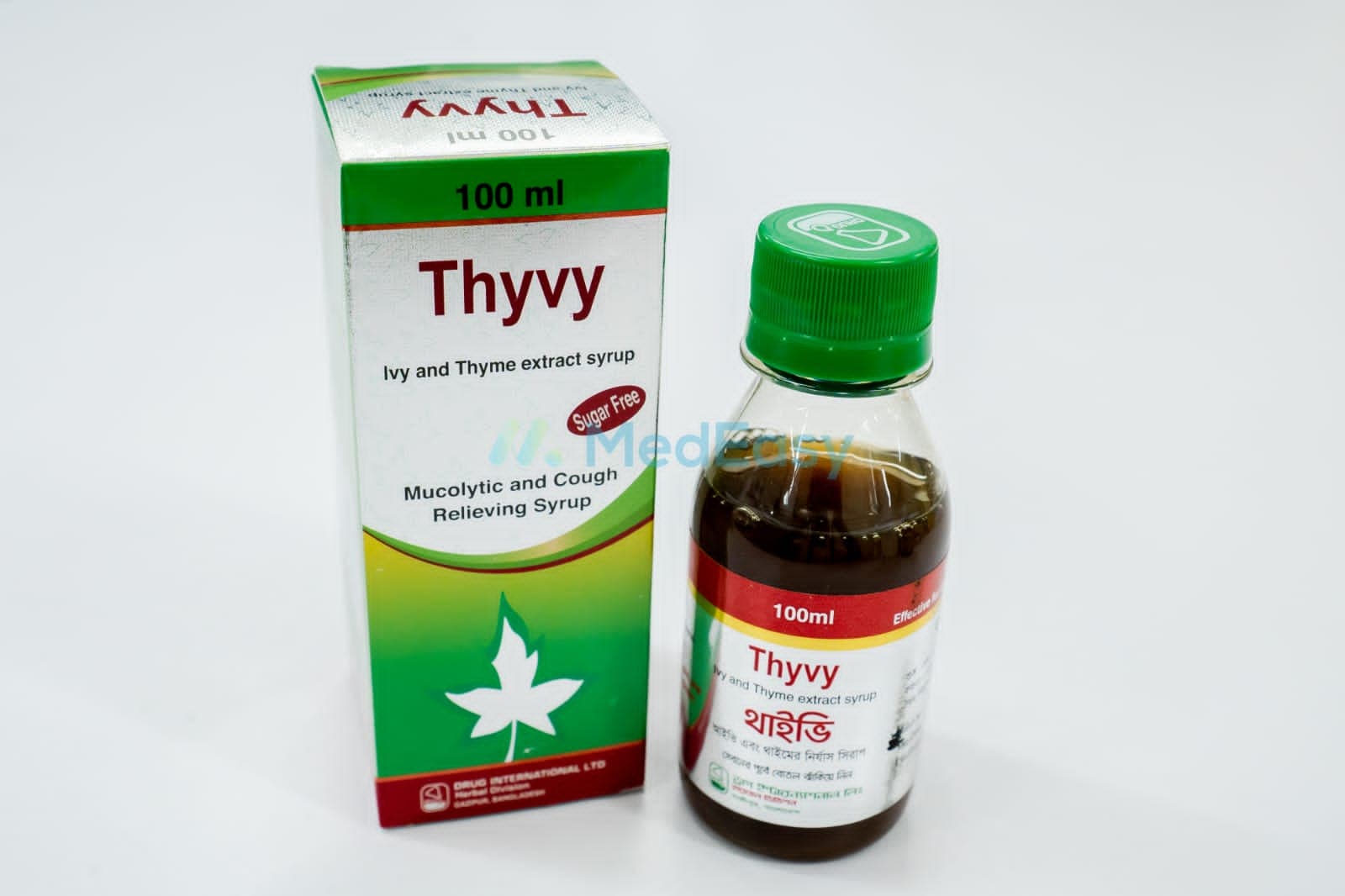

Medicine overview
Indications of Thyvy
Thyvy is indicated for:
Established traditional use
- Symptomatic relief of productive (chesty) cough associated with the common cold and mild, uncomplicated upper respiratory tract infections, by helping to loosen and clear bronchial mucus (expectorant/mucolytic-type action).
- Relief of cough accompanied by difficulty expectorating viscous mucus.
Strength of evidence
Clinical studies on ivy leaf extract, alone and combined with thyme extract, show moderate evidence for short-term symptomatic relief of cough frequency and severity. Thyvy is a traditional herbal remedy rather than a curative treatment, and it does not treat the underlying infection.
Not indicated for
- Chronic cough, cough lasting more than one week, or cough associated with high fever, shortness of breath, wheezing, chest pain, or blood-stained sputum, without prior medical evaluation.
Composition
Each unit dose of Ivy and Thyme extract contains a standardized herbal combination of:
- Dry extract of ivy leaf (Hedera helix)
- Dry extract of thyme herb (Thymus vulgaris)
The exact extract ratio and strength vary by formulation and dosage form (syrup, drops, or tablet); refer to the product label for the specific concentration.
Description
Thyvy is a fixed-dose herbal (phytopharmaceutical) combination that brings together two traditional plant-derived remedies used for respiratory symptom relief. Ivy leaf extract is traditionally used as an expectorant and mild bronchospasmolytic, while thyme extract is traditionally used for its antitussive, expectorant, and mild antimicrobial properties. Together, they are used as a symptomatic treatment for cough associated with the common cold and mild upper respiratory tract infections, particularly when the cough is productive (chesty).
Thyvy is a traditional/herbal medicinal product; it is not intended to treat the underlying cause of infection and is not an antibiotic.
Therapeutic Class
Thyvy belongs to the herbal/phytomedicine therapeutic class, specifically the expectorant and antitussive plant-based combination products used for cough and cold symptom relief.
Pharmacology
Ivy and Thyme extract combines two plant extracts with complementary actions on the respiratory tract:
- Ivy leaf extract (Hedera helix): contains triterpene saponins, principally hederacoside C (metabolized to alpha-hederin), believed to have secretolytic (mucus-thinning) and bronchospasmolytic (airway smooth-muscle relaxant) effects, and may increase surfactant activity in the airways, making it easier to cough up mucus.
- Thyme extract (Thymus vulgaris): contains volatile oils, chiefly thymol and carvacrol, along with flavonoids, believed to have expectorant, mild antispasmodic, and mild antimicrobial actions on the bronchial mucosa, and may support ciliary clearance.
The combined pharmacodynamic effect of Ivy and Thyme extract supports easier expectoration and symptomatic cough relief; it does not have a proven curative or disease-modifying effect on the underlying respiratory infection.
Dosage & Administration of Thyvy
Dosing of Thyvy depends on the specific product formulation (syrup, oral drops, or tablet) and its extract strength; always follow the dose stated on the product label or as advised by a physician or pharmacist. General age-based dosing guidance is summarized below.
| Age group | Typical dosing |
|---|---|
| Adults and adolescents (>12 years) | As per product-specific labeling, usually 2-3 times daily |
| Children (2-12 years) | Lower, weight/age-adjusted dose as per product-specific labeling; only use formulations specifically labeled for this age group |
| Infants and children under 2 years | Not recommended; safety and efficacy not established (see Pediatric Use) |
See Administration for how to take this medicine and Duration of Treatment for how long it may be used.
Administration of Thyvy
Thyvy is usually taken by mouth, with or without food, preferably with a glass of water. Shake liquid formulations well before use and measure the dose with the measuring cup or spoon provided. Doses are usually spaced evenly through the day; the last dose may be taken in the evening.
Interaction of Thyvy
No well-established, clinically significant drug interactions have been documented for Thyvy. As a general precaution, avoid combining with other cough/cold products containing overlapping herbal or antitussive ingredients unless advised by a physician, to avoid unintentional excess dosing. Inform your physician or pharmacist of all other medicines and herbal products you are taking.
Contraindications
Ivy and Thyme extract is contraindicated in patients with known hypersensitivity to ivy leaf, thyme, or other plants of the Araliaceae or Lamiaceae (mint) families, or to any excipient in the specific formulation.
Side Effects of Thyvy
Most people tolerate Thyvy well. Reported side effects include:
- Common: mild gastrointestinal upset such as nausea, vomiting, or diarrhea.
- Uncommon/rare: hypersensitivity reactions including skin rash, urticaria, or, rarely, dyspnea/angioedema (see Contraindications).
Stop use and seek medical advice if a hypersensitivity reaction occurs.
Pregnancy & Lactation
Data on the use of Thyvy during pregnancy and breastfeeding are limited. As a precaution, Thyvy should be used during pregnancy and lactation only if clearly needed and if the potential benefit justifies the potential risk; consult a physician before use in these situations.
Precautions & Warnings
Thyvy is intended only for short-term symptomatic relief of cough. Consult a physician if:
- Cough persists for more than one week, recurs, or is accompanied by fever, rash, persistent headache, shortness of breath, or wheezing.
- Cough is associated with excessive phlegm production of unclear cause.
Use with caution in young children and only with a formulation specifically labeled for the child's age (see Pediatric Use). Thyvy is not an antibiotic and does not treat bacterial infections; it should not be used as a substitute for prescribed antimicrobial therapy when one is needed. See Contraindications and Side Effects for hypersensitivity risk.
Overdose Effects of Thyvy
Overdose with Thyvy may cause exaggerated gastrointestinal symptoms such as nausea, vomiting, diarrhea, and abdominal discomfort, and possibly restlessness. If overdose is suspected, seek immediate medical attention or contact a poison control center; do not attempt unsupervised home treatment.
Storage Conditions
Store at room temperature (below 30°C), away from light and moisture. Keep out of reach of children. Once opened, liquid formulations of Thyvy should be used within the period stated on the pack.
Use In Special Populations
Renal/hepatic impairment: No well-established dose adjustment data exist for Thyvy in renal or hepatic impairment; use with caution and medical advice.
Elderly: No specific dose adjustment is established; standard adult dosing generally applies.
Children: see Pediatric Use.
Pregnancy/lactation: see Pregnancy and Lactation.
Duration Of Treatment
Thyvy is generally used for short-term symptomatic relief, typically up to one week. If cough has not improved, or has worsened, after one week of use, or if it recurs, a physician should be consulted rather than continuing self-treatment.
Drug Classes
Ivy and Thyme extract belongs to the herbal medicine (phytopharmaceutical) drug class; expectorant and antitussive combination.
Mode Of Action
The saponins in the ivy leaf component of Ivy and Thyme extract reduce the surface tension of bronchial secretions and relax bronchial smooth muscle, while the volatile oils in the thyme component loosen mucus and support its clearance via increased ciliary activity, together facilitating expectoration of viscous bronchial mucus.
Pediatric Uses
Use of Thyvy in children should follow the age restriction stated on the specific product label, since formulations differ in strength. Many formulations are not recommended for infants and children under 2 years because safety and efficacy have not been established in this age group; some formulations restrict use to children over 2 or over 6 years. Only use a formulation and dose specifically labeled as suitable for the child's age, and consult a pediatrician before use in young children, especially if symptoms are severe.
Frequently Asked Questions
Q: What is Thyvy 100 ml Syrup used for?
A: Thyvy 100 ml Syrup is a herbal combination used for the symptomatic relief of productive (chesty) cough associated with the common cold and mild upper respiratory tract infections. It helps loosen bronchial mucus and ease coughing but does not treat the underlying infection.
Q: Can I take Thyvy 100 ml Syrup if I am pregnant or breastfeeding?
A: Data are limited. Thyvy 100 ml Syrup should be used during pregnancy or breastfeeding only if clearly needed and after consulting a physician, since the potential benefit must be weighed against any potential, though unconfirmed, risk.
Q: Is Thyvy 100 ml Syrup safe for children?
A: Use only a formulation and dose specifically labeled for the child's age. Safety and efficacy of Thyvy 100 ml Syrup have not been established in children under 2 years, so it is not recommended in this age group; consult a pediatrician before use in young children.
Q: What side effects can Thyvy 100 ml Syrup cause?
A: Common side effects include mild gastrointestinal upset such as nausea, vomiting, or diarrhea. Rarely, skin rash or hypersensitivity reactions can occur; if this happens, stop Thyvy 100 ml Syrup and seek medical advice.
Q: How long can I take Thyvy 100 ml Syrup?
A: Thyvy 100 ml Syrup is generally intended for short-term use, up to about one week. If cough does not improve or worsens after one week, or recurs, consult a physician instead of continuing self-treatment.
Q: What should I do if I take too much Thyvy 100 ml Syrup?
A: Overdose may cause exaggerated nausea, vomiting, diarrhea, or abdominal discomfort. If overdose of Thyvy 100 ml Syrup is suspected, seek immediate medical attention or contact a poison control center.
Disclaimer
The information provided is accurate to the best of our knowledge, but it does not replace professional medical advice. We cannot guarantee its completeness or accuracy, and the absence of specific information about a drug should not be taken as an endorsement. We are not responsible for any consequences arising from this information, so please consult a healthcare professional for any concerns or questions.
