
10% Off
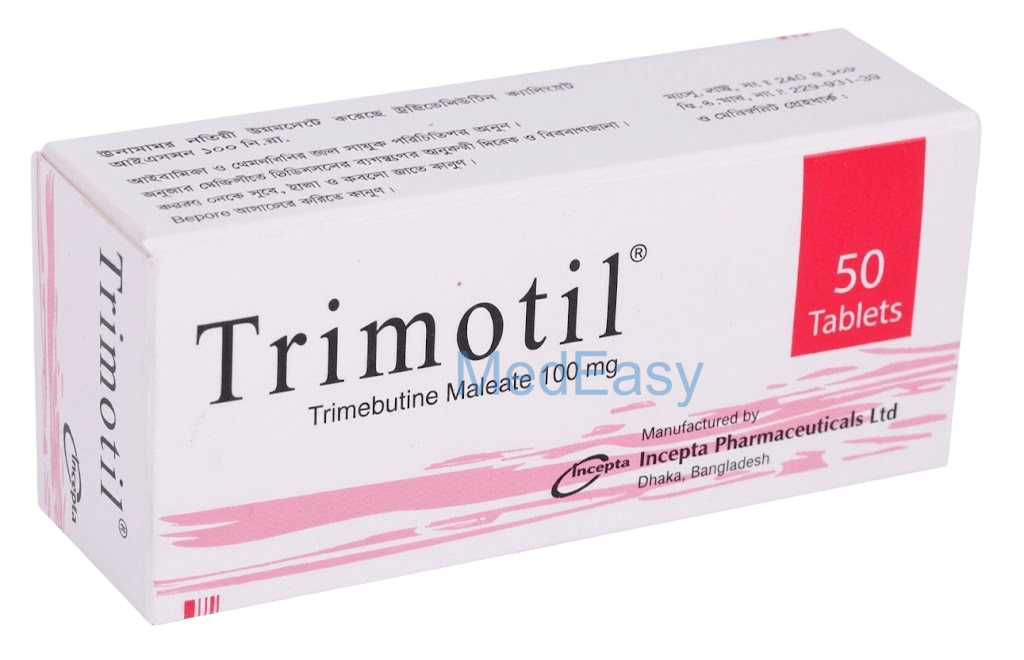
Trimotil100 mg
Incepta Pharmaceuticals Ltd.
৳4.50
Add to cart
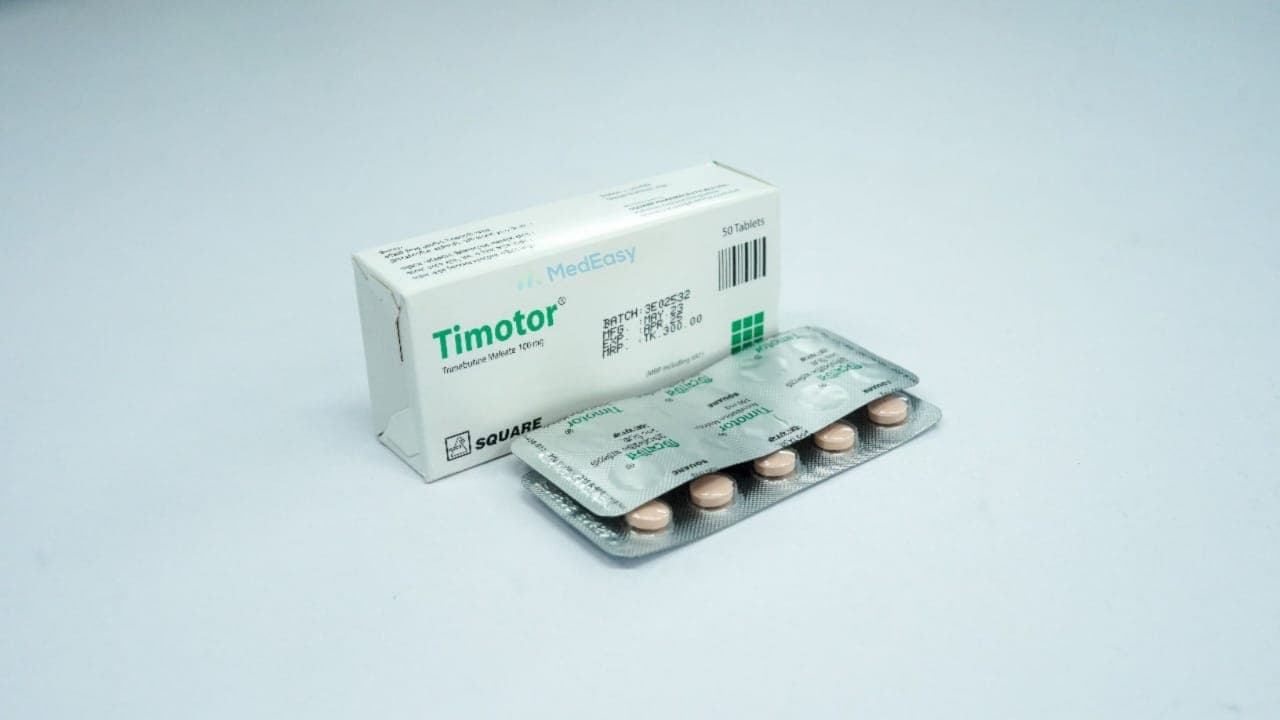

Timotor is used for the symptomatic management of functional gastrointestinal disorders. The strength of evidence and typical role in therapy vary by indication, as summarized below.
Timotor is a long-marketed agent in several countries; however, robust, modern high-quality randomized trial evidence is limited in some regulatory jurisdictions, and it is not approved by the US FDA. Prescribing should follow local regulatory labeling and clinical judgment, and Timotor should not be used in place of proper evaluation of alarm symptoms (see Precautions and Warnings).
Each tablet/capsule contains Trimebutine Maleate as the active pharmaceutical ingredient, commonly available in 100 mg and 200 mg oral dosage strengths, along with standard pharmaceutically acceptable excipients. Oral suspension formulations of Trimebutine Maleate are also available in some markets. Exact strength and excipients vary by manufacturer and brand; refer to the specific product packaging/leaflet.
Timotor is a gastrointestinal antispasmodic and motility-modulating (normalizing) agent. It acts on peripheral opioid receptors in the smooth muscle and enteric nervous system of the gut, giving it a dual "modulator" effect: it can reduce excessive, spasmodic gut contractions while also stimulating motility when the gut is hypomotile. Timotor is used mainly for symptomatic relief in irritable bowel syndrome and other functional gastrointestinal motility disorders, and is generally well tolerated.
Gastrointestinal antispasmodic and motility-modulating agent (Timotor is a peripherally-acting opioid receptor agonist affecting GI smooth muscle).
Trimebutine Maleate acts as an agonist at peripheral mu, kappa, and delta opioid receptors located on the smooth muscle and enteric (myenteric and submucosal plexus) neurons of the gastrointestinal tract. Through this combined musculotropic and neurotropic action, Trimebutine Maleate normalizes gastrointestinal motility: it has an inhibitory (spasmolytic) effect on hypercontractile or spastic gut segments and a stimulant (prokinetic) effect on hypomotile segments, without disrupting normal peristalsis. Trimebutine Maleate is also reported to reduce visceral hypersensitivity, which contributes to relief of abdominal pain in functional GI disorders.
Pharmacokinetically, Trimebutine Maleate is rapidly absorbed after oral administration, undergoes hepatic metabolism, and is eliminated mainly via the kidneys, with a short elimination half-life supporting a multiple-times-daily dosing schedule.
Dosing of Timotor should follow the specific product labeling and the treating physician's advice, as available strengths and approved age ranges vary by country and formulation.
| Indication / Population | Typical dose of Timotor |
|---|---|
| Adults - IBS / functional GI motility disorders | 100 mg to 200 mg orally, three times daily before meals, adjusted per physician advice and product strength. |
| Adults - post-operative bowel motility support (where locally approved) | As directed by the treating physician; formulation and dose depend on the local product license. |
| Children | Weight/age-based dosing with a pediatric oral suspension where such a formulation is locally available; safety and efficacy in children are not established for all age groups (see Pediatric Uses). Use only under direct physician supervision. |
| Renal or hepatic impairment | No well-established formal dose adjustment; use with caution and physician oversight (see Use in Special Populations). |
Duration of treatment with Timotor should be reassessed periodically by the prescribing physician (see Duration of Treatment).
Timotor tablets/capsules should be taken orally, generally before meals, swallowed with a glass of water. Oral suspension forms of Timotor, where available, should be measured using the calibrated device provided with the product. Timotor should be taken at evenly spaced intervals as directed by the physician, and the course should be completed as advised rather than stopped as soon as symptoms improve, unless the physician says otherwise.
Well-characterized, clinically significant drug interactions with Timotor are limited in the available literature. General precautions include:
Patients should inform their physician or pharmacist of all other medicines, supplements, and herbal products being taken before starting Timotor.
Trimebutine Maleate is contraindicated in patients with known hypersensitivity to trimebutine, trimebutine maleate, or any excipient of the specific product formulation.
Timotor is generally well tolerated. Reported adverse effects include:
Patients should seek medical advice if any side effect from Timotor is severe, persistent, or concerning.
Data on the use of Timotor in human pregnancy are limited. Timotor should be used during pregnancy only if clearly needed and if the potential benefit justifies the potential risk to the fetus; a physician should be consulted before use.
It is not well established whether Timotor passes into human breast milk. As a precaution, Timotor should be used during breastfeeding only after consulting a physician, weighing benefits against potential risk to the infant.
Timotor should be used with the following precautions:
Limited data exist on Timotor overdose in humans; exaggerated pharmacologic effects such as marked drowsiness, dizziness, or gastrointestinal upset may be expected. In case of suspected overdose of Timotor, seek immediate medical attention or contact a poison control center. Treatment is supportive and symptomatic, guided by a physician; there is no specific antidote.
Store at room temperature (below 30°C), away from light and moisture. Keep out of reach of children.
Pediatric patients: Safety and efficacy of Timotor are not established for all pediatric age groups; where a pediatric formulation is locally licensed, use only under direct physician supervision with weight/age-based dosing (see Pediatric Uses).
Elderly patients: No major dose adjustment is generally required for Timotor in the elderly, but use with routine caution given the higher likelihood of concurrent illness and polypharmacy in this group.
Hepatic/renal impairment: Use Timotor cautiously with physician oversight; formal dose-adjustment guidelines are not well established (see Precautions and Warnings).
Pregnancy/lactation: See Pregnancy and Lactation section for full guidance on Timotor.
Treatment with Timotor for functional GI disorders such as IBS or functional dyspepsia is typically given as a trial course of several weeks (commonly around 4 to 8 weeks), with the physician reassessing symptom response before continuing, adjusting, or stopping Timotor. Long-term use of Timotor should be periodically reviewed by the prescribing physician.
Gastrointestinal antispasmodics; GI motility-modulating agents (prokinetic/spasmolytic); peripherally-acting opioid receptor agonists.
Trimebutine Maleate acts as an agonist at peripheral mu, kappa, and delta opioid receptors on GI smooth muscle and the enteric nervous system. This dual musculotropic and neurotropic action allows Trimebutine Maleate to normalize gastrointestinal motility - inhibiting excessive/spastic contractions while stimulating motility where it is reduced - and to lower visceral hypersensitivity, without acting on the central nervous system in a clinically significant way at usual doses.
Use of Timotor in children should be conservative and physician-directed. Safety and efficacy of Timotor have not been firmly established across all pediatric age groups, and in many regulatory jurisdictions pediatric labeling is limited or absent. Where a locally licensed pediatric oral suspension of Timotor exists, dosing is weight/age-based per that product's specific labeling. Timotor should not be given to infants or young children except on the explicit advice of a pediatrician, who will weigh the potential benefit against the limited pediatric safety data.
Q: What is Timotor 100 mg Tablet used for?
A: Timotor 100 mg Tablet is used to relieve abdominal pain, cramping, bloating, and irregular bowel habits associated with irritable bowel syndrome and other functional gastrointestinal motility disorders.
Q: How should I take Timotor 100 mg Tablet?
A: Timotor 100 mg Tablet is usually taken by mouth, before meals, at the dose and frequency prescribed by your physician. Do not increase or decrease the dose of Timotor 100 mg Tablet on your own.
Q: Can Timotor 100 mg Tablet be taken during pregnancy?
A: Data are limited, so Timotor 100 mg Tablet should be used in pregnancy only if clearly needed and after consulting a physician, who will weigh potential benefits against potential risks to the fetus.
Q: What are the common side effects of Timotor 100 mg Tablet?
A: Timotor 100 mg Tablet is generally well tolerated; possible side effects include dry mouth, mild drowsiness or dizziness, constipation or diarrhea, and occasional skin reactions such as rash or itching. Contact your physician if any effect is severe or persistent.
Q: Who should not take Timotor 100 mg Tablet?
A: Timotor 100 mg Tablet should not be taken by anyone with a known hypersensitivity/allergy to Timotor 100 mg Tablet or to any excipient in the specific product.
Q: What should I do if I miss a dose or think I have taken too much Timotor 100 mg Tablet?
A: If you miss a dose of Timotor 100 mg Tablet, take it when you remember unless it is almost time for the next dose - do not double up. If you suspect an overdose of Timotor 100 mg Tablet, seek immediate medical attention or contact a poison control center.
Disclaimer
The information provided is accurate to the best of our knowledge, but it does not replace professional medical advice. We cannot guarantee its completeness or accuracy, and the absence of specific information about a drug should not be taken as an endorsement. We are not responsible for any consequences arising from this information, so please consult a healthcare professional for any concerns or questions.
