
7% Off
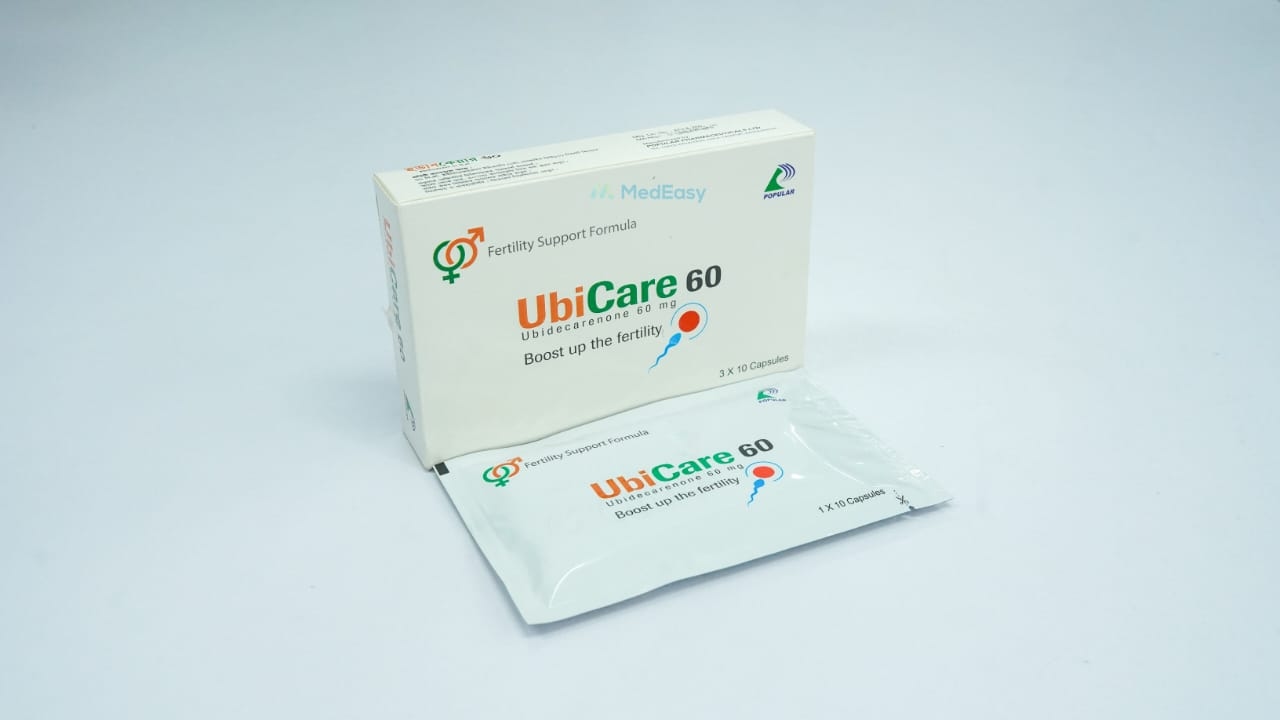
UbiCare60 mg
Popular Pharmaceuticals Ltd.
৳176.70
Add to cart


Ubi-Q 60 mg (ubiquinone/ubidecarenone) is a naturally occurring, fat-soluble compound that functions as a cofactor in mitochondrial energy (ATP) production and as an antioxidant. It is sold as a dietary/nutraceutical supplement rather than as an FDA-approved prescription drug for most uses, so the evidence supporting each use varies in strength.
Ubi-Q 60 mg should always be used in combination with, not as a substitute for, standard medical therapy prescribed by a physician for any serious condition.
Each capsule/softgel of Ubi-Q 60 mg contains ubidecarenone (Coenzyme Q10) as the active ingredient, typically available in strengths ranging from 30 mg to 200 mg. Formulations may use oil-based softgel suspensions to enhance absorption of this fat-soluble compound. Excipients vary by manufacturer (e.g., soybean oil, gelatin, glycerin) — patients with soy or gelatin sensitivities should check the specific product label.
Ubi-Q 60 mg is the ubidecarenone (oxidized/ubiquinone) form of Coenzyme Q10, a vitamin-like, fat-soluble substance naturally produced by the body and found in small amounts in foods such as organ meats, fatty fish, and whole grains. It plays a central role in the mitochondrial electron transport chain, where it helps generate cellular energy (ATP), and also acts as a lipid-soluble antioxidant that protects cell membranes from oxidative damage.
Endogenous CoQ10 production declines with age and can be reduced by certain medications (notably statins), which is part of the rationale for supplementation. Ubi-Q 60 mg is marketed worldwide, including in Bangladesh, as an oral nutraceutical/dietary supplement rather than as a conventional prescription drug, and is generally regarded as well tolerated.
Ubi-Q 60 mg belongs to the class of dietary/nutraceutical supplements — specifically a fat-soluble antioxidant and mitochondrial energy cofactor (vitamin-like quinone compound). It is not classified as a conventional pharmaceutical drug class such as an antihypertensive or antiarrhythmic, though it is frequently used as an adjunct alongside such therapies.
Mechanism of action: Ubi-Q 60 mg is a component of Complex I and Complex III of the mitochondrial electron transport chain, where it shuttles electrons during oxidative phosphorylation, the process that generates ATP. It also exists in a reduced form (ubiquinol) that scavenges free radicals and regenerates other antioxidants (e.g., vitamin E), protecting lipid membranes, proteins, and DNA from oxidative stress.
Pharmacokinetics: As a highly lipophilic molecule, Ubi-Q 60 mg is absorbed slowly and incompletely from the gastrointestinal tract, and absorption is significantly improved when taken with a fat-containing meal. Peak plasma concentrations occur roughly 6–8 hours after an oral dose. It is extensively distributed to tissues with high energy demand (heart, liver, kidney, muscle), highly protein-bound in plasma, metabolized in the liver, and eliminated primarily via biliary/fecal excretion, with a plasma half-life of approximately 33 hours.
Dosing of Ubi-Q 60 mg varies by indication and product formulation. Typical adult ranges used in clinical studies are summarized below; patients should follow the specific product label or their physician's advice, as bioavailability differs between formulations (softgel/oil-based products are generally better absorbed than dry powder tablets).
| Indication | Typical adult dose |
|---|---|
| General supplementation / mild deficiency | 30–100 mg once daily |
| Statin-associated muscle symptoms (adjunct) | 100–200 mg daily, in divided doses |
| Chronic heart failure (adjunct to standard therapy) | 100 mg three times daily (approx. 300 mg/day), or per treating cardiologist |
| Migraine prophylaxis (adjunct) | 100 mg three times daily (approx. 300 mg/day) |
| Hypertension (adjunct) | 100–200 mg daily, in divided doses |
| Male infertility (adjunct) | 200–300 mg daily |
Administration: Take Ubi-Q 60 mg by mouth with food, preferably a meal containing some fat, to improve absorption. If the total daily dose exceeds 100 mg, splitting it into two or three doses through the day may improve absorption and tolerability compared with a single large dose. Avoid taking a dose late at night, as it may cause insomnia in some individuals. Do not exceed the dose recommended by a physician or the product label.
See Dosage and Administration above for indication-specific dosing of Ubi-Q 60 mg. In general, most adult supplement regimens range from 30 mg to 300 mg per day, with higher doses (up to 1,200–2,400 mg/day) reserved for specific research/clinical protocols (e.g., primary mitochondrial disease) under physician supervision only.
Ubi-Q 60 mg is intended for oral use only. Swallow capsules/softgels whole with water, taken with a meal containing fat for optimal absorption. Do not crush or chew unless the specific product labeling permits it. Consistency (taking it at the same time each day, with food) helps maintain stable blood levels.
Warfarin and other vitamin K antagonists: Ubi-Q 60 mg has a chemical structure similar to vitamin K and can reduce the anticoagulant effect of warfarin, lowering the INR and increasing the risk of clot formation. Patients on warfarin who wish to start Ubi-Q 60 mg should only do so under physician supervision with closer INR monitoring.
Antihypertensive medications: Ubi-Q 60 mg has a mild blood-pressure-lowering effect and may have an additive effect when combined with antihypertensive drugs, increasing the risk of hypotension; blood pressure should be monitored, especially when starting or adjusting doses.
Antidiabetic medications (insulin, oral hypoglycemics): Ubi-Q 60 mg may modestly improve insulin sensitivity/glycemic control, which can enhance the blood-glucose-lowering effect of antidiabetic drugs; blood glucose monitoring is advised.
Chemotherapy agents: Because Ubi-Q 60 mg has antioxidant properties, some oncologists advise caution or avoidance during chemotherapy regimens that rely on oxidative mechanisms, as a theoretical concern that antioxidants could reduce efficacy; discuss with the treating oncologist before use.
Ubi-Q 60 mg is contraindicated in patients with known hypersensitivity to ubidecarenone/Coenzyme Q10 or to any excipient in the specific product formulation.
Ubi-Q 60 mg is generally well tolerated. Most reported side effects are mild and gastrointestinal in nature.
Data on the safety of Ubi-Q 60 mg during pregnancy and breastfeeding are limited. Because robust human safety data are lacking, Ubi-Q 60 mg should be used during pregnancy or lactation only if clearly needed and after consulting a physician, weighing potential benefit against potential unknown risk to the fetus or infant. It is generally advisable to avoid supplement-dose Ubi-Q 60 mg during pregnancy and breastfeeding unless specifically recommended by a treating physician.
Use Ubi-Q 60 mg with caution in the following situations:
Ubi-Q 60 mg is a supplement, not a substitute for prescribed treatment of any diagnosed medical condition; do not stop or replace prescribed medications with Ubi-Q 60 mg without medical advice.
Ubi-Q 60 mg has a wide margin of safety, and doses up to several thousand milligrams per day have been used in research settings with mainly mild gastrointestinal effects. However, if an excessive amount of Ubi-Q 60 mg is ingested, or if an adverse reaction such as significant dizziness, fainting, severe gastrointestinal upset, or an allergic reaction occurs, seek immediate medical attention or contact a poison control center/emergency services rather than attempting home treatment.
Store at room temperature (below 30°C), away from light and moisture. Keep out of reach of children.
Pediatric use: Ubi-Q 60 mg is used under specialist supervision in children with confirmed primary mitochondrial/CoQ10 deficiency disorders, with dosing individualized by the treating specialist. For general supplementation purposes in otherwise healthy children, safety and efficacy have not been established, and routine use is not recommended without medical advice.
Elderly: No specific dose adjustment is established for elderly patients; Ubi-Q 60 mg is generally well tolerated in this age group, but caution is warranted regarding blood pressure and interaction with warfarin or antihypertensive medications, which are more commonly prescribed in older adults.
Renal impairment: No well-established dose adjustment is required, as Ubi-Q 60 mg is eliminated mainly via the biliary/fecal route; use with routine caution.
Hepatic impairment: Because Ubi-Q 60 mg is metabolized in the liver, use with caution in patients with significant hepatic impairment; consult a physician.
Duration of Ubi-Q 60 mg use depends on the indication. For general antioxidant/energy supplementation, it may be used long-term as advised by a physician. For statin-associated myopathy or migraine prophylaxis, a trial of at least 4–12 weeks is typically needed to assess benefit before deciding whether to continue. For primary CoQ10 deficiency, treatment is typically long-term/lifelong under specialist supervision. Re-evaluate the need for continued use periodically with a physician.
Dietary/nutraceutical supplement; fat-soluble antioxidant; mitochondrial energy cofactor (quinone compound)
Ubi-Q 60 mg functions as an essential electron carrier within Complex I and Complex III of the mitochondrial electron transport chain, enabling oxidative phosphorylation and ATP synthesis in energy-demanding tissues such as the heart, liver, kidney, and skeletal muscle. In its reduced (ubiquinol) form, it also acts as a potent lipid-soluble antioxidant, neutralizing reactive oxygen species and regenerating other antioxidants such as vitamin E, thereby protecting cell membranes from oxidative damage.
Ubi-Q 60 mg does not have a broadly established pediatric indication for general use. Its clearest pediatric role is as a targeted therapy, under specialist (usually metabolic/neurology) supervision, for children with confirmed primary Coenzyme Q10 deficiency or certain mitochondrial disorders, where dosing is individualized based on the child's weight, age, and clinical response. For otherwise healthy children, safety and efficacy of routine Ubi-Q 60 mg supplementation have not been established, and it should not be given without a physician's specific recommendation.
Q: What is Ubi-Q 60 mg used for?
A: Ubi-Q 60 mg is a dietary supplement used mainly as an adjunct — alongside standard medical treatment, not in place of it — for conditions such as statin-associated muscle symptoms, chronic heart failure, migraine prevention, and, in rare inherited cases, primary Coenzyme Q10 deficiency. It is also used off-label for hypertension, male infertility, and periodontal disease support.
Q: Can I take Ubi-Q 60 mg with warfarin?
A: Caution is needed. Ubi-Q 60 mg has a chemical structure similar to vitamin K and can reduce the effectiveness of warfarin, lowering the INR and increasing clot risk. If you are on warfarin, only start Ubi-Q 60 mg under your physician's supervision with more frequent INR monitoring.
Q: Is Ubi-Q 60 mg safe during pregnancy or breastfeeding?
A: Safety data are limited. Ubi-Q 60 mg should be used during pregnancy or breastfeeding only if clearly needed and recommended by a physician, who will weigh the potential benefit against any unknown risk to the baby.
Q: What are the common side effects of Ubi-Q 60 mg?
A: Ubi-Q 60 mg is generally well tolerated. The most common side effects are mild gastrointestinal symptoms such as nausea, upset stomach, loss of appetite, and diarrhea. Less commonly, headache, dizziness, insomnia, or mild skin rash may occur.
Q: How should I take Ubi-Q 60 mg for best absorption?
A: Ubi-Q 60 mg is fat-soluble, so it should be taken with a meal containing some fat to improve absorption. If your daily dose is above 100 mg, your doctor may recommend splitting it into two or three smaller doses through the day.
Q: What happens if I take too much Ubi-Q 60 mg?
A: Ubi-Q 60 mg has a wide margin of safety, but taking more than recommended may cause stomach upset or other side effects. If you experience severe symptoms such as significant dizziness, fainting, or an allergic reaction after taking Ubi-Q 60 mg, seek immediate medical attention or contact emergency services/poison control.
Disclaimer
The information provided is accurate to the best of our knowledge, but it does not replace professional medical advice. We cannot guarantee its completeness or accuracy, and the absence of specific information about a drug should not be taken as an endorsement. We are not responsible for any consequences arising from this information, so please consult a healthcare professional for any concerns or questions.

