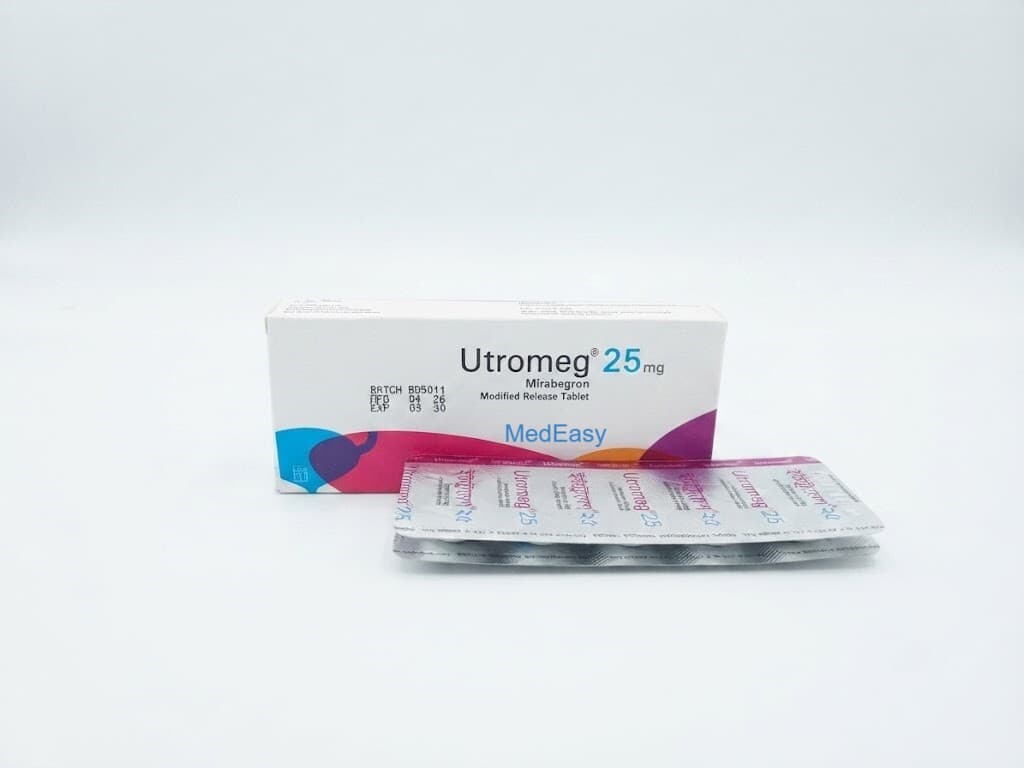
Utromeg 25 mg is indicated for the symptomatic treatment of urgency, increased micturition frequency and urgency incontinence as may occur in adult patients with overactive bladder (OAB) syndrome.
Theropeutic Class
BPH/ Urinary retention/ Urinary incontinence
Pharmacology
Utromeg 25 mg is a potent and selective beta 3-adrenoceptor agonist. Utromeg 25 mg showed relaxation of bladder smooth muscle in rat and human isolated tissue, increased cyclic adenosine monophosphate (cAMP) concentrations in rat bladder tissue and showed a bladder relaxant effect in rat urinary bladder function models. Utromeg 25 mg increased mean voided volume per micturition, and decreased the frequency of non-voiding contractions, without affecting voiding pressure or residual urine in rat models of bladder overactivity. In a monkey model, Utromeg 25 mg showed decreased voiding frequency. These results indicate that Utromeg 25 mg enhances urine storage function by stimulating beta 3-adrenoceptors in the bladder. During the urine storage phase, when urine accumulates in the bladder, sympathetic nerve stimulation predominates. Noradrenaline is released from nerve terminals, leading predominantly to beta adrenoceptor activation in the bladder musculature and hence bladder smooth muscle relaxation. During the urine voiding phase, the bladder is predominantly under parasympathetic nervous system control. Acetylcholine, released from pelvic nerve terminals, stimulates cholinergic M2 and M3 receptors, inducing bladder contraction. The activation of the M2 pathway also inhibits beta 3-adrenoceptor induced increases in cAMP. Therefore beta 3-adrenoceptor stimulation should not interfere with the voiding process. This was confirmed in rats with partial urethral obstruction, where Utromeg 25 mg decreased the frequency of non-voiding contractions without affecting the voided volume per micturition, voiding pressure or residual urine volume.
Dosage & Administration of Utromeg 25 mg
Recommended starting dose: 25 mg once daily, alone or in combination with solifenacin succinate 5 mg, once daily. Based on individual efficacy and tolerability, may increase dose to 50 mg once daily, alone or in combination with solifenacin succinate 5 mg, once daily. Swallow whole with water, with or without food, do not chew, divide or crushPatients with Severe Renal Impairment or Patients with Moderate Hepatic Impairment: Maximum dose is 25 mg Utromeg 25 mg once daily Patients with End Stage Renal Disease (ESRD) or Patients with Severe Hepatic Impairment: Not recommended
Dosage of Utromeg 25 mg
Adults including elderly: The recommended starting dose is Utromeg 25 mg 25 mg tablet once daily with or without food. Based on individual patient efficacy and tolerability the dose may be increased to Utromeg 25 mg 50 mg tablet once daily. Renal or hepatic impairment:
Patients with severe renal impairment (ClCr 15 to 29 mL/min or eGFR 15 to 29 mL/min/1.73 m2) or moderate hepatic impairment (Child-Pugh Class B), the daily dose of Utromeg 25 mg should not exceed 25 mg tablet once daily.
Utromeg 25 mg has not been studied in patients with end stage renal disease (GFR <15 mL/min/1.73 m2 or patients requiring haemodialysis) or severe hepatic impairment (Child Pugh Class C) and it is therefore not recommended for use in these patient populations.
Gender: No dose adjustment is necessary according to gender.Paediatric population: The safety and efficacy of Utromeg 25 mg in children below 18 years of age have not yet been established.
Administration of Utromeg 25 mg
Utromeg 25 mg tablet is to be taken once daily, with liquids, swallowed whole and is not to be chewed, divided, or crushed.
Interaction of Utromeg 25 mg
Effect of enzyme inhibitors: Utromeg 25 mg exposure (AUC) was increased 1.8-fold in the presence of the strong inhibitor of CYP3A/P-gp ketoconazole in healthy volunteers. No dose adjustment is needed when Utromeg 25 mg is combined with inhibitors of CYP3A and/or P-gp. However, in patients with mild to moderate renal impairment or mild hepatic impairment concomitantly receiving strong CYP3A inhibitors, such as itraconazole, ketoconazole, ritonavir and clarithromycin, the recommended dose is 25 mg once daily with or without food. Utromeg 25 mg is not recommended in patients with severe renal impairment or patients with moderate hepatic impairment concomitantly receiving strong CYP3A inhibitors. Effect of enzyme inducers: Substances that are inducers of CYP3A or P-gp decrease the plasma concentrations of Utromeg 25 mg. No dose adjustment is needed for Utromeg 25 mg when administered with therapeutic doses of rifampicin or other CYP3A or P-gp inducers. Effect of Utromeg 25 mg on CYP2D6 substrates: In healthy volunteers, the inhibitory potency of Utromeg 25 mg towards CYP2D6 is moderate and the CYP2D6 activity recovers within 15 days after discontinuation of Utromeg 25 mg. Multiple once daily dosing of Utromeg 25 mg IR resulted in a 90% increase in Cmax and a 229% increase in AUC of a single dose of metoprolol. Multiple once daily dosing of Utromeg 25 mg resulted in a 79% increase in Cmax and a 241% increase in AUC of a single dose of desipramine. Caution is advised if Utromeg 25 mg is co-administered with medicinal products with a narrow therapeutic index and significantly metabolised by CYP2D6, such as thioridazine, Type 1 C antiarrhythmics (e.g., flecainide, propafenone) and tricyclic antidepressants (e.g., imipramine, desipramine). Caution is also advised if Utromeg 25 mg is co-administered with CYP2D6 substrates that are individually dose titrated. Effect of Utromeg 25 mg on transporters: Utromeg 25 mg is a weak inhibitor of P-gp. Utromeg 25 mg increased Cmax and AUC by 29% and 27%, respectively, of the P-gp substrate digoxin in healthy volunteers. For patients who are initiating a combination of Utromeg 25 mg and digoxin, the lowest dose for digoxin should be prescribed initially. Serum digoxin concentrations should be monitored and used for titration of the digoxin dose to obtain the desired clinical effect.Other interactions: No clinically relevant interactions have been observed when Utromeg 25 mg was co-administered with therapeutic doses of solifenacin, tamsulosin, warfarin, metformin or a combined oral contraceptive medicinal product containing ethinylestradiol and levonorgestrel. Dose-adjustment is not recommended.
Contraindications
Utromeg 25 mg is contraindicated in patients with hypersensitivity to the active substance or to any of the excipients and severe uncontrolled hypertension defined as systolic blood pressure 180 mm Hg and/or diastolic blood pressure 110 mm Hg.
Side Effects of Utromeg 25 mg
The most common side effects reported for patients treated with Utromeg 25 mg 50 mg during the three 12-week phase 3 double blind, placebo controlled studies are tachycardia and urinary tract infections. The frequency of tachycardia was 1.2% in patients receiving Utromeg 25 mg 50 mg. Tachycardia led to discontinuation in 0.1% patients receiving Utromeg 25 mg 50 mg. The frequency of urinary tract infections was 2.9% in patients receiving Utromeg 25 mg 50 mg. Urinary tract infections led to discontinuation in none of the patients receiving Utromeg 25 mg 50 mg. Serious adverse reactions included atrial fibrillation (0.2%).
Pregnancy & Lactation
Use in Pregnancy: There are limited amount of data from the use of Utromeg 25 mg in pregnant women. Studies in animals have shown reproductive toxicity. Utromeg 25 mg is not recommended during pregnancy and in women of childbearing potential not using contraception.Use in Lactation: Utromeg 25 mg is excreted in the milk of rodents and therefore, is predicted to be present in human milk. No studies have been conducted to assess the impact of Utromeg 25 mg on milk production in humans, its presence in human breast milk, or its effects on the breast-fed child. Utromeg 25 mg should not be administered during breast-feeding
Precautions & Warnings
Renal impairment: Utromeg 25 mg has not been studied in patients with end stage renal disease (GFR <15 mL/min/1.73 m2 or patients requiring haemodialysis) and therefore, it is not recommended for use in this patient population. Data are limited in patients with severe renal impairment (GFR 15 to 29 mL/min/1.73 m2); based on a pharmacokinetic study a dose reduction to 25 mg is recommended in this population. Utromeg 25 mg is not recommended for use in patients with severe renal impairment (GFR 15 to 29 mL/min/1.73 m2) concomitantly receiving strong CYP3A inhibitors. Hepatic impairment: Utromeg 25 mg has not been studied in patients with severe hepatic impairment (Child-Pugh Class C) and, therefore, it is not recommended for use in this patient population. Utromeg 25 mg is not recommended for use in patients with moderate hepatic impairment (Child-Pugh Class B) concomitantly receiving strong CYP3A inhibitors. Hypertension: Utromeg 25 mg can increase blood pressure. Blood pressure should be measured at baseline and periodically during treatment with Utromeg 25 mg, especially in hypertensive patients. Data are limited in patients with stage 2 hypertension (systolic blood pressure 160 mm Hg or diastolic blood pressure 100 mm Hg). Patients with congenital or acquired QT prolongation: Caution should be exercised when administering Utromeg 25 mg in patients with congenital or acquired QT prolongation. Patients with bladder outlet obstruction and patients taking antimuscarinics medications for OAB: A controlled clinical safety study in patients with bladder outlet obstruction (BOO) did not demonstrate increased urinary retention in patients treated with Utromeg 25 mg; however, Utromeg 25 mg should be administered with caution to patients with clinically significant bladder outlet obstruction. Utromeg 25 mg should also be administered with caution to patients taking antimuscarinic medications for the treatment of OAB.
Overdose Effects of Utromeg 25 mg
Utromeg 25 mg has been administered to healthy volunteers at single doses up to 400 mg. At this dose, adverse events reported included palpitations and increased pulse rate exceeding 100 beats per minute (bpm). Multiple doses of Utromeg 25 mg up to 300 mg daily for 10 days showed increases in pulse rate and systolic blood pressure when administered to healthy volunteers. Treatment for overdose should be symptomatic and supportive. In the event of overdose, pulse rate, blood pressure, and ECG monitoring is recommended.
Storage Conditions
Store in a cool and dry place, protected from light.
Use In Special Populations
Renal and Hepatic Impairment: Utromeg 25 mg has not been studied in patients with end stage renal diseaseGender: No dose adjustment is necessary according to gender.Children: The safety and efficacy of Utromeg 25 mg in children below 18 years of age have not yet been established. No data are available.
Drug Classes
BPH/ Urinary retention/ Urinary incontinence
Mode Of Action
Utromeg 25 mg is the first beta-3 adrenoceptor agonist. Utromeg 25 mg exerts its effect via a dual mechanism, both directly acts on the bladder smooth muscle and also via the sensory nervous system, it increases the levels of cyclic adenosine monophosphate (cyclic AMP) and leads to relaxation of the detrusor smooth muscle during storage phase of urinary bladder fill-void cycle by activation of beta-3 adrenoceptor which increase bladder capacity.
Pregnancy
There are limited amount of data from the use of Utromeg 25 mg in pregnant women. Studies in animals have shown reproductive toxicity. Utromeg 25 mg is not recommended during pregnancy and in women is planning to be pregnant. Utromeg 25 mg is excreted in the milk of rodents and therefore is predicted to be present in human milk. No studies have been conducted to assess the impact of Utromeg 25 mg on milk production in humans, its presence in human breast milk, or its effects on the breast-fed child. Utromeg 25 mg should not be administered during breast-feeding. There were no treatment-related effects of Utromeg 25 mg on fertility in animals. The effect of Utromeg 25 mg on human fertility has not been established.
Frequently Asked Questions
What is Utromeg 25 mg used for?
Utromeg 25 mg is indicated for the symptomatic treatment of urgency, increased micturition frequency and urgency incontinence as may occur in adult patients with overactive bladder (OAB) syndrome.
What is the dosage of Utromeg 25 mg?
Adults including elderly: The recommended starting dose is Utromeg 25 mg 25 mg tablet once daily with or without food. Based on individual patient efficacy and tolerability the dose may be increased to Utromeg 25 mg 50 mg tablet once daily. Renal or hepatic impairment: Patients with severe renal impairment (ClCr 15 to 29 mL/min or eGFR 15 to 29 mL/min/1.73 m2) or moderate hepatic impairment (Child…
What are the side effects of Utromeg 25 mg?
The most common side effects reported for patients treated with Utromeg 25 mg 50 mg during the three 12-week phase 3 double blind, placebo controlled studies are tachycardia and urinary tract infections. The frequency of tachycardia was 1.2% in patients receiving Utromeg 25 mg 50 mg. Tachycardia led to discontinuation in 0.1% patients receiving Utromeg 25 mg 50 mg. The frequency of urinary tract i…
Who should not take Utromeg 25 mg?
Utromeg 25 mg is contraindicated in patients with hypersensitivity to the active substance or to any of the excipients and severe uncontrolled hypertension defined as systolic blood pressure 180 mm Hg and/or diastolic blood pressure 110 mm Hg.
What precautions should be taken with Utromeg 25 mg?
Renal impairment: Utromeg 25 mg has not been studied in patients with end stage renal disease (GFR <15 mL/min/1.73 m2 or patients requiring haemodialysis) and therefore, it is not recommended for use in this patient population. Data are limited in patients with severe renal impairment (GFR 15 to 29 mL/min/1.73 m2); based on a pharmacokinetic study a dose reduction to 25 mg is recommended in this p…
Is Utromeg 25 mg safe during pregnancy and breastfeeding?
Use in Pregnancy: There are limited amount of data from the use of Utromeg 25 mg in pregnant women. Studies in animals have shown reproductive toxicity. Utromeg 25 mg is not recommended during pregnancy and in women of childbearing potential not using contraception.Use in Lactation: Utromeg 25 mg is excreted in the milk of rodents and therefore, is predicted to be present in human milk. No studies…
Disclaimer
The information provided is accurate to our best practices, but it does not replace professional medical advice. We cannot guarantee its completeness or accuracy. The absence of specific information about a drug should not be seen as an endorsement. We are not responsible for any consequences resulting from this information, so consult a healthcare professional for any concerns or questions.