
10% Off
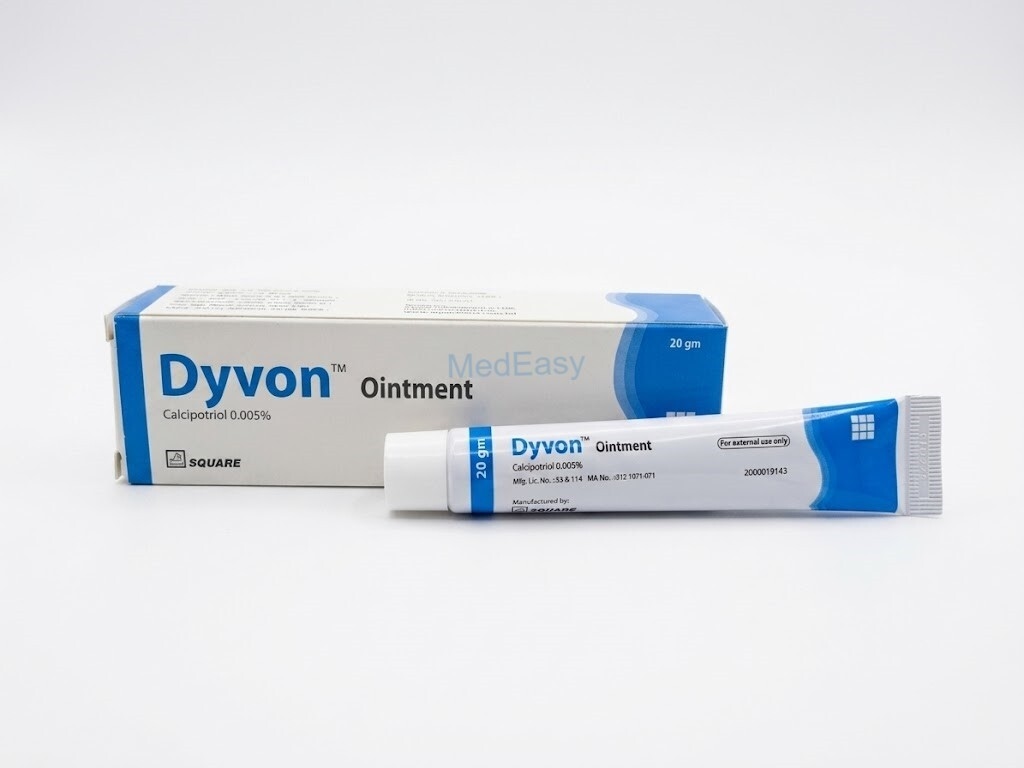
Dyvon0.005% w/w
Square Pharmaceuticals PLC.
৳315.95
Add to cart
Calcipotriol Monohydrate is a synthetic vitamin D3 analog used topically for the treatment of plaque psoriasis (psoriasis vulgaris).
Calcipotriol Monohydrate is a synthetic vitamin D3 analog used topically for the treatment of plaque psoriasis (psoriasis vulgaris).
Calcipotriol Monohydrate is not indicated for erythrodermic, exfoliative, or generalized pustular psoriasis.
Calcipotriol Monohydrate should be applied only to the affected (psoriatic) skin, in the minimum amount needed to cover lesions, and the total weekly dose limit (see below) should not be exceeded to avoid disturbance of calcium metabolism.
| Indication | Adult dose | Notes |
|---|---|---|
| Plaque psoriasis (body), monotherapy | Apply a thin layer once or twice daily | Maximum weekly dose of Calcipotriol Monohydrate should not exceed 100 g of cream/ointment (or the equivalent) per week |
| Scalp psoriasis | Apply solution/foam to scalp lesions once or twice daily | Part hair, apply directly to plaques |
| Combination with topical corticosteroid | Apply once daily, generally for up to 4 weeks (body) as directed by physician | Follow the specific combination product's approved regimen |
Use in children below 18 years should be under specialist supervision only, with lower body-surface-area treatment limits; safety and effectiveness have not been established in children under 12 years for most Calcipotriol Monohydrate products (see Pediatric Use).
No well-established dose adjustment is defined for topical Calcipotriol Monohydrate, but caution is advised in patients with significant hepatic or renal impairment because of a theoretical risk of altered calcium handling; consult a physician.
Adverse effects reported with Calcipotriol Monohydrate are generally local and most common at the start of treatment:
Calcipotriol Monohydrate is contraindicated in patients with:
Note: Calcipotriol Monohydrate should not be used on erythrodermic, exfoliative, or generalized pustular psoriasis; this is a use-limitation based on lack of established safety/efficacy and risk of increased systemic absorption in these severe/unstable forms of psoriasis, assessed on an individual basis by the treating physician, rather than an absolute hypersensitivity-type contraindication.
Disclaimer
The information provided is accurate to the best of our knowledge, but it does not replace professional medical advice. We cannot guarantee its completeness or accuracy, and the absence of specific information about a drug should not be taken as an endorsement. We are not responsible for any consequences arising from this information, so please consult a healthcare professional for any concerns or questions.
