8% Off
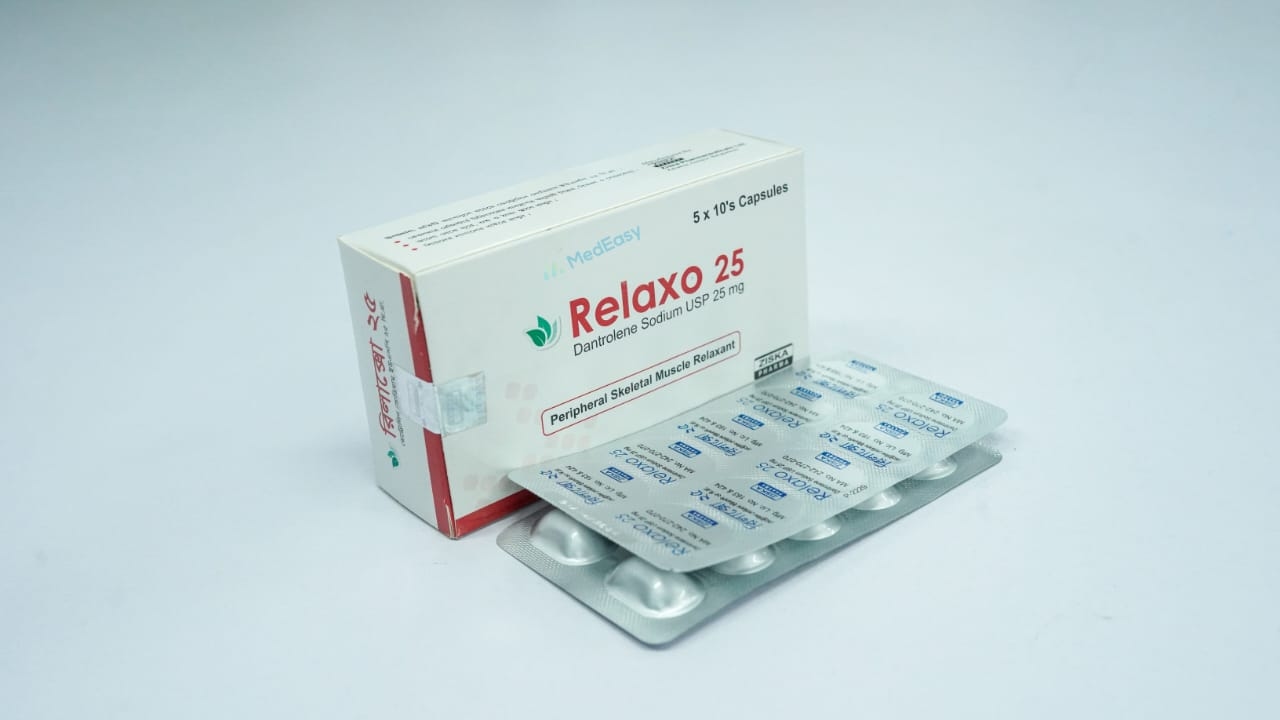
Relaxo25 mg
Ziska Pharmaceuticals Ltd.
৳92.00
Add to cart
Dantrolene Sodium is a direct-acting skeletal muscle relaxant with two well-established, FDA-approved indications: 1.
Dantrolene Sodium is a direct-acting skeletal muscle relaxant with two well-established, FDA-approved indications:
Used for the treatment of spasticity resulting from upper motor neuron disorders, including:
Dantrolene Sodium is indicated only when spasticity interferes with function or nursing care and relief is expected to give an overall functional benefit; it is not indicated when spasticity is needed to sustain posture or balance during walking.
The intravenous formulation of Dantrolene Sodium is the specific treatment for malignant hyperthermia (MH), a rare, life-threatening hypermetabolic reaction to certain general anesthetic agents. It is also used:
Dantrolene Sodium has also been used off-label, based on case reports and clinical experience, for severe hyperthermic emergencies such as neuroleptic malignant syndrome, exertional heat stroke, and stimulant (e.g., MDMA)-associated hyperthermia when standard cooling and supportive measures are insufficient. Such use should only be undertaken by specialists in a hospital or critical care setting.
Dosage of Dantrolene Sodium must be individualized to the indication and titrated to the lowest effective dose.
| Indication | Population | Typical Dosing |
|---|---|---|
| Chronic spasticity (oral) | Adults | Initiate 25 mg once daily; if tolerated, increase gradually at weekly intervals to 25 mg three times daily, then 50 mg three times daily, then 100 mg three times daily, as needed. Maximum dose is typically 100 mg four times daily. |
| Chronic spasticity (oral) | Children (5 years and older) | Initiate approximately 0.5 mg/kg once daily; increase gradually at weekly intervals as tolerated, up to a maximum of 100 mg four times daily. Not established for children under 5 years — see Pediatric Use. |
| Malignant hyperthermia crisis (IV) | Adults and children | Administered by rapid intravenous injection, starting at approximately 1 mg/kg, repeated as needed up to a cumulative dose of about 10 mg/kg, until symptoms subside. Must only be given by trained personnel in a hospital setting. |
| Malignant hyperthermia prophylaxis (oral or IV) | At-risk patients before surgery | Oral: approximately 4-8 mg/kg/day in 3-4 divided doses for 1-2 days before surgery, with the last dose 3-4 hours preoperatively. IV: a single preoperative infusion may be used per institutional protocol. |
| Post-crisis prevention | Adults and children | Approximately 4-8 mg/kg/day in 4 divided doses for 1-3 days following a treated malignant hyperthermia crisis. |
Daily doses above 400 mg are rarely needed and substantially increase the risk of serious liver injury (see Precautions and Warnings). If no clinical benefit is seen for chronic spasticity within 45 days, Dantrolene Sodium should be discontinued.
The most common side effects of Dantrolene Sodium, especially during the first two weeks of therapy or with dose increases, include:
Less common effects include constipation, loss of appetite, speech disturbance, and blurred or double vision.
Serious but less common reactions include liver injury/hepatitis (see Precautions and Warnings for full detail), pleural effusion with pericarditis, blood disorders such as aplastic anemia or leukopenia, and hypersensitivity or photosensitivity reactions. Seek prompt medical attention for yellowing of the skin or eyes, unusual bleeding or bruising, severe breathlessness, or chest pain while taking Dantrolene Sodium.
Dantrolene Sodium is contraindicated in the following situations:
Disclaimer
The information provided is accurate to the best of our knowledge, but it does not replace professional medical advice. We cannot guarantee its completeness or accuracy, and the absence of specific information about a drug should not be taken as an endorsement. We are not responsible for any consequences arising from this information, so please consult a healthcare professional for any concerns or questions.