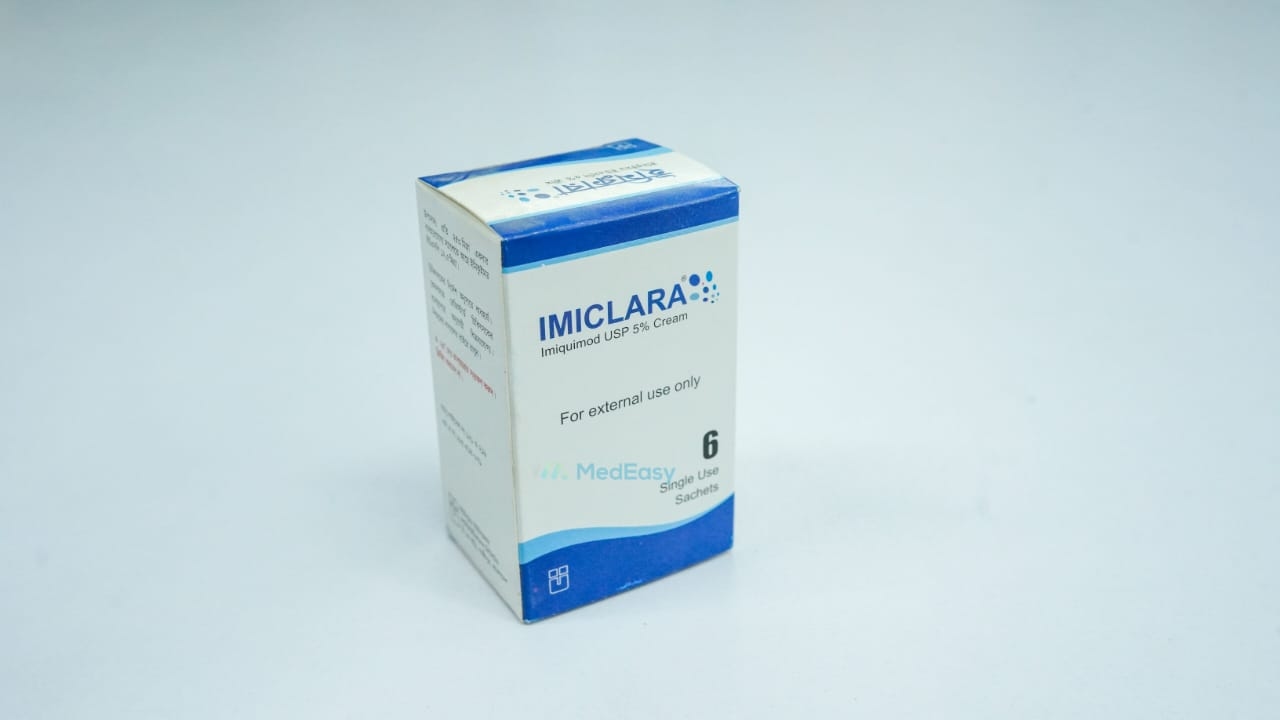
Generic medicine

Imiquimod: Brands, Price & Uses in Bangladesh

Imiquimod cream is a topical immune response modifier approved for three distinct dermatological conditions.

Forms:Cream

About Imiquimod

Indications of Imiquimod

Imiquimod cream is a topical immune response modifier approved for three distinct dermatological conditions. The specific product strength and treatment regimen differ by indication, so the exact product and schedule prescribed by a physician must be used for each condition.

Established (FDA-Approved) Indications

  • External genital and perianal warts (condyloma acuminata) in patients 12 years of age and older (5% and 3.75% cream formulations).
  • Actinic keratosis (AK) — clinically typical, non-hyperkeratotic, non-hypertrophic, visible or palpable lesions on the face or scalp in immunocompetent adults (5%, 3.75%, or 2.5% cream, depending on the specific product).
  • Superficial basal cell carcinoma (sBCC) — biopsy-confirmed, maximum tumour diameter 2 cm, located on the trunk, neck, or extremities (excluding hands and feet), in adults for whom surgical treatment is considered less appropriate (5% cream only).

Important Limitations

Imiquimod has not been shown effective for molluscum contagiosum and is not indicated for urethral, intra-vaginal, cervical, rectal, or intra-anal human papillomavirus (HPV) disease. Use for actinic keratosis or superficial basal cell carcinoma is not recommended in immunosuppressed patients, as safety and efficacy have not been established in that population.

Dosage & Administration of Imiquimod

The dose, frequency, and duration of Imiquimod treatment depend on the specific indication and product strength. The regimens below are typical; the treating physician's specific instructions should always be followed.

IndicationTypical RegimenMaximum Duration
External genital/perianal warts (5% cream)Apply a thin layer 3 times per week (e.g., Mon-Wed-Fri) at bedtime; leave on 6-10 hours, then wash off with mild soap and water.Until warts clear, up to 16 weeks per wart episode
External genital/perianal warts (3.75% cream)Apply once daily at bedtime; leave on approximately 8 hours, then wash off.Up to 8 weeks
Actinic keratosis (5% cream)Apply twice weekly (e.g., Mon and Thu) at bedtime to the face or scalp; leave on approximately 8 hours, then wash off.16 weeks
Actinic keratosis (2.5%/3.75% cream)Apply once daily at bedtime for two 2-week treatment cycles separated by a 2-week treatment-free interval; leave on approximately 8 hours, then wash off.Two 2-week cycles
Superficial basal cell carcinoma (5% cream only)Apply 5 times per week at bedtime to the tumour and a 1 cm margin of surrounding skin; leave on approximately 8 hours, then wash off.6 weeks

If a severe local skin reaction occurs, a rest period of several days may be needed before resuming treatment, on a physician's advice. See Precautions and Warnings for details on expected local skin reactions.

Side Effects of Imiquimod

Local Reactions (Very Common)

Local skin reactions at the application site are expected and common as part of how Imiquimod works, including redness (erythema), erosion, excoriation/flaking, swelling (oedema), scabbing/crusting, itching, and burning. These can be intense, particularly during superficial basal cell carcinoma treatment, and may require a temporary rest from treatment (see Precautions and Warnings).

Systemic Reactions (Less Common)

  • Headache
  • Fatigue
  • Flu-like symptoms (fever, myalgia, chills)
  • Back pain
  • Nausea and diarrhoea
  • Regional lymphadenopathy

Patients should contact their physician if local reactions become severe or intolerable, or if systemic symptoms occur.

Contraindications of Imiquimod

Imiquimod is contraindicated in patients with known hypersensitivity to imiquimod or to any component of the cream formulation.

Frequently Asked Questions about Imiquimod

What is Imiquimod used for?

Imiquimod cream is used to treat three specific skin conditions: external genital and perianal warts, actinic keratosis (sun-damaged pre-cancerous skin patches) on the face or scalp, and superficial basal cell carcinoma, an early type of skin cancer. The product strength and treatment schedule differ for each condition, so it should only be used exactly as prescribed by a physician.

Is it normal for the skin to become red and irritated during treatment?

Yes. Imiquimod works by stimulating the body's own immune response in the skin, so redness, swelling, itching, burning, and even erosion or scabbing at the application site are expected and common reactions, not necessarily a sign of allergy. If the reaction becomes very severe or intolerable, contact a physician, who may recommend a temporary break from treatment.

Can Imiquimod be used during pregnancy or breastfeeding?

Imiquimod should be used during pregnancy only if clearly necessary and if a physician judges the benefit outweighs any potential risk to the baby, since data in pregnant women are limited. Whether it passes into breast milk is unknown, though systemic absorption from the skin is minimal; consult a physician before use while breastfeeding.

Can I have sexual contact while using Imiquimod for genital warts?

Sexual, genital, anal, or oral contact should be avoided while Imiquimod cream remains on the skin, because it can weaken latex condoms and diaphragms and may irritate a partner's skin. Plan application so the wash-off period does not overlap with sexual activity.

What happens if Imiquimod is used inside the vagina or anus by mistake?

Imiquimod has not been studied and is not approved for use inside the vagina, cervix, urethra, rectum, or anal canal, or on mucous membranes, eyes, lips, or nostrils. Using it in these areas can cause severe irritation or damage and should be avoided; it is intended for external genital/perianal skin, or facial/scalp/trunk skin depending on indication, exactly as directed.

Is Imiquimod an antibiotic?

No, Imiquimod is not an antibiotic. It is a topical immune response modifier that stimulates the body's own immune cells to fight HPV-infected tissue or abnormal skin cells; it does not directly kill bacteria, viruses, or cancer cells itself.

Disclaimer

The information provided is accurate to the best of our knowledge, but it does not replace professional medical advice. We cannot guarantee its completeness or accuracy, and the absence of specific information about a drug should not be taken as an endorsement. We are not responsible for any consequences arising from this information, so please consult a healthcare professional for any concerns or questions.

DoctorBlogArticles