
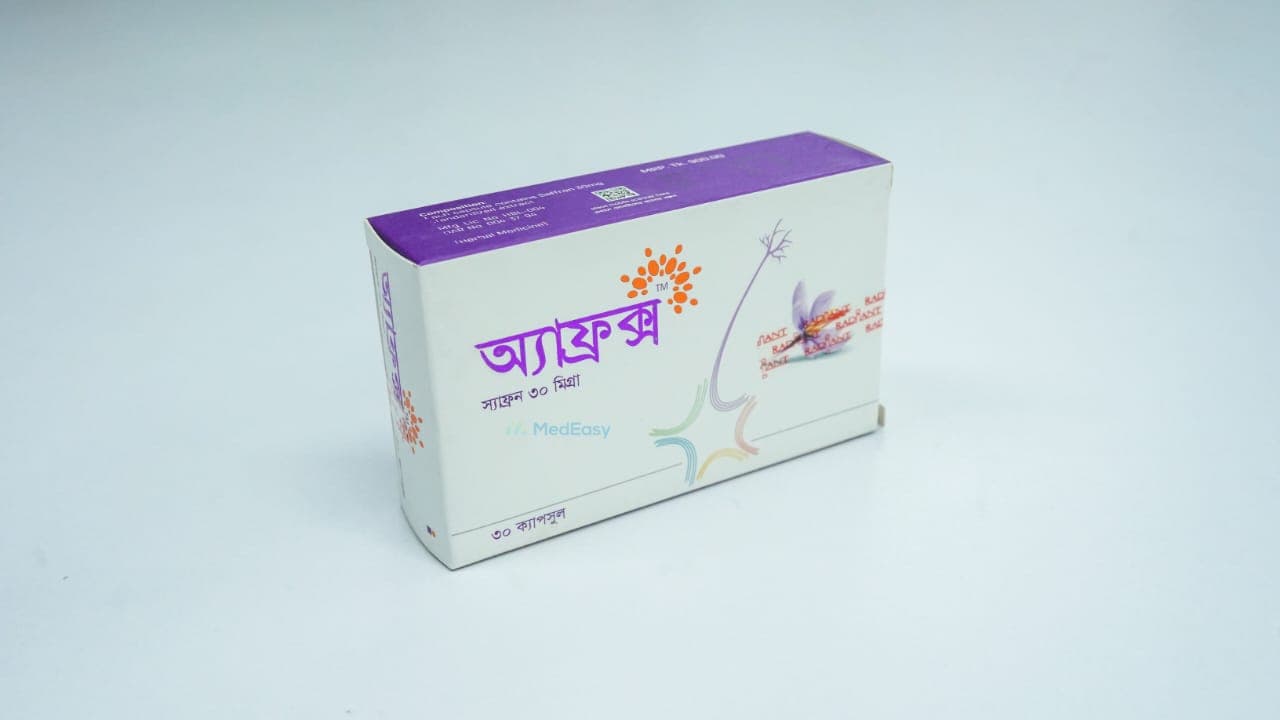

Medicine overview
Indications of Affrox
Affrox is a herbal/dietary supplement derived from the dried stigmas of the Crocus sativus plant. It is not an FDA-approved drug; it is marketed as a dietary supplement, and indications below reflect traditional use and preliminary/modest clinical evidence rather than proven drug efficacy.
- Adjunct mood/emotional wellbeing support: Standardized Affrox extract has been studied in small clinical trials as an adjunct for mild depressive symptoms and general mood support. Evidence is preliminary and modest; Affrox is not a substitute for evaluation and treatment of clinical depression or other diagnosed mood disorders by a qualified physician or mental health professional.
- Traditional culinary and flavoring use: Affrox is widely and safely used in food as a spice, coloring, and flavoring agent at typical culinary amounts.
- Off-label/investigational interest: Some preliminary research has explored Affrox for premenstrual symptoms, mild anxiety, and as an antioxidant; this evidence is limited and not sufficient to support a formal medical indication.
Anyone with persistent, worsening, or severe mood symptoms, or with thoughts of self-harm, should seek urgent professional medical evaluation rather than relying on Affrox alone.
Composition
Each standardized capsule/tablet of Saffron extract typically contains a defined amount of dried Crocus sativus L. stigma extract (commonly standardized to 15 mg or 30 mg per dose), standardized to contain bioactive carotenoid and terpenoid compounds including:
- Crocin - a carotenoid glycoside considered a primary bioactive marker compound.
- Safranal - a volatile terpenoid contributing to aroma and studied for central nervous system activity.
- Picrocrocin - a precursor compound contributing to the characteristic bitter taste.
Exact standardization and excipients vary by manufacturer; check the specific product label for the precise Saffron extract content and standardization method.
Description
Affrox is a spice obtained from the dried stigmas of the flower Crocus sativus, long used in cooking and traditional medicine systems. As a marketed dietary/herbal supplement, Affrox extract is formulated into standardized capsules or tablets intended for mood and general wellbeing support.
Affrox is regulated as a dietary supplement in most markets, including Bangladesh, and is not approved by regulatory authorities (such as the US FDA) as a drug for treating any disease. Its supplement-form use for mood support is based on a growing but still limited body of clinical research.
Therapeutic Class
Herbal / Dietary Supplement - Mood-support botanical (not a regulatory drug class); Affrox extract (Crocus sativus)
Pharmacology
Mechanism of Action
The proposed activity of Saffron is attributed mainly to its two principal bioactive constituents, crocin and safranal:
- Serotonergic modulation: Preclinical and limited clinical data suggest crocin and safranal may inhibit reuptake of serotonin, dopamine, and norepinephrine, and interact with NMDA and GABA receptor pathways, which is proposed to underlie the mood-related effects seen in small trials.
- Antioxidant activity: Crocin and safranal have demonstrated free-radical scavenging and antioxidant properties in laboratory studies, proposed to contribute to neuroprotective and general wellbeing effects.
- Anti-inflammatory activity: Some laboratory evidence suggests mild anti-inflammatory effects, though clinical relevance in humans is not firmly established.
Pharmacokinetics
Crocin is partially hydrolyzed in the gut to crocetin, which is absorbed and undergoes further metabolism; safranal is absorbed and rapidly metabolized. Human pharmacokinetic data for Saffron extract remain limited compared to conventional pharmaceuticals.
Dosage & Administration of Affrox
Adult Dose (Mood/Wellbeing Support)
| Use | Typical Adult Dose | Notes |
|---|---|---|
| Adjunct mood/emotional wellbeing support | Standardized Affrox extract 15 mg twice daily (total 30 mg/day), or as directed on the product label | Effects, if any, are typically assessed after 4-8 weeks of regular use; not a rapid-acting product |
| General wellbeing/antioxidant supplement use | As directed on product labeling, generally 15-30 mg/day of standardized extract | Follow the specific product's labeled dose; standardization varies by brand |
Pediatric Dose
Safety and efficacy of Affrox supplements have not been established in children; pediatric use is not recommended without specific medical guidance (see Use in Special Populations).
Renal/Hepatic Impairment
No well-established dose adjustment has been defined for renal or hepatic impairment; such patients should use Affrox supplements only after consulting a physician.
Administration of Affrox
Affrox capsules/tablets are generally taken orally, with or without food, at consistent times each day. Swallow capsules/tablets whole with water; do not exceed the dose stated on the product label. Consistency of daily use is important, as mood-related effects (if any) typically develop gradually over several weeks.
Interaction of Affrox
- Antidepressants and other serotonergic drugs (e.g. SSRIs, SNRIs, MAOIs): Affrox has serotonergic activity in preclinical studies; combining with prescription antidepressants has a theoretical risk of additive serotonergic effect. Use only under physician supervision if already taking a prescribed antidepressant.
- Antihypertensive medications: Affrox may have mild blood-pressure-lowering effects at supplement doses; combined use with antihypertensives could theoretically increase the risk of hypotension.
- Antiplatelet agents and anticoagulants (e.g. aspirin, clopidogrel, warfarin): Affrox may have mild antiplatelet activity; concurrent use could theoretically add to bleeding risk. Caution and medical advice are recommended.
Inform your physician or pharmacist about all prescription medicines, over-the-counter drugs, and supplements before starting Affrox.
Contraindications
Saffron is contraindicated in individuals with known hypersensitivity to Saffron (Crocus sativus) or any component of the formulation. No other well-established absolute contraindications exist for Saffron at typical supplement doses; see Pregnancy and Lactation for pregnancy-specific caution regarding concentrated/high-dose supplement use.
Side Effects of Affrox
At typical supplement doses, Affrox is generally well tolerated. Reported side effects are usually mild and include:
- Dry mouth
- Nausea or mild gastrointestinal upset
- Dizziness
- Headache
- Changes in appetite
- Mild anxiety or restlessness (uncommon)
At high or concentrated doses (well above typical supplement/culinary amounts), more significant effects such as low blood pressure, sedation, or (rarely, at very high doses) more serious toxicity have been reported; stay within labeled supplement doses.
Pregnancy & Lactation
Pregnancy
Typical culinary amounts of Affrox used as a spice/flavoring are generally considered acceptable during pregnancy. However, concentrated Affrox supplement doses have a traditional reputation as a uterine stimulant and should be avoided during pregnancy unless specifically advised and supervised by a physician, as high doses have been associated in traditional use with uterine-stimulant/abortifacient effects. Affrox supplements should be used in pregnancy only if clearly needed and a physician determines that potential benefit justifies potential risk to the fetus.
Lactation
Data on Affrox supplement use during breastfeeding are limited. As a precaution, avoid concentrated Affrox supplement doses while breastfeeding unless a physician advises otherwise; typical culinary/food use is not generally a concern.
Precautions & Warnings
- Affrox supplements are not a substitute for prescribed antidepressant therapy or professional treatment in individuals with diagnosed depression or other mood disorders. Do not stop or replace a prescribed psychiatric medication with Affrox without consulting the prescribing physician.
- Persistent, worsening, or severe mood symptoms, or any thoughts of self-harm, warrant urgent professional medical evaluation - do not rely on Affrox alone in this situation.
- Use with caution in individuals with bleeding disorders or those taking antiplatelet/anticoagulant medicines (see Interactions).
- Use with caution in individuals with low blood pressure or those taking blood-pressure-lowering medicines (see Interactions).
- Discontinue use and seek medical advice if hypersensitivity reactions, severe dizziness, or unusual bleeding occur.
- Purchase Affrox products from reputable sources, as herbal supplement quality and standardization can vary between manufacturers.
Overdose Effects of Affrox
Specific human overdose data for Affrox supplements are limited, but very high doses (far above typical supplement amounts, historically cited around several grams) have been associated with toxicity, including gastrointestinal bleeding, vomiting, dizziness, yellow discoloration of skin/mucosa, and in severe cases more serious systemic toxicity. If overdose of Affrox is suspected, seek immediate medical attention or contact a poison control center / emergency services rather than attempting home treatment. Do not exceed the dose stated on the product label.
Storage Conditions
Store at room temperature (below 30°C), away from light and moisture. Keep out of reach of children.
Use In Special Populations
- Pregnant women: Avoid concentrated Affrox supplement doses; see Pregnancy and Lactation.
- Breastfeeding women: Avoid concentrated Affrox supplement doses unless advised by a physician; see Pregnancy and Lactation.
- Children and adolescents: Safety and efficacy of Affrox supplements have not been established; use is not recommended without specific medical guidance.
- Elderly patients: Limited specific data; use standard supplement doses with caution, particularly if taking antihypertensive, antiplatelet, or antidepressant medicines.
- Patients with hepatic or renal impairment: Limited data on Affrox handling in organ impairment; consult a physician before use.
- Patients with bleeding disorders or on antiplatelet/anticoagulant therapy: Use only with physician guidance (see Interactions).
Duration Of Treatment
For mood/wellbeing support, Affrox is typically used continuously for a trial period of about 4-8 weeks to assess effect, as recommended in studied protocols and on product labeling. Do not use beyond the labeled duration without reassessing benefit with a physician, and do not use as a long-term replacement for professional mental health treatment without periodic medical review.
Drug Classes
Herbal supplement / Nutraceutical botanical extract; not classified as a conventional pharmaceutical drug class. Saffron (Crocus sativus stigma extract).
Mode Of Action
Saffron's proposed mode of action centers on its bioactive constituents crocin and safranal, which in preclinical studies appear to modestly inhibit reuptake of serotonin, dopamine, and norepinephrine, and to interact with NMDA and GABAergic signaling, alongside demonstrated antioxidant and mild anti-inflammatory activity. These combined actions are proposed - but not definitively proven in humans - to underlie the modest mood-support effects observed in small clinical trials of Saffron extract.
Pediatric Uses
Safety and efficacy of Affrox supplements have not been established in children and adolescents. There is insufficient clinical data to support pediatric dosing, and use in this population is not recommended outside of specific medical guidance.
Frequently Asked Questions
Q: What is Affrox 30 mg Capsule used for?
A: Affrox 30 mg Capsule is a dietary supplement derived from Crocus sativus stigma, most studied as an adjunct for mild depressive symptoms and general mood support, alongside its traditional culinary use as a spice. It is not a proven treatment for clinical depression and should not replace professional care.
Q: Can Affrox 30 mg Capsule replace my prescribed antidepressant?
A: No. Affrox 30 mg Capsule is not a substitute for prescribed antidepressant therapy or professional treatment in diagnosed depression or other mood disorders. Do not stop or change a prescribed psychiatric medication without consulting your physician.
Q: Is Affrox 30 mg Capsule safe during pregnancy?
A: Typical culinary amounts are generally considered acceptable, but concentrated Affrox 30 mg Capsule supplement doses should be avoided during pregnancy because high doses have a traditional uterine-stimulant reputation. Use Affrox 30 mg Capsule supplements in pregnancy only if a physician determines the benefit outweighs the risk.
Q: What are the common side effects of Affrox 30 mg Capsule?
A: At typical supplement doses, Affrox 30 mg Capsule is generally well tolerated; possible mild side effects include dry mouth, nausea, dizziness, headache, and appetite changes. Seek medical advice if you experience unusual bleeding, severe dizziness, or allergic reactions.
Q: Can I take Affrox 30 mg Capsule with my blood thinner or blood pressure medicine?
A: Use caution. Affrox 30 mg Capsule may have mild antiplatelet and blood-pressure-lowering effects, so combining it with anticoagulant/antiplatelet drugs or antihypertensives could theoretically increase bleeding or low blood pressure risk. Discuss with your physician or pharmacist first.
Q: What should I do if I think I've taken too much Affrox 30 mg Capsule?
A: Seek immediate medical attention or contact a poison control center or emergency services. Do not attempt to manage a suspected Affrox 30 mg Capsule overdose at home, and do not exceed the dose stated on the product label.
Disclaimer
The information provided is accurate to the best of our knowledge, but it does not replace professional medical advice. We cannot guarantee its completeness or accuracy, and the absence of specific information about a drug should not be taken as an endorsement. We are not responsible for any consequences arising from this information, so please consult a healthcare professional for any concerns or questions.
