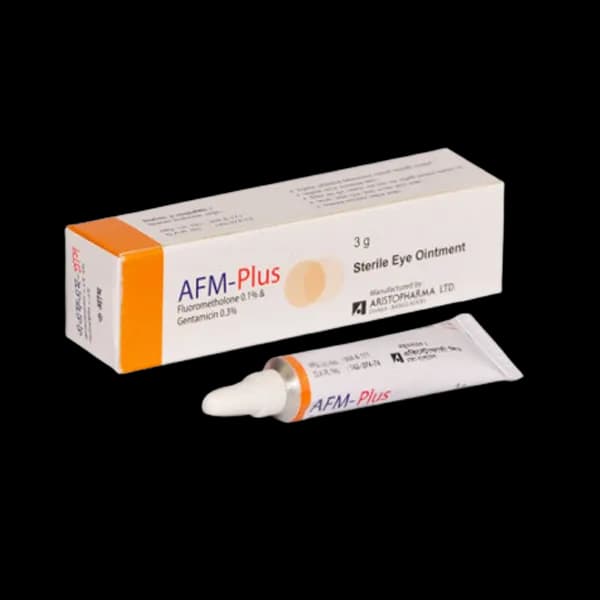
Medicine overview
Indications of AFM-Plus
AFM-Plus is a fixed-dose ophthalmic combination of a corticosteroid (fluorometholone) with an aminoglycoside antibiotic (gentamicin). It is used when steroid-responsive inflammation of the eye is present together with a risk of, or an existing, susceptible superficial bacterial infection.
Established / approved uses
- Steroid-responsive inflammatory conditions of the palpebral and bulbar conjunctiva, cornea, and anterior segment of the globe (e.g. allergic conjunctivitis, phlyctenular keratoconjunctivitis, iritis, cyclitis, episcleritis) where a bacterial infection or a definite risk of bacterial infection exists.
- Inflammation following chemical, thermal, or radiation burns, or penetration of foreign bodies, when infection risk justifies antibiotic cover alongside anti-inflammatory treatment.
- Postoperative ocular inflammation after ophthalmic surgery, when a physician judges combined anti-inflammatory and antibiotic cover to be appropriate.
Notes on evidence strength
- The gentamicin component provides coverage against many common susceptible gram-negative organisms (including Pseudomonas aeruginosa) and some gram-positive organisms such as Staphylococcus aureus, but does not reliably cover streptococcal species — AFM-Plus is not appropriate as monotherapy for infections known or suspected to involve streptococci.
- AFM-Plus is a combination therapy by design: the corticosteroid controls inflammation while the antibiotic reduces the risk of bacterial proliferation; it is not intended for infections without an accompanying inflammatory component that would benefit from steroid use.
- AFM-Plus is not indicated, and should not be used, for infections due to viruses, fungi, or mycobacteria (see Contraindications).
Composition
Each mL of Fluorometholone + Gentamicin ophthalmic suspension typically contains:
- Fluorometholone 0.1% w/v
- Gentamicin (as gentamicin sulfate) 0.3% w/v
Exact strengths and the vehicle/excipients (e.g. benzalkonium chloride as preservative, suspending agents) vary by brand and formulation; always check the product label of the dispensed brand of Fluorometholone + Gentamicin.
Description
AFM-Plus is a multi-ingredient anti-inflammatory and anti-infective ophthalmic preparation that combines a corticosteroid with an antibiotic acting by a distinct mechanism. Fluorometholone suppresses the ocular inflammatory response (reducing redness, swelling, and discomfort) and, compared with more potent corticosteroids, has a somewhat lower tendency to raise intraocular pressure with short-term use, although this risk still exists with prolonged use. Gentamicin, an aminoglycoside antibiotic, provides bactericidal activity against many common gram-negative and some gram-positive bacteria, including Pseudomonas aeruginosa.
AFM-Plus is most commonly supplied as a sterile ophthalmic suspension or, in some markets, an ointment for eye use. It is a prescription-only medicine intended for short-term, physician-supervised use.
Therapeutic Class
AFM-Plus belongs to the therapeutic class of ophthalmic corticosteroid–antibiotic combinations, used for the combined anti-inflammatory and anti-infective management of eye conditions.
Pharmacology
Fluorometholone + Gentamicin combines two active ingredients with complementary mechanisms:
- Fluorometholone is a synthetic corticosteroid that diffuses into cells, binds glucocorticoid receptors, and suppresses the inflammatory cascade — reducing capillary dilation, leukocyte migration, fibrin deposition, and scar formation. It inhibits phospholipase A2, reducing prostaglandin and leukotriene synthesis. Its comparatively limited corneal/anterior-chamber penetration relative to more potent steroids is associated with a somewhat lower propensity to raise intraocular pressure with short courses, though this protective margin is not absolute.
- Gentamicin is an aminoglycoside antibiotic that binds irreversibly to the bacterial 30S ribosomal subunit, causing misreading of mRNA and inhibition of protein synthesis; it is bactericidal against many gram-negative organisms (including Pseudomonas aeruginosa) and several gram-positive organisms.
Following topical ophthalmic application, systemic absorption of both components is generally low, but can increase with prolonged use, high dosing frequency, or when applied to damaged corneal or conjunctival epithelium, raising the risk of local and, rarely, systemic adverse effects.
Dosage & Administration of AFM-Plus
Dosage of AFM-Plus should always follow the prescribing physician's instructions and the specific product label, as strength and formulation vary by brand.
| Indication | Typical adult dosing | Notes |
|---|---|---|
| Mild to moderate inflammation with infection risk | Instill 1–2 drops into the affected eye(s) 2–4 times daily, or apply a thin ribbon of ointment 2–3 times daily | Reduce frequency gradually as inflammation improves |
| Severe inflammation | 1–2 drops every 2–4 hours initially, tapering to less frequent dosing as the condition responds | Requires close physician follow-up; not for unsupervised prolonged use |
| Postoperative inflammation (physician-directed) | 1–2 drops 3–4 times daily, or as specifically directed | Duration and tapering individualised by the operating physician |
Pediatric dosing: Safety and efficacy of AFM-Plus in young children have not been formally established; when used in children it should be under close physician supervision at the lowest effective frequency.
Renal/hepatic impairment: No formal dose adjustment has been established for topical ophthalmic use because systemic absorption is normally minimal; caution is still advised with prolonged or extensive use.
Duration: Treatment courses are generally kept short (often not exceeding 7–14 days) and re-evaluated by a physician before continuation — see Duration of Treatment.
Antibiotic stewardship: Use AFM-Plus exactly as prescribed by your physician; do not stop, extend, skip doses, or share this medicine with others without medical advice.
Administration of AFM-Plus
- Wash hands before use. Shake the suspension well before each use if the dispensed formulation of AFM-Plus is a suspension.
- Avoid letting the dropper or tube tip touch the eye, eyelid, fingers, or any other surface, to prevent contamination.
- Tilt the head back, gently pull down the lower eyelid to form a pocket, instill the prescribed number of drops (or ointment), then close the eye gently for 1–2 minutes. Apply light pressure at the inner corner of the eye to reduce systemic absorption.
- If using more than one eye medication, wait at least 5 minutes between different products.
- Remove soft contact lenses before applying AFM-Plus and wait as advised by your physician before reinserting them.
- Do not use AFM-Plus for longer than prescribed, and return for follow-up as advised, especially if used for 10 days or more.
Interaction of AFM-Plus
Formal drug–drug interaction studies with AFM-Plus are limited because systemic absorption from topical ophthalmic use is normally low; however, the following clinically relevant points apply:
- Other topical or systemic corticosteroids: concurrent use may compound corticosteroid-related ocular effects (raised intraocular pressure, cataract risk) — avoid unnecessary duplication.
- Other ototoxic or nephrotoxic drugs (e.g. systemic aminoglycosides, loop diuretics): if significant systemic absorption of gentamicin occurs (for example through extensive corneal/conjunctival epithelial damage), additive ototoxicity or nephrotoxicity is theoretically possible — use with caution.
- Other topical ophthalmic products: using multiple topical products together can dilute or wash out each other's effect; space administration of different products apart as advised.
Contraindications
Fluorometholone + Gentamicin is contraindicated in:
- Known hypersensitivity to fluorometholone, gentamicin, other aminoglycoside antibiotics, other corticosteroids, or any excipient in the formulation.
- Most viral diseases of the cornea and conjunctiva, including epithelial herpes simplex keratitis (dendritic keratitis), vaccinia, and varicella.
- Mycobacterial infections of the eye (e.g. ocular tuberculosis).
- Fungal infections of ocular structures.
Side Effects of AFM-Plus
Side effects of AFM-Plus are usually local and related to either the corticosteroid or antibiotic component:
- Common: transient burning, stinging, or itching on application; blurred vision immediately after use.
- Hypersensitivity/allergic reactions: itching, redness, or swelling of the eyelids, or worsening irritation, may indicate an allergic reaction requiring the medicine to be stopped.
- With prolonged use (corticosteroid-related): raised intraocular pressure/glaucoma, posterior subcapsular cataract formation, delayed wound/epithelial healing, thinning and possible perforation of the cornea or sclera, and secondary ocular infection (including fungal overgrowth) due to masking or exacerbating an existing infection.
- Rare: ototoxicity or nephrotoxicity if substantial systemic absorption of gentamicin occurs; this is uncommon with normal topical ocular use but has a theoretically higher chance with extensive epithelial damage or prolonged high-frequency use.
Pregnancy & Lactation
Pregnancy: Corticosteroids such as the fluorometholone component of AFM-Plus have been associated with fetal effects in animal studies when given systemically at high doses; data specific to topical ophthalmic use in human pregnancy are limited. Aminoglycosides such as gentamicin can cross the placenta and, with substantial systemic exposure, have been associated with a risk of fetal ototoxicity, although systemic exposure from topical ocular use is normally minimal. AFM-Plus should be used in pregnancy only if clearly needed and the potential benefit justifies the potential risk to the fetus — consult a physician before use.
Lactation: It is not known whether topically applied fluorometholone or gentamicin are excreted in human breast milk in clinically significant amounts. Caution is advised, and a physician should be consulted before using AFM-Plus while breastfeeding.
Precautions & Warnings
- Not for injection. AFM-Plus is for topical ophthalmic use only.
- Prolonged use (10 days or more) requires monitoring of intraocular pressure by a physician because of the risk of steroid-induced glaucoma and optic nerve damage.
- Long-term corticosteroid use can cause posterior subcapsular cataracts, delay healing, and increase susceptibility to secondary ocular infection, including fungal infection following prolonged use — fungal infection should be suspected in any persistent corneal ulceration despite treatment.
- Use with caution in conditions causing corneal or scleral thinning, as perforation has been reported with corticosteroid-containing ophthalmic products.
- AFM-Plus may mask signs of an existing infection or allow a secondary infection to develop unnoticed; a physician should reassess if symptoms do not improve or worsen.
- AFM-Plus is not intended for prolonged, unsupervised self-use; regular physician follow-up is required, and it should not be continued beyond the prescribed course.
- Antibiotic stewardship: Use AFM-Plus exactly as prescribed by your physician; do not stop, extend, skip doses, or share this medicine with others without medical advice, to reduce the risk of antibiotic resistance and treatment failure.
Overdose Effects of AFM-Plus
Topical ophthalmic overdose of AFM-Plus (e.g. excessive drops used at one time) is unlikely to cause serious systemic toxicity but may increase local side effects such as irritation, redness, or increased intraocular pressure with repeated excess use. If a significantly larger amount than prescribed is used, or if the product is swallowed accidentally, seek immediate medical attention or contact a poison control centre rather than attempting home treatment. If AFM-Plus is accidentally splashed in the eye in excess, rinse the eye gently with clean water and contact a physician.
Storage Conditions
Store at room temperature (below 30°C), away from light and moisture. Shake the suspension well before use. Do not freeze. Discard any unused portion as advised on the label after opening (typically within 4 weeks). Keep out of reach of children.
Use In Special Populations
- Pediatric patients: Safety and efficacy of AFM-Plus in young children have not been formally established. When used in children, it should be under close physician supervision at the lowest effective dose and shortest duration.
- Elderly: No specific dose adjustment is established; use with the same precautions as in adults, with attention to pre-existing eye conditions such as glaucoma or cataract.
- Renal/hepatic impairment: Because systemic absorption after topical ophthalmic use is normally minimal, no formal dose adjustment is established; caution is still advised with prolonged or extensive application.
- Contact lens wearers: Remove lenses before application of AFM-Plus; do not reinsert until advised by a physician.
Duration Of Treatment
AFM-Plus is intended for short-term use. Treatment is generally not continued beyond 7–14 days without physician review, particularly because of the risk of raised intraocular pressure and other steroid-related complications with longer use. The exact duration should be determined by the treating physician based on clinical response and follow-up findings.
Drug Classes
Mode Of Action
Fluorometholone + Gentamicin acts through two complementary mechanisms: fluorometholone suppresses inflammation by inhibiting the inflammatory cascade at multiple points (reducing vascular permeability, leukocyte infiltration, and mediator release), while gentamicin inhibits bacterial protein synthesis by binding irreversibly to the 30S ribosomal subunit, producing a bactericidal effect against many gram-negative and some gram-positive organisms. Together, this reduces inflammation while covering common bacterial pathogens that could otherwise proliferate under corticosteroid-induced local immune suppression at the site of application.
Pregnancy
C
Pediatric Uses
The safety and effectiveness of AFM-Plus in young pediatric patients have not been formally established, and it should be used in this age group only on specific physician direction. When used in children, AFM-Plus should be given under close physician supervision, following the same instillation technique as in adults but for the shortest effective duration, with attention to signs of hypersensitivity or raised intraocular pressure. Parents/caregivers should be counselled on proper administration technique to avoid contamination and systemic absorption.
Frequently Asked Questions
Q: What is AFM-Plus 0.1%+0.3% Ophthalmic Ointment used for?
A: AFM-Plus 0.1%+0.3% Ophthalmic Ointment is a combination eye medicine used to treat inflammation of the eye when there is also a risk of, or existing, bacterial infection caused by susceptible organisms. It should only be used on a physician's prescription.
Q: Can I use AFM-Plus 0.1%+0.3% Ophthalmic Ointment if I have a viral or fungal eye infection?
A: No. AFM-Plus 0.1%+0.3% Ophthalmic Ointment is contraindicated in viral infections such as herpes simplex keratitis, vaccinia, and varicella, and in fungal or mycobacterial eye infections, because the corticosteroid component can worsen these infections.
Q: How long can I use AFM-Plus 0.1%+0.3% Ophthalmic Ointment?
A: AFM-Plus 0.1%+0.3% Ophthalmic Ointment is meant for short-term use, typically not more than 7–14 days without physician review. If used for 10 days or longer, your doctor should check your intraocular pressure, because prolonged corticosteroid use can raise eye pressure and cause other complications such as cataract.
Q: Is AFM-Plus 0.1%+0.3% Ophthalmic Ointment safe during pregnancy or breastfeeding?
A: AFM-Plus 0.1%+0.3% Ophthalmic Ointment should be used in pregnancy or while breastfeeding only if clearly needed and your physician judges that the benefit outweighs the potential risk. Discuss your individual situation with your doctor before use.
Q: What side effects should I watch for with AFM-Plus 0.1%+0.3% Ophthalmic Ointment?
A: Common effects include mild burning, stinging, or temporary blurred vision after applying AFM-Plus 0.1%+0.3% Ophthalmic Ointment. Prolonged use can raise eye pressure, cause cataract, delay healing, or lead to a secondary infection, so let your doctor know if symptoms do not improve, worsen, or if the treatment lasts longer than about 10 days.
Q: What if I miss a dose or want to stop early?
A: Use AFM-Plus 0.1%+0.3% Ophthalmic Ointment exactly as prescribed by your physician. Do not stop, extend, skip doses, or share this medicine with others without medical advice, as doing so can lead to treatment failure or contribute to antibiotic resistance.
Disclaimer
The information provided is accurate to the best of our knowledge, but it does not replace professional medical advice. We cannot guarantee its completeness or accuracy, and the absence of specific information about a drug should not be taken as an endorsement. We are not responsible for any consequences arising from this information, so please consult a healthcare professional for any concerns or questions.