10% Off
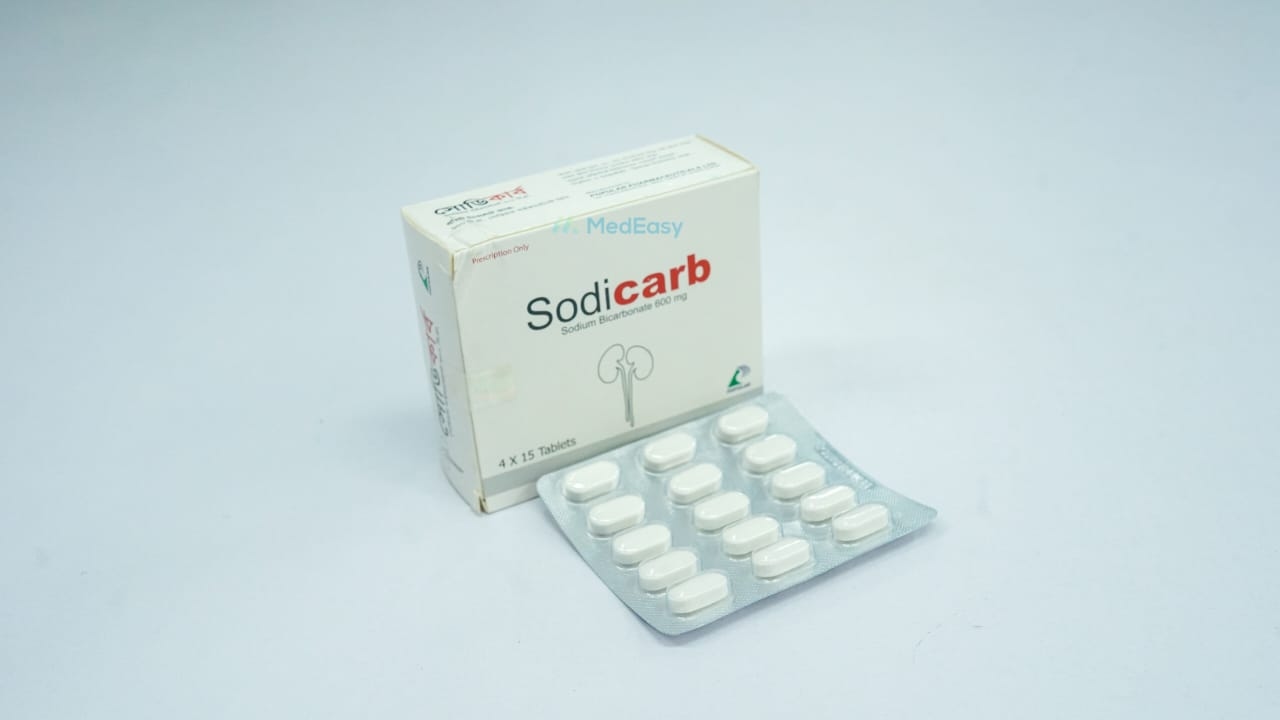
Sodicarb600 mg
Popular Pharmaceuticals Ltd.
৳94.50
Add to cart


Alkalina is indicated for the treatment and prevention of specific acid-base and electrolyte disturbances. Indications are classified below by strength of evidence.
Alkalina is not a first-line treatment for routine diabetic ketoacidosis or most cases of cardiac arrest and should be used only under direct medical supervision when indicated.
Each unit of Sodium Bicarbonate contains Sodium Bicarbonate (NaHCO3) as the sole active ingredient. Sodium Bicarbonate is available in multiple dosage forms, including oral tablets/powder and parenteral (intravenous) injection solutions of varying strengths (e.g., 4.2%, 5%, 7.5%, 8.4%), formulated in water for injection, sometimes with disodium edetate as a stabilizer.
Alkalina is an inorganic alkalinizing salt that dissociates in the body to provide bicarbonate ions, a key component of the blood's buffering system. Alkalina is used medically to correct acidosis, alkalinize urine, and, taken orally, as a short-term antacid for symptomatic relief of excess stomach acid. Alkalina is given orally for antacid and mild alkalinization purposes and intravenously for correction of significant metabolic acidosis and selected emergency indications, always under medical guidance for the parenteral route.
Alkalinizing agent; Antacid; Electrolyte replenisher.
Sodium Bicarbonate dissociates to provide bicarbonate (HCO3-) and sodium (Na+) ions. Bicarbonate is a normal constituent of body fluids and the principal extracellular buffer; it neutralizes excess hydrogen ions, raising blood and urinary pH. When given intravenously, Sodium Bicarbonate rapidly increases plasma bicarbonate concentration and buffers circulating hydrogen ion, raising blood pH and reversing clinical manifestations of acidosis. Taken orally, Sodium Bicarbonate reacts with gastric hydrochloric acid to form sodium chloride, water, and carbon dioxide, transiently neutralizing gastric acidity. Alkalinization of urine with Sodium Bicarbonate increases the ionization and renal clearance of acidic drugs such as salicylates, while decreasing clearance of basic drugs.
| Indication | Typical Adult Dose of Alkalina |
|---|---|
| Severe metabolic acidosis (IV) | Individualized based on arterial blood gas/serum bicarbonate deficit: HCO3- deficit (mEq) = 0.5 x body weight (kg) x (desired HCO3- minus observed HCO3-); typically given as a slow IV infusion of Alkalina with repeat doses guided by serial blood gas monitoring. |
| Cardiac arrest (adjunct, selected situations) | Per current advanced cardiac life support protocols, generally 1 mEq/kg IV, only for specific indications (pre-existing metabolic acidosis, hyperkalemia, tricyclic antidepressant toxicity) and not for routine use. |
| Severe salicylate poisoning (urinary alkalinization) | IV infusion of Alkalina titrated to maintain urinary pH around 7.5-8, with close monitoring of serum electrolytes and pH. |
| Antacid (oral, OTC use) | 0.3-2 g of Alkalina in water, 1-4 times daily after meals and at bedtime; do not exceed the maximum labeled daily dose or use for more than 2 weeks without consulting a physician. |
In neonates and infants, IV Alkalina for severe metabolic acidosis is dosed on the calculated bicarbonate deficit and given as a slow infusion (not a rapid bolus), diluted as appropriate, due to the risk of hypernatremia and intracranial hemorrhage with rapid administration. Oral antacid use of Alkalina in children should only occur under physician direction.
No specific hepatic dose adjustment for Alkalina is established. In renal impairment, Alkalina should be used cautiously with reduced doses and close monitoring, due to risk of sodium/fluid retention and delayed excretion of excess bicarbonate (see Use in Special Populations).
Alkalina injection is for intravenous use only, generally as a slow infusion (or, in emergencies, controlled slow IV push per protocol); rapid administration of Alkalina should be avoided, particularly in neonates and infants, due to the risk of hypernatremia and intracranial hemorrhage. Alkalina should not be mixed with calcium-containing solutions or catecholamines in the same IV line due to incompatibility. Oral Alkalina (tablets or powder dissolved in water) should be taken with a full glass of water, preferably after meals; it should not be taken with, or immediately after, a large meal.
Alkalina can cause clinically significant interactions through alteration of urinary pH and by direct chemical incompatibility.
Sodium Bicarbonate is contraindicated in patients with:
Adverse effects of Alkalina are generally related to sodium and alkali load and are more likely with excessive or prolonged use.
Formal controlled studies of Alkalina in human pregnancy are limited. Alkalina should be used during pregnancy only if clearly needed and if the potential benefit justifies the potential risk to the fetus; consult a physician before use, especially for anything beyond occasional, short-term antacid use. High-dose or prolonged use of Alkalina in pregnancy could theoretically contribute to maternal fluid overload, alkalosis, or excess sodium load. During breastfeeding, occasional standard antacid doses of Alkalina are generally considered acceptable, but a physician should be consulted before regular or high-dose use.
Alkalina should be used with caution in the following situations:
Overdose or excessive use of Alkalina can cause severe metabolic alkalosis, hypokalemia, hypernatremia, hypocalcemia with tetany, muscle twitching, confusion, seizures, and cardiac arrhythmias. If overdose of Alkalina is suspected, seek immediate medical attention or contact emergency services or a poison control center. Management is supportive and typically undertaken in a hospital setting, including correction of fluid and electrolyte imbalances under close monitoring; no specific antidote exists.
Store at room temperature (below 30°C), away from light and moisture. Keep out of reach of children.
Alkalina may be used in infants and children for severe metabolic acidosis under close medical and laboratory supervision; rapid IV administration of Alkalina should be avoided in neonates and young infants due to the risk of hypernatremia and intracranial hemorrhage. Oral antacid use of Alkalina in young children should be under physician direction.
Elderly patients, who more often have age-related decline in renal or cardiac function, should use Alkalina cautiously, with attention to sodium load and monitoring for fluid retention or alkalosis.
Use Alkalina with caution and at reduced doses; monitor closely for sodium/fluid retention and alkalosis.
No specific dose adjustment for Alkalina is established; general precautions for sodium and fluid status apply.
Duration of Alkalina therapy depends on the indication. Intravenous Alkalina for acute metabolic acidosis is continued only until acid-base status is corrected, guided by laboratory monitoring, and under direct medical supervision. Oral antacid use of Alkalina should be limited to short-term, occasional symptom relief (generally no more than 2 weeks) unless a physician directs longer use for a specific chronic condition, such as management of chronic metabolic acidosis in kidney disease.
Alkalinizing agents; Antacids; Electrolyte and acid-base balance agents.
Sodium Bicarbonate acts as a source of bicarbonate ion, the body's principal buffer base, which combines with excess hydrogen ions to neutralize acid and raise pH. Systemically, Sodium Bicarbonate corrects metabolic acidosis; in the stomach, Sodium Bicarbonate neutralizes hydrochloric acid to relieve symptoms of hyperacidity; in the renal tubules, the alkaline urine pH produced by Sodium Bicarbonate alters the ionization and reabsorption of certain drugs, changing their rate of excretion.
C
Alkalina is used in pediatric patients, including neonates, for treatment of severe metabolic acidosis under close medical supervision, with dosing individualized to body weight and calculated bicarbonate deficit. In neonates and infants, slow administration of Alkalina is essential, as rapid IV injection has been associated with hypernatremia, decreased cerebrospinal fluid pressure, and intracranial hemorrhage. Safety and efficacy of routine oral antacid use of Alkalina in young children have not been well established, and such use should only occur under a physician's direction.
Q: What is Alkalina 600 mg Tablet used for?
A: Alkalina 600 mg Tablet is used to correct metabolic acidosis (often given intravenously in a hospital setting), to alkalinize urine in certain poisoning cases, and, when taken orally, as a short-term antacid for heartburn, acid indigestion, and upset stomach.
Q: Can I take Alkalina 600 mg Tablet every day for indigestion?
A: No. Alkalina 600 mg Tablet is intended for short-term or occasional antacid use only, generally not more than 2 weeks, unless a physician directs otherwise. Frequent or prolonged use of Alkalina 600 mg Tablet can cause metabolic alkalosis, sodium overload, and fluid retention, and persistent indigestion should be evaluated by a doctor.
Q: Who should not use Alkalina 600 mg Tablet?
A: Alkalina 600 mg Tablet should not be used by people who are losing chloride from vomiting or continuous stomach suction, those taking diuretics that cause hypochloremic alkalosis, patients with hypocalcemia (since alkalosis from Alkalina 600 mg Tablet can trigger tetany), and patients who already have metabolic or respiratory alkalosis.
Q: Is Alkalina 600 mg Tablet safe during pregnancy and breastfeeding?
A: Alkalina 600 mg Tablet should be used in pregnancy only if clearly needed, with a physician's guidance, as controlled studies are limited. During breastfeeding, occasional standard antacid doses of Alkalina 600 mg Tablet are generally considered acceptable, but regular or high-dose use should be discussed with a doctor first.
Q: What happens if I take too much Alkalina 600 mg Tablet?
A: Taking too much Alkalina 600 mg Tablet can cause metabolic alkalosis, low potassium, high sodium levels, muscle twitching, confusion, seizures, or abnormal heart rhythm. If an overdose of Alkalina 600 mg Tablet is suspected, seek immediate medical attention or contact a poison control center.
Q: Can Alkalina 600 mg Tablet be given intravenously at home?
A: No. Intravenous Alkalina 600 mg Tablet is administered only in a hospital or clinical setting by trained healthcare professionals, with careful monitoring of blood gases and electrolytes; it is not for home use.
Disclaimer
The information provided is accurate to the best of our knowledge, but it does not replace professional medical advice. We cannot guarantee its completeness or accuracy, and the absence of specific information about a drug should not be taken as an endorsement. We are not responsible for any consequences arising from this information, so please consult a healthcare professional for any concerns or questions.