

10% Off
Quinolex250 mg
Globe Pharmaceuticals Ltd.
৳0.90
Add to cart
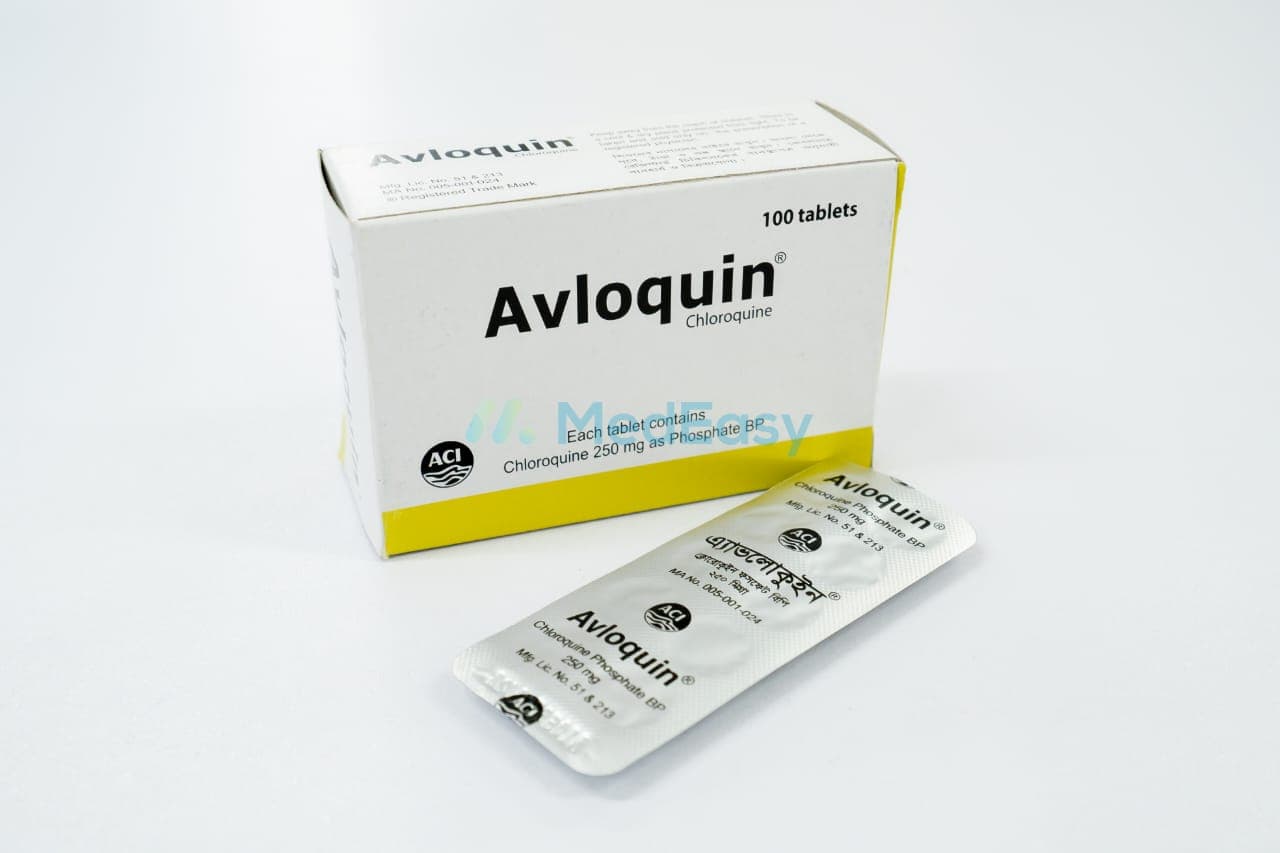

Avloquin is indicated for the following uses:
Avloquin is not effective against chloroquine-resistant strains of malaria and should not be relied upon in regions where resistance is documented; a physician should confirm local resistance patterns before prescribing.
Each tablet of Chloroquine Phosphate typically contains chloroquine phosphate equivalent to a specific amount of chloroquine base (e.g., 250 mg chloroquine phosphate is approximately equal to 150 mg base; 500 mg chloroquine phosphate is approximately equal to 300 mg base). Oral liquid/syrup formulations of Chloroquine Phosphate are also available in some markets, typically expressed as base-equivalent strength per 5 mL. Exact strength and excipients vary by manufacturer and formulation; refer to the specific product label for details.
Avloquin is the phosphate salt of chloroquine, a synthetic 4-aminoquinoline compound with antimalarial and amebicidal activity. It has been used clinically since the mid-20th century and remains an option for malaria caused by chloroquine-sensitive parasite strains, as well as an adjunct treatment for extraintestinal amebiasis. It is administered orally and is available as tablets and, in some markets, oral suspension/syrup.
Avloquin belongs to the antimalarial drug class, specifically the 4-aminoquinoline group of agents. It also possesses amebicidal properties and has been used, off-label, in the management of certain autoimmune conditions.
Chloroquine Phosphate acts against the erythrocytic (blood) stages of susceptible Plasmodium species. Within the parasite's digestive vacuole, Chloroquine Phosphate concentrates and interferes with the parasite's ability to detoxify heme released during hemoglobin digestion, allowing toxic heme complexes to accumulate and damage the parasite. It does not eliminate hepatic (liver-stage) forms of P. vivax or P. ovale (hypnozoites), so a separate agent such as primaquine is needed to prevent relapse. Against Entamoeba histolytica, Chloroquine Phosphate concentrates in the liver and is amebicidal against the trophozoite form, which explains its usefulness in extraintestinal (hepatic) amebiasis. Following oral administration, Chloroquine Phosphate is rapidly and almost completely absorbed from the gastrointestinal tract, is extensively distributed into tissues, is partly metabolized in the liver, and is slowly eliminated (elimination half-life may extend to several weeks), largely via renal excretion.
Dosage of Avloquin is expressed below as the phosphate salt, with the chloroquine base equivalent noted in parentheses; always confirm strength with the specific product label.
| Indication | Dosage |
|---|---|
| Treatment of acute malaria | 1 g (600 mg base) as an initial dose, followed by 500 mg (300 mg base) at 6 hours, 24 hours, and 48 hours after the first dose (total 2.5 g phosphate / 1.5 g base over 3 days) |
| Malaria prophylaxis | 500 mg (300 mg base) once weekly on the same day each week, starting 1–2 weeks before entering an endemic area and continuing for 4 weeks after leaving |
| Extraintestinal amebiasis (with an intestinal amebicide) | 1 g (600 mg base) daily for 2 days, then 500 mg (300 mg base) daily for at least 2–3 weeks |
| Indication | Dosage |
|---|---|
| Treatment of acute malaria | 10 mg base/kg (maximum 600 mg base) initially, then 5 mg base/kg at 6, 24, and 48 hours after the first dose |
| Malaria prophylaxis | 5 mg base/kg once weekly (maximum 300 mg base), starting 1–2 weeks before and continuing 4 weeks after travel to an endemic area |
Pediatric dosing must always be calculated on a mg/kg basis by a physician; the pediatric dose of Avloquin should never exceed the corresponding adult dose. Because Avloquin has a narrow margin between therapeutic and fatal doses, especially in children, dosage must be measured and administered with extreme care.
Avloquin should be used with caution and may require dose adjustment or closer monitoring in patients with significant renal or hepatic impairment, as elimination may be reduced; consult a physician for individualized dosing.
Avloquin should be taken orally with food or milk to reduce gastrointestinal upset, at the same time each day/week as prescribed. Doses of antacids or kaolin-containing products should be separated from Avloquin by at least 4 hours (see Interaction).
Avloquin is for oral use only. Tablets should be swallowed with food or a full glass of water/milk to minimize stomach upset; the oral liquid formulation, where available, should be measured with an accurate dosing device. Do not take antacids at the same time as Avloquin; separate dosing by at least 4 hours.
Avloquin has several clinically significant drug interactions:
Always inform your physician or pharmacist of all medicines, supplements, and herbal products being taken before starting Avloquin.
Chloroquine Phosphate is contraindicated in:
Common side effects of Avloquin include:
Serious but less common effects include:
Seek medical attention promptly for visual changes, palpitations, fainting, unusual bleeding/bruising, or signs of infection while taking Avloquin.
Pregnancy: Avloquin should be used during pregnancy only if clearly needed and if the potential benefit justifies the potential risk to the fetus. For the treatment and prevention of malaria specifically, the benefit of Avloquin generally outweighs the risk, because malaria itself poses substantial risk to both mother and fetus; however, use should always be guided by a physician. Data on use for other (e.g., autoimmune) indications in pregnancy are more limited, and such use should be individualized.
Lactation: Avloquin passes into breast milk in small amounts. It is generally considered acceptable for malaria prophylaxis/treatment in breastfeeding women under medical supervision, but a nursing infant should still be monitored, and a physician should be consulted before use.
Avloquin carries several important warnings:
Avloquin overdose is a recognized medical emergency and a well-documented cause of serious and potentially fatal poisoning — a single tablet can be fatal to a young child. Symptoms of overdose can develop rapidly (within 1–3 hours) and may include headache, drowsiness, visual disturbances, nausea and vomiting, cardiovascular collapse (hypotension, life-threatening arrhythmias), seizures, and respiratory/cardiac arrest.
If overdose of Avloquin is suspected, seek emergency medical attention or contact a poison control center immediately — do not wait for symptoms to appear. There is no specific antidote widely available; treatment is supportive and requires close monitoring in a hospital/emergency setting, potentially including gastric decontamination, cardiac monitoring, and management of arrhythmias and seizures, all under direct medical supervision. Do not attempt home treatment.
Store Avloquin at room temperature (below 30°C), away from light and moisture. Keep Avloquin strictly out of the reach and sight of children — accidental ingestion of even a small number of tablets can be fatal to a child.
Renal impairment: Use Avloquin with caution; dose adjustment or closer monitoring may be needed as elimination can be reduced.
Hepatic impairment: Use Avloquin with caution in patients with significant liver disease or in combination with other hepatotoxic drugs.
Elderly: Older adults may be more susceptible to the cardiac and neuromuscular effects of Avloquin; use with caution and monitor closely.
G6PD deficiency: Risk of hemolysis; use with caution and monitor (see Precautions and Warnings).
Children: Weight-based (mg/kg) dosing is required; children are especially vulnerable to fatal overdose with Avloquin, so dosing and storage require extreme care (see Dosage and Administration, Overdose Effects, and Storage Conditions).
Duration of Avloquin therapy depends on the indication: malaria treatment courses typically last 3 days; malaria prophylaxis continues weekly throughout exposure and for 4 weeks after leaving an endemic area; extraintestinal amebiasis treatment typically continues for at least 2–3 weeks in combination with an intestinal amebicide. For off-label autoimmune indications, duration is determined by the prescribing physician based on response and tolerability. Do not extend or shorten the prescribed course of Avloquin without medical advice.
Chloroquine Phosphate is classified as an antimalarial agent of the 4-aminoquinoline chemical class, with additional amebicidal activity.
Chloroquine Phosphate concentrates within the acidic digestive vacuole of intraerythrocytic malaria parasites, where it interferes with the parasite's ability to detoxify heme generated from hemoglobin breakdown. Accumulation of toxic heme complexes damages parasite membranes and metabolism, leading to parasite death. Against Entamoeba histolytica, Chloroquine Phosphate concentrates in hepatic tissue and exerts amebicidal activity against trophozoites, which underlies its use in extraintestinal (hepatic) amebiasis.
C
Avloquin is used in children for the treatment and prevention of malaria caused by susceptible Plasmodium species, with dosing calculated on a milligrams-per-kilogram (base-equivalent) basis and never exceeding the adult dose. Safety and efficacy of Avloquin for indications other than malaria and extraintestinal amebiasis have not been established in children. Because children are especially susceptible to fatal overdose from even small amounts of Avloquin, doses must be measured precisely by a caregiver or healthcare professional, and the medicine must be stored strictly out of children's reach.
Q: What is Avloquin 250 mg Tablet used for?
A: Avloquin 250 mg Tablet is primarily used to treat and prevent malaria caused by chloroquine-sensitive strains of Plasmodium parasites, and as an adjunct treatment for extraintestinal (liver) amebiasis together with an intestinal amebicide.
Q: Can Avloquin 250 mg Tablet be taken during pregnancy?
A: Avloquin 250 mg Tablet should be used in pregnancy only if clearly needed and if the potential benefit outweighs potential risk to the fetus. For malaria treatment or prevention, benefits generally outweigh risks because untreated malaria itself poses serious danger to mother and baby, but a physician should always guide use.
Q: What are the serious risks of Avloquin 250 mg Tablet?
A: With long-term or high-dose use, Avloquin 250 mg Tablet can cause irreversible retinal damage (retinopathy) and, less commonly, heart problems including QT-interval prolongation and cardiomyopathy. Regular eye examinations and medical monitoring are recommended for extended therapy.
Q: Is Avloquin 250 mg Tablet dangerous in overdose, especially for children?
A: Yes. Avloquin 250 mg Tablet has a narrow margin between an effective dose and a fatal one; even a single tablet can be fatal to a young child. Overdose is a medical emergency — seek immediate emergency care or contact poison control, and always store this medicine safely out of children's reach.
Q: Can I take antacids with Avloquin 250 mg Tablet?
A: Antacids and kaolin-containing products reduce the absorption of Avloquin 250 mg Tablet. If you need an antacid, separate it from your Avloquin 250 mg Tablet dose by at least 4 hours, and discuss the timing with your physician or pharmacist.
Q: Who should not take Avloquin 250 mg Tablet?
A: Avloquin 250 mg Tablet should not be taken by people with known hypersensitivity to chloroquine or related 4-aminoquinoline drugs, those with pre-existing retinal/visual field changes from 4-aminoquinoline use, or those with psoriasis, as it can trigger a severe flare.
Disclaimer
The information provided is accurate to the best of our knowledge, but it does not replace professional medical advice. We cannot guarantee its completeness or accuracy, and the absence of specific information about a drug should not be taken as an endorsement. We are not responsible for any consequences arising from this information, so please consult a healthcare professional for any concerns or questions.
