8% Off
Betameson-N15 gm
Square Pharmaceuticals PLC.
৳32.20
Add to cart
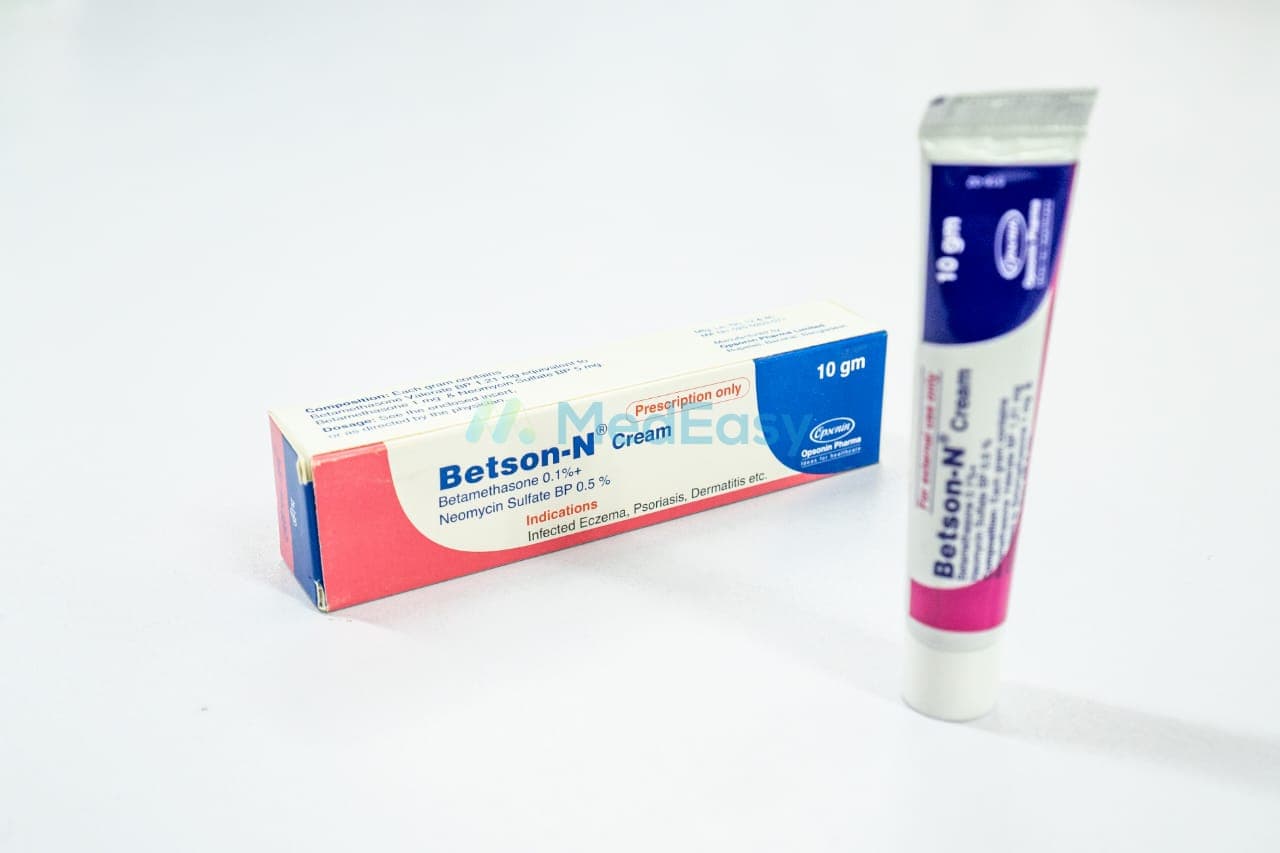
Betson-N 15 gm Cream is available on MedEasy for ৳31.50 per 15 gm tube, with home delivery anywhere in Bangladesh. It is manufactured by Opsonin Pharma Ltd. Its generic name is Betamethasone + Neomycin Sulphate.

Betson-N is a topical corticosteroid-antibiotic combination indicated for the treatment of steroid-responsive inflammatory dermatoses that are infected or likely to be infected by neomycin-susceptible bacteria (e.g. Staphylococcus aureus, Proteus species, and other gram-positive and gram-negative organisms).
Betson-N is not appropriate for primary bacterial, viral (e.g. herpes simplex, varicella), or primary fungal skin infections that are not being treated with an appropriate concurrent antimicrobial, and is not a substitute for definitive treatment of extensive or systemic infection.
Each gram of cream/ointment typically contains Betamethasone (as valerate or dipropionate) 0.05%-0.1% and Neomycin Sulphate 0.5% (equivalent to neomycin base), in a suitable cream or ointment base. Strength and exact ester of betamethasone may vary by brand; refer to the specific product label.
Betson-N is a fixed-dose topical combination of a potent synthetic corticosteroid (betamethasone) and a broad-spectrum aminoglycoside antibiotic (neomycin sulphate). It is formulated as a cream or ointment for dermatological use, and combines anti-inflammatory, antipruritic, and antibacterial actions to treat inflamed skin conditions that are infected or at risk of secondary bacterial infection.
Betson-N belongs to the therapeutic class of topical corticosteroids combined with topical antibiotics, used in dermatological and otological practice.
Betamethasone + Neomycin Sulphate combines two complementary mechanisms of action:
Topical absorption of both components is normally low through intact skin, but increases significantly with application to broken or denuded skin, use under occlusion, application over large body surface areas, or in infants and young children, raising the risk of systemic corticosteroid and aminoglycoside effects.
| Population/Indication | Dosing |
|---|---|
| Adults and adolescents - infected dermatoses | Apply a thin film to the affected area 1-2 times daily (up to 3-4 times daily for short periods if directed by a physician). Gently rub in. Use the smallest amount that adequately covers the affected area. |
| Duration | Treatment is generally limited to a short course (commonly up to 7 days); do not continue beyond the period advised by the physician without re-evaluation. |
| Children | Use only under close medical supervision, with the least potent effective regimen and for the shortest duration; see Use in Special Populations. |
| Otitis externa (ear preparations) | Only as directed by a physician, and only if the tympanic membrane is intact; not to be used with a perforated eardrum. |
Apply Betson-N only to the areas of skin that are inflamed and infected, exactly as prescribed. Wash hands after application unless the hands are the treated area. Do not use with occlusive dressings unless specifically instructed by a physician, as this increases systemic absorption.
For external/topical use only. Clean and dry the affected area before application (unless otherwise directed). Apply a thin film and gently massage in. Avoid contact with the eyes, mouth, and mucous membranes. Do not apply to broken skin, wounds, or ulcers unless specifically directed by a physician, and do not cover with airtight (occlusive) dressings unless instructed.
Betson-N has few clinically significant interactions when used topically as directed, because systemic absorption is normally minimal. However:
These interactions are of greatest concern when Betson-N is applied over large areas, under occlusion, or on broken skin for prolonged periods; inform your physician about all other medicines you are using.
Betamethasone + Neomycin Sulphate is contraindicated in:
When used as directed for short periods on limited skin areas, Betson-N is generally well tolerated. Reported adverse effects include:
Pregnancy: There is limited controlled data on topical Betson-N use in human pregnancy. Topical corticosteroids have been associated with fetal growth restriction in some studies when used extensively, and neomycin crosses the placenta. Betson-N should be used in pregnancy only if clearly needed and the potential benefit justifies the potential risk to the fetus; use the smallest effective amount for the shortest duration and consult a physician before use.
Lactation: It is not known whether topically applied betamethasone or neomycin are excreted in clinically significant amounts in breast milk. Caution is advised; avoid application to the breast/nipple area before breastfeeding, and consult a physician before use while breastfeeding.
Observe the following precautions when using Betson-N:
Topical overdose or misuse (excessive quantity, prolonged duration, or use over large/occluded areas) of Betson-N can lead to systemic corticosteroid effects (e.g. Cushingoid features, HPA-axis suppression) and, rarely, neomycin-related ototoxicity or nephrotoxicity. If accidental ingestion occurs or excessive/prolonged application is suspected, discontinue use and seek immediate medical attention or contact a poison control center/emergency services; do not attempt specific home treatment. A physician may advise gradual tapering of corticosteroid use and monitoring of hearing and renal function if significant systemic absorption is suspected.
Store at room temperature (below 30°C), away from light and moisture. Do not freeze. Keep the container tightly closed and out of the reach of children.
Children: Betson-N should be used with caution in children, at the lowest effective strength/amount and for the shortest duration necessary, under medical supervision, due to a greater risk of HPA-axis suppression and neomycin absorption from a proportionally larger skin-surface-to-body-weight ratio. Use in infants (particularly under 1-2 years of age) is generally not recommended unless specifically directed by a physician; avoid use with occlusive dressings (including tight-fitting diapers/nappies acting as occlusion) in this age group.
Elderly: Use the minimum effective quantity for the shortest duration, as elderly patients may have thinner skin that is more susceptible to atrophy and increased absorption.
Renal impairment: Use with caution; reduced renal clearance of any absorbed neomycin may increase the risk of accumulation and nephrotoxicity/ototoxicity with extensive or prolonged use.
Hepatic impairment: No specific dosage adjustment is established for topical use; use as directed by a physician.
Treatment with Betson-N should generally be limited to short courses (commonly up to 7 days, or as directed by the prescribing physician) and re-evaluated if there is no improvement. Prolonged, uninterrupted use beyond the recommended duration should be avoided due to the increased risk of skin atrophy, HPA-axis suppression, and contact sensitization.
Topical corticosteroid (betamethasone) combined with a topical aminoglycoside antibiotic (neomycin sulphate).
Betamethasone suppresses inflammation by binding glucocorticoid receptors and downregulating inflammatory mediators, reducing redness, swelling, and itching. Neomycin sulphate acts as a bactericidal antibiotic by binding the bacterial 30S ribosomal subunit and disrupting protein synthesis, eliminating susceptible bacteria contributing to secondary skin infection.
Betson-N may be used in children only under close medical supervision. Safety and efficacy for prolonged or unsupervised use in infants and young children have not been established, and use in infants below 1-2 years of age is generally not recommended except on specific physician advice. Because children have a larger skin-surface-area-to-body-weight ratio, they are at greater risk of systemic corticosteroid absorption (HPA-axis suppression, growth effects with long-term use) and of neomycin-related toxicity. The lowest effective strength, smallest amount, and shortest duration should be used, and occlusive dressings (including tight diapers) should be avoided.
Q: What is Betson-N 15 gm Cream used for?
A: Betson-N 15 gm Cream is a topical cream/ointment used to treat inflamed skin conditions (such as eczema, dermatitis, or otitis externa) that are infected or likely to be infected by susceptible bacteria. It combines a corticosteroid to reduce inflammation and itching with an antibiotic to treat the bacterial infection.
Q: How long can I use Betson-N 15 gm Cream?
A: Treatment is usually limited to a short course, commonly up to about 7 days, or as directed by your physician. Do not use it continuously for a longer period without medical review, as prolonged use increases the risk of skin thinning, adrenal suppression, and allergic contact sensitization.
Q: Can I use Betson-N 15 gm Cream on my face or in skin folds?
A: Use on the face, groin, and skin folds should be limited and only as directed by a physician, because these areas are more prone to steroid-related skin thinning and striae with prolonged use.
Q: Is Betson-N 15 gm Cream safe during pregnancy or breastfeeding?
A: Betson-N 15 gm Cream should be used in pregnancy only if clearly needed and the potential benefit justifies the potential risk to the fetus, using the smallest effective amount for the shortest time; consult your physician before use. During breastfeeding, avoid applying it to the breast/nipple area and consult your physician first.
Q: What should I do if my rash gets worse while using this medicine?
A: If the treated area becomes more red, itchy, or a new rash appears, this could be an allergic contact reaction to neomycin. Stop using Betson-N 15 gm Cream and consult your physician promptly.
Q: Can I use this medicine for a fungal or viral skin infection?
A: No. Betson-N 15 gm Cream should not be used on primary viral infections (such as herpes or chickenpox), fungal skin infections, or untreated bacterial infections, as the corticosteroid component can worsen these conditions by suppressing the local immune response.
Disclaimer
The information provided is accurate to the best of our knowledge, but it does not replace professional medical advice. We cannot guarantee its completeness or accuracy, and the absence of specific information about a drug should not be taken as an endorsement. We are not responsible for any consequences arising from this information, so please consult a healthcare professional for any concerns or questions.