

8% Off
Salitic15 ml
Ziska Pharmaceuticals Ltd.
৳230.00
Add to cart
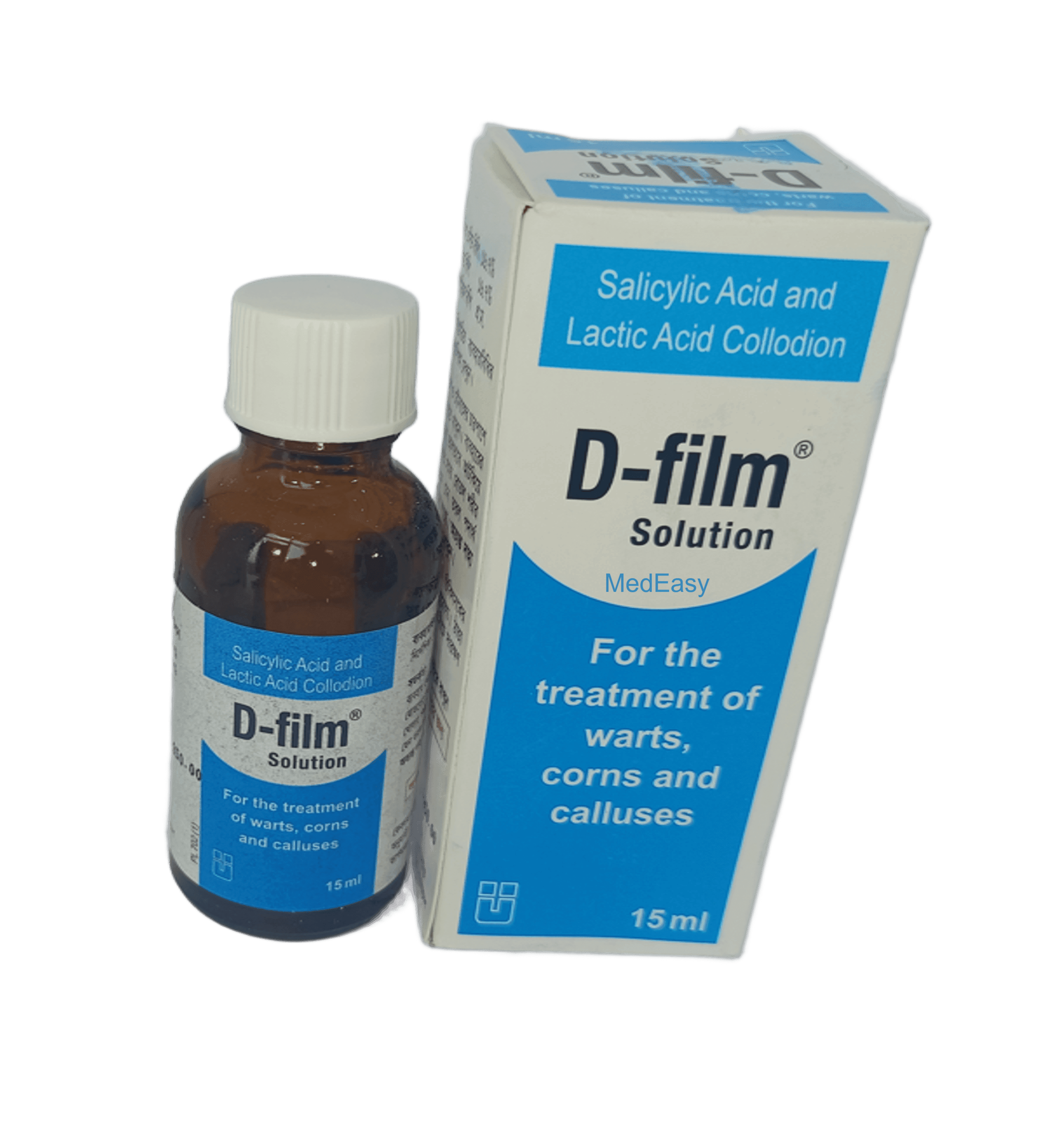

D-film topical solution (collodion-based) is indicated for the removal of common warts, plantar (foot) warts, corns, and calluses. This is an established, widely marketed over-the-counter and prescription topical keratolytic combination.
D-film is not indicated for facial warts, genital/anogenital warts, warts on mucous membranes, or moles and other skin lesions that have not been evaluated by a physician.
Each application of Salicylic Acid + Lactic Acid topical solution typically contains Salicylic Acid and Lactic Acid in equal strengths (commonly around 16.7% + 16.7% w/w, though local brand strengths may vary), formulated in a flexible collodion base (a film-forming vehicle containing agents such as pyroxylin, ethanol, and ether/isopropyl alcohol) that dries to form a protective, occlusive film over the treated lesion.
D-film is a topical keratolytic combination used to treat warts, corns, and calluses. Salicylic acid softens and dissolves the intercellular cement holding thickened, keratinized skin cells together, while lactic acid adds a complementary keratolytic and mild caustic action that helps destroy the abnormal epidermal tissue of the wart. The collodion vehicle forms an adherent film on drying, which keeps the medication in contact with the lesion, protects it, and enhances penetration into the hyperkeratotic tissue. With regular, correctly localized application, the treated wart or corn gradually softens, whitens, and can be pared away over several weeks.
D-film belongs to the therapeutic class of topical keratolytics / wart and callus removers, used exclusively for external dermatological application.
Salicylic Acid + Lactic Acid acts through a combined keratolytic mechanism. Salicylic acid lowers the pH of the stratum corneum and dissolves the intercellular cementing substance (desmosomal and lipid matrix) between keratinocytes, causing the outer, thickened layer of skin to soften, swell, and eventually slough off. Lactic acid contributes an additional mild keratolytic and locally caustic/exfoliative effect, helping to break down the abnormal keratin of the wart or callus and accelerating tissue shedding. Because both agents are applied within a flexible collodion film, the vehicle occludes the lesion, increases hydration of the stratum corneum, and enhances penetration of the active ingredients specifically into the treated area, while protecting adjacent normal skin from prolonged exposure when used as directed.
D-film is for external, topical use only and should be applied only to the wart, corn, or callus, avoiding surrounding healthy skin.
| Indication | Directions |
|---|---|
| Common/plantar warts | Soak the affected area in warm water for about 5 minutes, gently rub with a pumice stone or emery board to remove loose surface tissue, and dry thoroughly. Using the brush applicator, apply D-film directly onto the wart only, once daily (or as directed), allow to dry fully, and cover with an adhesive plaster if needed. Repeat daily for up to 6-12 weeks, re-assessing the lesion regularly. |
| Corns and calluses | Soak and pare down loose thickened skin as above, then apply a small amount of D-film to the corn or callus once daily, protecting surrounding normal skin (e.g., with petroleum jelly or a corn pad) and allowing the solution to dry completely before covering. |
If no improvement occurs after 12 weeks of consistent use, or if the lesion worsens, application should be stopped and a physician consulted.
D-film is for topical (external) use only - never oral, ophthalmic, or mucosal use. Wash hands before and after application, apply only to the lesion itself using the applicator, avoid contact with surrounding normal skin, eyes, and mucous membranes, and allow the solution to dry fully before dressing or covering the area.
No clinically significant systemic drug interactions have been established for D-film when used topically as directed, because systemic absorption from small, localized application is minimal. However, concurrent use of other topical products (e.g., other keratolytics, retinoids, or irritant skin preparations) on the same area may increase local irritation or absorption and should be avoided unless directed by a physician. Application over very large body surface areas, on broken skin, or under tight occlusion may increase salicylate absorption and should be avoided, particularly in patients also taking other salicylates.
Salicylic Acid + Lactic Acid is contraindicated in the following situations:
When applied correctly to the intended lesion, D-film is generally well tolerated. Reported adverse effects are mostly local and include:
Excessive or widespread application, especially on broken or extensive skin areas, may lead to systemic salicylate absorption and toxicity (salicylism) - see Overdose Effects.
Data on the use of D-film during pregnancy and lactation are limited, since systemic absorption from topical use on small, localized lesions is expected to be minimal. As a precaution, D-film should be used during pregnancy and breastfeeding only if clearly needed, over the smallest area and for the shortest duration necessary, and only after consulting a physician, given that salicylates are known to cross the placenta and be excreted in breast milk when absorbed systemically in larger amounts.
For external use only. Avoid contact with the eyes, lips, mucous membranes, and healthy surrounding skin when applying D-film; if accidental contact occurs, flush thoroughly with water. Protect normal skin around the lesion (for example with petroleum jelly) before treatment. Do not apply to large areas of skin or use for prolonged periods beyond the recommended course, as excessive use increases the risk of systemic salicylate absorption and toxicity, particularly in children and in patients with impaired renal function. D-film should not be used on children or teenagers who have or are recovering from chickenpox or influenza-like illness, because of a theoretical association between salicylate exposure and Reye's syndrome, even though topical absorption is much lower than with oral salicylates. The product is flammable while wet (collodion base); keep away from open flame or heat until fully dry. Discontinue use and consult a physician if excessive irritation, infection, or spreading redness develops.
Overdose of D-film is uncommon with correct topical use but can occur with application to large areas, prolonged/excessive use, or accidental ingestion. Signs of systemic salicylate toxicity (salicylism) include ringing in the ears (tinnitus), nausea, vomiting, dizziness, rapid breathing, confusion, or drowsiness. If accidental ingestion occurs, or if signs of systemic toxicity develop after topical use, seek immediate medical attention or contact a poison control center; do not attempt specific home treatment. If the product contacts the eyes, rinse thoroughly with water for several minutes and seek medical advice.
Store at room temperature (below 30°C), away from light, heat, and open flame (the collodion base is flammable). Keep the container tightly closed to prevent evaporation, and keep out of reach of children.
Diabetic patients and those with poor circulation: D-film should not be used on the feet without direct medical supervision due to increased risk of skin breakdown, ulceration, and delayed wound healing.
Renal impairment: use with caution and limit the treated area, since reduced renal clearance may increase the risk of systemic salicylate accumulation if significant absorption occurs.
Elderly patients: generally safe when used as directed on localized lesions, but skin is often thinner and more prone to irritation and ulceration, so smaller areas and closer monitoring are advised.
Treatment with D-film is typically continued once daily for up to 6 to 12 weeks, depending on the size and location of the wart, corn, or callus. The lesion should be reassessed periodically; if it has not resolved after 12 weeks of consistent use, or if it worsens at any point, treatment should be stopped and a physician consulted.
Topical keratolytic / wart and callus remover (dermatological)
Salicylic Acid + Lactic Acid works by softening and dissolving the keratin protein that binds thickened skin cells together, causing the outer hyperkeratotic layer to swell and separate. Salicylic acid provides the primary keratolytic effect by disrupting corneocyte cohesion, while lactic acid supplements this with additional exfoliative and mildly caustic activity against the abnormal tissue of the wart, corn, or callus. The flexible collodion vehicle forms a film that keeps both active ingredients concentrated on the lesion and enhances their penetration, allowing progressive removal of the affected tissue with repeated application.
Use of D-film in children should be limited to small, localized areas under adult supervision, as children are at greater risk of systemic salicylate absorption relative to their body surface area. D-film should not be used in children or teenagers currently having or recovering from chickenpox or flu-like symptoms due to a theoretical link between salicylate exposure and Reye's syndrome. Safety and efficacy of D-film in infants and very young children have not been well established, and use in this age group should only occur on the advice of a physician.
Q: What is D-film 15 ml Topical Solution used for?
A: D-film 15 ml Topical Solution is a topical solution used to remove common warts, plantar (foot) warts, corns, and calluses by softening and gradually breaking down the thickened, keratinized skin of the lesion.
Q: How should I apply D-film 15 ml Topical Solution correctly?
A: Soak the area in warm water for about 5 minutes, gently file away loose dead skin, dry completely, then apply D-film 15 ml Topical Solution only to the wart or corn using the applicator brush, avoiding healthy surrounding skin, and let it dry fully before covering. This is usually repeated once daily for 6-12 weeks.
Q: Can I use D-film 15 ml Topical Solution if I have diabetes?
A: No. D-film 15 ml Topical Solution should not be used on the feet of people with diabetes or poor blood circulation without direct medical supervision, because it can cause skin ulceration or slow-healing wounds in these patients.
Q: Is D-film 15 ml Topical Solution safe to use during pregnancy?
A: Data are limited. D-film 15 ml Topical Solution should be used during pregnancy or breastfeeding only if clearly needed and only after consulting a physician, applying it to the smallest area possible for the shortest necessary time.
Q: What if D-film 15 ml Topical Solution gets in my eyes or is swallowed?
A: If it contacts the eyes, rinse thoroughly with water and seek medical advice. If accidentally swallowed, or if symptoms such as ringing in the ears, nausea, dizziness, or rapid breathing occur after use, seek immediate medical attention or contact a poison control center.
Q: Can children use D-film 15 ml Topical Solution?
A: D-film 15 ml Topical Solution should only be used in children under adult supervision on small areas, and must not be used in children or teenagers who have chickenpox or flu-like illness because of a theoretical risk of Reye's syndrome with salicylate exposure.
Disclaimer
The information provided is accurate to the best of our knowledge, but it does not replace professional medical advice. We cannot guarantee its completeness or accuracy, and the absence of specific information about a drug should not be taken as an endorsement. We are not responsible for any consequences arising from this information, so please consult a healthcare professional for any concerns or questions.
