10% Off
Ivaprex5 mg
Incepta Pharmaceuticals Ltd.
৳225.00
Add to cart
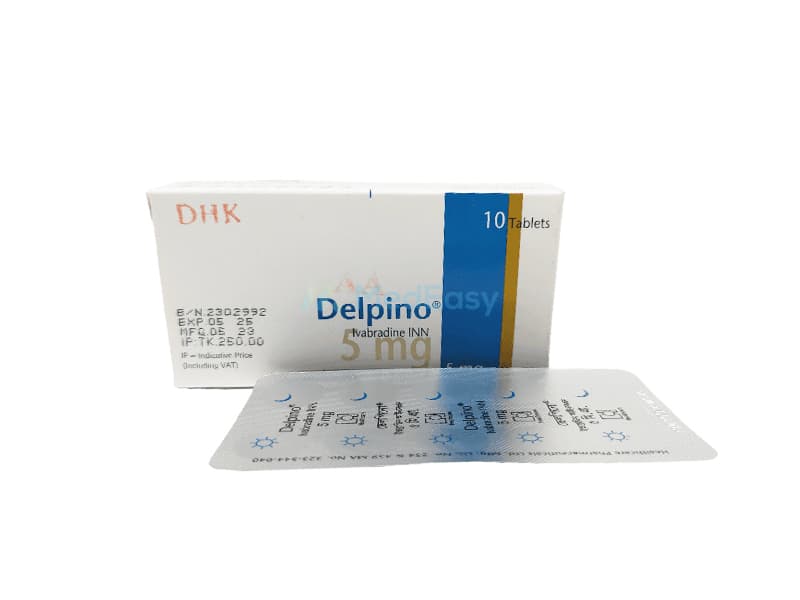

Note: Delpino must always be used as an adjunct to, not a replacement for, guideline-directed therapy such as beta-blockers, ACE inhibitors/ARBs/ARNI, mineralocorticoid receptor antagonists, and SGLT2 inhibitors in heart failure.
Each film-coated tablet of Ivabradine contains Ivabradine (as hydrochloride) equivalent to 5 mg or 7.5 mg of Ivabradine base. In some markets, Ivabradine is also available as an oral solution containing 5 mg/5 mL of Ivabradine, intended primarily for pediatric dosing where precise weight-based titration is required.
Delpino is a selective and specific sinoatrial (SA) node If (funny current) channel inhibitor. It is a heart-rate–lowering agent that acts purely on cardiac pacemaker activity, without affecting myocardial contractility, blood pressure, or intracardiac conduction to any clinically relevant extent at therapeutic doses. Delpino is used long-term in selected patients with chronic heart failure with reduced ejection fraction and, in some markets, as adjunctive therapy for chronic stable angina.
Cardiac Selective Sinoatrial (SA) Node If-Channel Inhibitor (Heart-Rate Lowering Agent); Antianginal / Anti-ischemic Agent
Ivabradine selectively and specifically inhibits the cardiac pacemaker If current that controls the spontaneous diastolic depolarization in the sinoatrial node, thereby regulating heart rate. The If current is a mixed Na+/K+ inward current activated by hyperpolarization at the end of an action potential and modulated by the autonomic nervous system. By blocking this current in a dose-dependent manner, Ivabradine slows the pacemaker activity of the SA node and reduces heart rate, without affecting intracardiac conduction, myocardial contractility, or ventricular repolarization at recommended doses.
| Step | Dose |
|---|---|
| Usual starting dose | 5 mg twice daily with food |
| Starting dose (patients with conduction defects or otherwise vulnerable to excessive heart-rate lowering, e.g. age >75) | 2.5 mg twice daily with food |
| Titration | After 2 weeks, adjust based on resting heart rate to target a resting heart rate between 50–60 beats per minute |
| Maximum dose | 7.5 mg twice daily |
| If heart rate is persistently below 50 bpm or symptoms of bradycardia occur | Down-titrate or discontinue as directed by the physician |
Usual starting dose 5 mg twice daily, titrated after 3–4 weeks based on response and tolerability, up to a maximum of 7.5 mg twice daily, guided by resting heart rate and anginal symptoms.
| Body weight | Starting dose | Maximum dose |
|---|---|---|
| < 40 kg | 0.05 mg/kg twice daily with food | Up to 0.2 mg/kg twice daily (age 6–12 months) or 0.3 mg/kg twice daily (age ≥1 year), not exceeding 7.5 mg twice daily |
| ≥ 40 kg | 2.5 mg twice daily with food | 7.5 mg twice daily |
In pediatric patients, dose is titrated approximately every 2 weeks in increments guided by heart-rate response, under close physician supervision.
If a dose of Delpino is missed, the next dose should be taken at the usual scheduled time; patients should not double the dose to make up for a missed one.
Delpino should be taken orally, twice daily, with food (morning and evening meals), as food increases bioavailability and reduces variability in absorption. Tablets should be swallowed whole with water. The oral solution formulation (where available) should be measured precisely using the provided dosing device, especially for pediatric weight-based dosing. Grapefruit juice should be avoided as it can increase Delpino blood levels.
Delpino should not be used during pregnancy unless clearly necessary, as animal studies have shown embryo-fetal toxicity and cardiac teratogenic effects at exposures close to those used therapeutically in humans, and there is limited data on use in pregnant women. Women of reproductive potential should use effective contraception during treatment with Delpino. If pregnancy occurs or is planned, Delpino should be discontinued and the physician consulted promptly to weigh potential fetal risk against maternal benefit.
It is not known whether Delpino passes into human breast milk in clinically relevant amounts, but animal data show transfer into milk at concentrations higher than plasma. Breastfeeding is generally not recommended during treatment with Delpino; a physician should be consulted to decide between discontinuing breastfeeding or discontinuing therapy, considering the benefit of the drug to the mother.
Overdose with Delpino may cause severe and prolonged bradycardia, along with possible hypotension, headache, or dizziness. Any suspected overdose of Delpino requires immediate medical attention — contact emergency services or a poison control center right away. In a hospital setting, severe bradycardia with poor hemodynamic tolerance may require supportive care, including intravenous fluids, and, if needed, temporary cardiac pacing or beta-agonist support under close cardiac monitoring; there is no specific antidote. Do not attempt to manage a suspected overdose of Delpino at home.
Store at room temperature (below 30°C), away from light and moisture. Keep out of reach of children. Do not use after the expiry date printed on the pack.
In chronic heart failure, Delpino is generally intended for long-term, continuous use alongside standard heart failure therapy, for as long as the underlying condition and heart-rate criteria persist and benefit is maintained, as determined by the treating physician. In chronic stable angina, treatment duration is likewise long-term and individualized based on symptom control and tolerability. Delpino should not be stopped or the dose changed without medical advice, as this can affect heart-rate control and disease management.
Selective Sinoatrial (SA) Node If-Channel Inhibitors; Heart-Rate Lowering Agents; Antianginal Agents
Ivabradine works by selectively inhibiting the If ("funny") current in the sinoatrial node — the current responsible for the spontaneous, gradual depolarization that sets the heart's natural pacing rate. By blocking this current in a dose-dependent way, Ivabradine reduces the rate of diastolic depolarization and lowers heart rate, without exerting a clinically relevant negative inotropic effect on the heart muscle, without altering blood pressure significantly, and without affecting intracardiac conduction. This heart-rate-specific action distinguishes Ivabradine from beta-blockers and calcium channel blockers, which additionally affect contractility and/or conduction.
Delpino is approved for the treatment of stable, symptomatic heart failure due to dilated cardiomyopathy in pediatric patients 6 months of age and older who are in sinus rhythm with an elevated heart rate. Dosing is weight-based and titrated gradually under close physician and, where possible, cardiology supervision (see Dosage and Administration for the full schedule). Safety and efficacy of Delpino in children younger than 6 months have not been established, and Delpino should not be used in this age group outside of specialist guidance. Pediatric patients treated with Delpino require regular monitoring of heart rate and cardiac rhythm, as bradycardia has been reported more frequently than in adults in some studies.
Q: What is Delpino 5 mg Tablet used for?
A: Delpino 5 mg Tablet is mainly used to reduce the risk of hospitalization in adults with chronic heart failure with reduced ejection fraction who have a resting heart rate of 70 bpm or higher and are already on maximally tolerated beta-blocker therapy or cannot take beta-blockers. In some countries it is also used as an add-on treatment for chronic stable angina, and in children 6 months and older for heart failure due to dilated cardiomyopathy.
Q: How should I take Delpino 5 mg Tablet?
A: Delpino 5 mg Tablet should be taken by mouth twice daily, with food, at approximately the same times each day (e.g., with breakfast and dinner). Do not stop or change the dose of Delpino 5 mg Tablet without consulting your physician, as this can affect heart-rate control.
Q: Why do I see flashes of light or brightness while taking Delpino 5 mg Tablet?
A: This effect, called phosphenes or luminous phenomena, is a well-known and distinctive side effect of Delpino 5 mg Tablet. It usually appears as a brief increase in brightness in part of the visual field, often triggered by sudden changes in light, and typically improves within the first months of treatment. If it is severe, persistent, or bothersome, discuss it with your physician.
Q: Can Delpino 5 mg Tablet be taken during pregnancy or while breastfeeding?
A: Delpino 5 mg Tablet should not be used during pregnancy unless clearly necessary, because animal studies have shown harm to the developing fetus and there is limited human data; women who could become pregnant should use effective contraception while taking Delpino 5 mg Tablet. Breastfeeding is generally not recommended during treatment with Delpino 5 mg Tablet. Always consult your physician before use if you are pregnant, planning pregnancy, or breastfeeding.
Q: Who should not take Delpino 5 mg Tablet?
A: Delpino 5 mg Tablet should not be used in people with known hypersensitivity to it, acute decompensated heart failure, significant low blood pressure, sick sinus syndrome or certain heart block conditions without a functioning pacemaker, a pre-treatment resting heart rate below 70 bpm, severe liver impairment, or in combination with strong CYP3A4-inhibiting medicines (such as certain antifungals, macrolide antibiotics, or HIV protease inhibitors). Tell your doctor about all your medical conditions and medicines before starting Delpino 5 mg Tablet.
Q: What should I do if I miss a dose or take too much Delpino 5 mg Tablet?
A: If you miss a dose of Delpino 5 mg Tablet, take your next dose at the usual time — do not double the dose. If you or someone else has taken too much Delpino 5 mg Tablet, seek immediate medical attention or contact a poison control center, as overdose can cause severe slowing of the heart rate that needs medical monitoring and treatment.
Disclaimer
The information provided is accurate to the best of our knowledge, but it does not replace professional medical advice. We cannot guarantee its completeness or accuracy, and the absence of specific information about a drug should not be taken as an endorsement. We are not responsible for any consequences arising from this information, so please consult a healthcare professional for any concerns or questions.