
Key facts
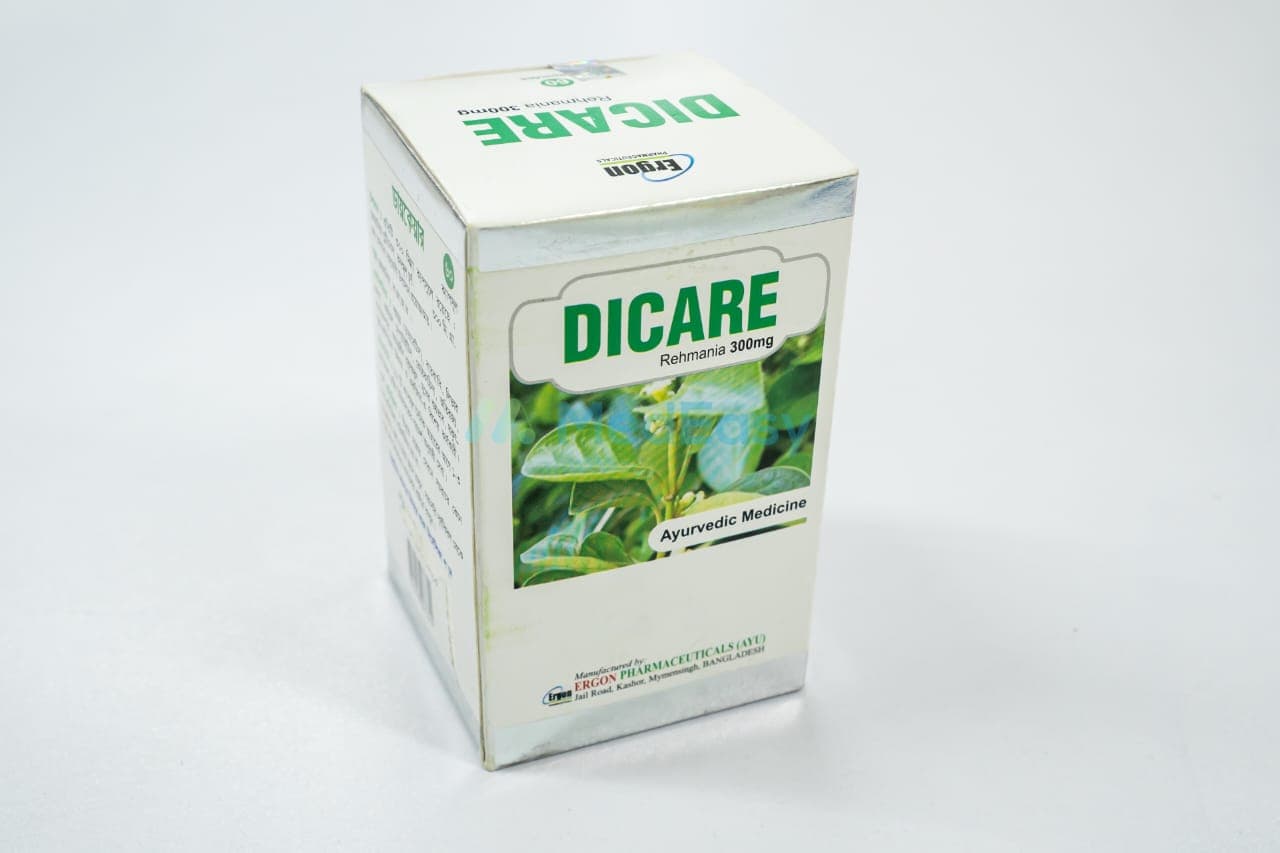
Dicare 300 mg Capsule is available on MedEasy for ৳783.00 per 60's Pack, with home delivery anywhere in Bangladesh. It is manufactured by Technokit Healthcare Ltd. Its generic name is Rehmania.
- Pack sizes
- 60's Pack
- Prescription
- Not required (over-the-counter).
- Delivery
- Home delivery across Bangladesh. Same-day delivery (12-24 hours) in Dhaka, Chattogram, Sylhet and Bogura city areas; 1-3 days by courier elsewhere.
- Payment
- Cash on delivery, bKash, cards and mobile banking.
- Brand
- Dicare
- Generic name
- Rehmania
- Manufacturer
- Technokit Healthcare Ltd
- Form & strength
- Capsule 300 mg
- Availability
- In stock
- Authenticity
- Sourced from licensed suppliers and the manufacturer's authorised distributors in Bangladesh.

Medicine overview
Indications of Dicare
Dicare is a herbal supplement derived from the root of Rehmannia glutinosa, a plant long used in Traditional Chinese Medicine (TCM) and Ayurveda. It is available in two traditionally distinguished forms — raw/dried root ("sheng di huang") and steamed/processed root ("shu di huang") — which are attributed different traditional properties.
- Traditional/adjunct use (evidence-limited): Dicare is traditionally used as an adjunct to support general vitality, as a "blood-nourishing" and "yin-tonifying" tonic, and to help manage symptoms such as fatigue and menstrual irregularities within traditional medicine frameworks.
- No FDA-approved or guideline-supported medical indication: Dicare is not an FDA-approved drug and has no indication recognized by modern clinical practice guidelines. Evidence from controlled human clinical trials is limited, and most supporting data come from traditional use, animal studies, or small/low-quality studies.
- Not a substitute for medical evaluation: Dicare should not be used in place of proper medical evaluation of the underlying cause of fatigue, menstrual irregularities, or any other symptom. Persistent or severe symptoms should be assessed by a physician.
Composition
Each unit of Rehmania is prepared from the dried root of Rehmannia glutinosa, in either raw (unprocessed) or steamed/cured form. The concentration of active constituents (including iridoid glycosides such as catalpol) and the standardization method vary by manufacturer and preparation form, so the exact composition of Rehmania should always be confirmed on the product label of the specific brand/manufacturer being used.
Description
Dicare is a herbal (botanical) supplement made from the root of Rehmannia glutinosa, a flowering plant native to China. It is one of the most widely used herbs in Traditional Chinese Medicine, where the raw root and the steamed/processed root are considered to have distinct traditional properties (the raw form traditionally described as "heat-clearing" and the processed form as more strongly "blood- and yin-nourishing"). Dicare is typically found in combination herbal formulas as well as standalone preparations, and is marketed as a dietary/herbal supplement rather than as a regulated pharmaceutical drug.
Therapeutic Class
Pharmacology
Rehmania contains iridoid glycosides (notably catalpol and related compounds), along with polysaccharides and other plant constituents. In traditional Chinese medicine theory, Rehmania is described as nourishing "yin" and "blood." In modern pharmacological research, preliminary and largely preclinical (cell and animal) studies suggest possible antioxidant activity and a mild blood-glucose-lowering effect for Rehmania, but a well-established mechanism of action in humans has not been confirmed, and high-quality clinical trial evidence is limited.
Dosage & Administration of Dicare
Because Dicare is an herbal supplement rather than a standardized pharmaceutical product, dosing varies considerably between manufacturers, preparation forms (raw vs. processed root), and product formats (raw decoction, extract powder, capsule, or tablet). The information below reflects typical traditional/manufacturer ranges and is not a substitute for the specific product label.
| Form | Typical Traditional Range | Notes |
|---|---|---|
| Raw or processed dried root (decoction) | Approximately 9–30 g of dried root per day, prepared as a decoction, often as part of a combination formula | Traditional dosing; varies by formula and practitioner |
| Standardized extract, capsule, or tablet | Per manufacturer's product label | No universally standardized dose of Dicare extract exists; follow the specific product instructions |
Always use Dicare under the guidance of a qualified physician or licensed traditional medicine practitioner, and do not exceed the dose stated on the product label.
Administration of Dicare
Dicare is taken by mouth, typically with food, either as a decoction (boiled preparation of the raw or processed root), or as a capsule/tablet/extract according to the product label. It is often combined with other herbs in traditional formulas rather than used strictly alone.
Interaction of Dicare
Dicare may have a mild blood-glucose-lowering effect. Concomitant use of Dicare with antidiabetic medications (e.g., insulin, sulfonylureas, metformin) may theoretically increase the risk of hypoglycemia; blood glucose should be monitored if Dicare is used alongside these medications. Because Dicare is often used within multi-herb combination formulas, interactions with other herbal products cannot be fully excluded. Data on interactions between Dicare and other conventional medications are limited; inform your physician of all supplements, including Dicare, before starting new medications.
Contraindications
Rehmania is contraindicated in individuals with known hypersensitivity to Rehmania (Rehmannia glutinosa) or related plants of the Orobanchaceae/Scrophulariaceae family. Rehmania should also be avoided during pregnancy because of insufficient safety data (see Pregnancy and Lactation).
Side Effects of Dicare
Dicare is generally described as well tolerated in traditional use, but the following effects have been reported:
- Gastrointestinal upset, including loose stools, diarrhea, or abdominal discomfort, particularly in individuals with pre-existing weak digestion (a traditionally recognized sensitivity to Dicare)
- Mild reduction in blood glucose in some individuals
- Rare allergic/hypersensitivity reactions (e.g., skin rash, itching)
Because Dicare is not subject to the same rigorous adverse-event reporting as conventional pharmaceuticals, the true frequency of side effects is not well established.
Pregnancy & Lactation
Safety data on Dicare in pregnancy are insufficient. Dicare should be avoided during pregnancy unless specifically recommended and supervised by a qualified physician, since potential risks to the fetus cannot be excluded. Similarly, there is insufficient reliable data on the use of Dicare during breastfeeding; it should only be used if clearly needed and after consulting a physician, weighing potential benefit against potential unknown risk to the infant.
Precautions & Warnings
The composition, potency, and recommended dose of Dicare vary by manufacturer and by preparation form (raw vs. processed root), since it is not standardized in the way conventional pharmaceuticals are. Dicare may cause mild blood-glucose-lowering effects; use with caution and monitor blood glucose in people taking antidiabetic medication (see Interactions). Individuals with diarrhea, loose stools, or otherwise weak digestive function should use Dicare with caution, as it is traditionally associated with aggravating these symptoms. Dicare should be used only under the guidance of a qualified physician or licensed traditional medicine practitioner, and should not replace standard medical evaluation or treatment for underlying conditions causing fatigue or menstrual irregularities.
Overdose Effects of Dicare
There is limited formal data on overdose with Dicare. Taking substantially more than the recommended dose of Dicare may increase the risk of gastrointestinal upset (such as diarrhea) and, theoretically, low blood glucose. If overdose of Dicare is suspected, or if severe symptoms occur, seek immediate medical attention or contact a poison control center/emergency services rather than attempting home treatment.
Storage Conditions
Store Dicare at room temperature (below 30°C), away from light and moisture. Keep out of reach of children.
Use In Special Populations
Pediatric: Safety and efficacy of Dicare in children have not been established; use in children is not recommended without specific guidance from a qualified practitioner.
Elderly: No specific dose adjustment for Dicare has been established for elderly patients, but caution is advised, particularly in those with diabetes or gastrointestinal sensitivity.
Renal or hepatic impairment: There are no well-established dosing recommendations for Dicare in renal or hepatic impairment; use with caution and under medical supervision in these populations.
Diabetic patients: Because Dicare may mildly lower blood glucose, diabetic patients using Dicare should monitor blood glucose closely (see Interactions).
Duration Of Treatment
There is no well-established maximum or minimum duration of use for Dicare. In traditional practice, Dicare is often used in defined courses as part of a broader treatment plan and reassessed periodically by the prescribing practitioner. Long-term safety and efficacy data for Dicare are limited; use should be reviewed regularly with a physician, and Dicare should not be continued indefinitely without medical reassessment, especially if symptoms do not improve.
Drug Classes
Mode Of Action
The proposed mode of action of Rehmania is not fully established in modern pharmacology. Its principal constituents, including the iridoid glycoside catalpol and related compounds, have shown antioxidant and mild hypoglycemic activity in preclinical (cell and animal) studies. In traditional Chinese medicine theory, Rehmania is understood to act by nourishing "yin" and "blood," a framework that does not map directly onto modern pharmacological mechanisms. Robust human mechanistic data for Rehmania are lacking.
Pediatric Uses
Safety and efficacy of Dicare in pediatric patients have not been established. Dicare is not recommended for use in children unless specifically directed and supervised by a qualified physician or licensed traditional medicine practitioner.
Frequently Asked Questions
Q: What is Dicare 300 mg Capsule used for?
A: Dicare 300 mg Capsule is a herbal supplement traditionally used as an adjunct to support general vitality and as a "blood-nourishing" tonic, and traditionally to help with symptoms such as fatigue and menstrual irregularities. It is not FDA-approved, and modern clinical evidence for these uses is limited, so it should not replace medical evaluation of the underlying cause of such symptoms.
Q: Is Dicare 300 mg Capsule safe to take during pregnancy?
A: Safety data on Dicare 300 mg Capsule in pregnancy are insufficient, so Dicare 300 mg Capsule should be avoided during pregnancy unless specifically recommended and supervised by a physician, as potential risks to the fetus cannot be excluded.
Q: Can I take Dicare 300 mg Capsule if I have diabetes?
A: Dicare 300 mg Capsule may have a mild blood-glucose-lowering effect, so people with diabetes who are taking antidiabetic medication should use Dicare 300 mg Capsule only with medical guidance and should monitor their blood glucose closely, since combining Dicare 300 mg Capsule with these medications may increase the risk of hypoglycemia.
Q: What are the side effects of Dicare 300 mg Capsule?
A: Dicare 300 mg Capsule is generally well tolerated in traditional use, but it can cause gastrointestinal upset such as loose stools, diarrhea, or abdominal discomfort, especially in people with weak digestion, mild lowering of blood glucose, and rarely allergic reactions such as skin rash or itching.
Q: Who should not take Dicare 300 mg Capsule?
A: Dicare 300 mg Capsule should not be used by anyone with a known allergy or hypersensitivity to Dicare 300 mg Capsule or related plants, and should be avoided during pregnancy due to insufficient safety data. People with diarrhea or weak digestive function should use Dicare 300 mg Capsule with caution.
Q: What should I do if I take too much Dicare 300 mg Capsule?
A: If you suspect you have taken more than the recommended amount of Dicare 300 mg Capsule, or experience severe symptoms, seek immediate medical attention or contact a poison control center or emergency services rather than trying to treat it at home.
Disclaimer
The information provided is accurate to the best of our knowledge, but it does not replace professional medical advice. We cannot guarantee its completeness or accuracy, and the absence of specific information about a drug should not be taken as an endorsement. We are not responsible for any consequences arising from this information, so please consult a healthcare professional for any concerns or questions.