

10% Off
Fucimax250 mg
Incepta Pharmaceuticals Ltd.
৳585.00
Add to cart
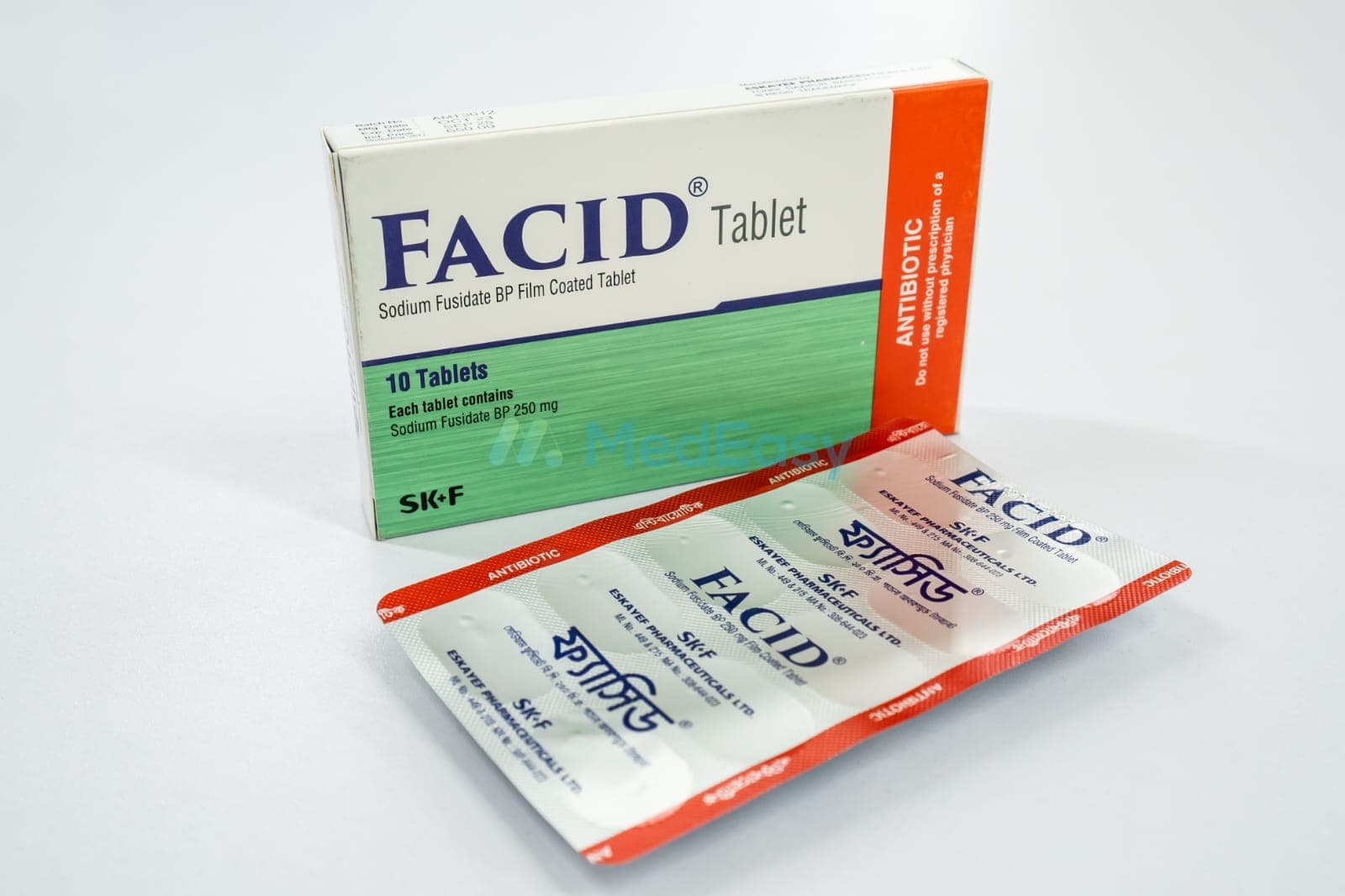

Facid is an antibiotic (fusidane class) with established activity against Staphylococcus aureus, including many penicillin-resistant strains. It is indicated for:
Facid should only be used for infections proven or strongly suspected to be caused by susceptible staphylococci; it is not effective against most Gram-negative organisms.
Each formulation of Sodium Fusidate contains sodium fusidate as the active ingredient, available as oral tablets, oral suspension (as fusidic acid), and intravenous infusion (as diethanolamine fusidate) depending on local product availability. Strength varies by dosage form and brand; refer to the specific product label for exact composition.
Facid is the sodium salt of fusidic acid, a narrow-spectrum, steroid-like antibiotic belonging to the fusidane class. Unlike topical fusidic acid preparations used for skin infections, Facid is formulated for systemic use (oral or intravenous) to treat deeper or more serious staphylococcal infections. It is well absorbed orally, distributes well into bone, soft tissue, and abscess fluid, and is metabolised primarily in the liver with biliary excretion.
Facid belongs to the fusidane class of antibiotics, a distinct chemical class structurally related to steroids but with no corticosteroid activity. It is classified as a narrow-spectrum, primarily anti-staphylococcal antibacterial agent.
Sodium Fusidate inhibits bacterial protein synthesis by binding to elongation factor G (EF-G), preventing its release from the ribosome after translocation. This blocks the ribosomal cycle required for peptide chain elongation, resulting in bacteriostatic (and at higher concentrations, bactericidal) activity against susceptible staphylococci.
Sodium Fusidate is well absorbed after oral administration, is highly protein-bound (>95%), and penetrates well into bone, joint fluid, and infected soft tissue, which supports its use in osteomyelitis. It is extensively metabolised in the liver and eliminated mainly via bile into the faeces, with minimal renal excretion.
| Indication | Route | Typical Dose |
|---|---|---|
| Skin/soft tissue and bone/joint infections | Oral (tablet) | 500 mg (as Facid) three times daily |
| Serious or deep-seated infections | Intravenous infusion | 500 mg three times daily by slow IV infusion, switching to oral therapy as soon as clinically feasible |
| Age/Weight | Typical Dose (oral suspension) |
|---|---|
| Under 1 year | Approximately 50 mg/kg/day in divided doses |
| 1–5 years | 250 mg (as fusidic acid) three times daily |
| 5–12 years | 500 mg three times daily |
Duration of treatment depends on the site and severity of infection; bone/joint infections typically require several weeks of therapy. Facid is frequently combined with another antistaphylococcal antibiotic, particularly for serious infections, specifically to reduce the risk of resistance emerging during treatment.
Take Facid exactly as prescribed by your physician; do not stop, extend, skip doses, or share this medicine with others without medical advice. Tablets and suspension are best taken with food to reduce gastrointestinal upset.
Oral tablets and suspension should be taken with or after food to minimise gastrointestinal upset. The intravenous infusion of Facid must be given slowly, diluted as directed, via a large vein to reduce the risk of local irritation or thrombophlebitis, and should be switched to oral therapy as soon as the patient's condition allows.
Concurrent use of Facid with statins (particularly simvastatin and atorvastatin) is associated with an increased risk of severe, sometimes fatal, rhabdomyolysis. This combination should generally be avoided; statin therapy is typically withheld temporarily during systemic Facid treatment, and patients should be monitored closely for muscle pain, weakness, or dark urine.
Concomitant use with other hepatotoxic medications may increase the risk of liver injury; liver function should be monitored when such combinations are unavoidable.
Facid may potentiate the anticoagulant effect of warfarin, increasing bleeding risk; more frequent INR monitoring is advised when used together.
Sodium Fusidate is contraindicated in:
Patients should seek medical attention promptly if they notice yellowing of the skin/eyes, severe abdominal pain, or unusual bruising/bleeding.
Facid should be used during pregnancy only if clearly needed and if the potential benefit justifies the potential risk to the fetus, as safety data in human pregnancy are limited. Similarly, caution is advised during breastfeeding, since it is not fully established whether Facid passes into breast milk in clinically significant amounts. A physician should be consulted before use in pregnant or breastfeeding women.
Facid should be used with caution in patients with hepatic impairment, as it is extensively metabolised by the liver and carries a dose-related risk of hepatotoxicity; liver function should be monitored, especially during prolonged or high-dose systemic therapy. Facid is frequently used in combination with another antistaphylococcal antibiotic specifically to minimise the risk of resistance developing during monotherapy. Concurrent statin use should be avoided due to the risk of severe rhabdomyolysis (see Interactions). Take Facid exactly as prescribed by your physician; do not stop, extend, skip doses, or share this medicine with others without medical advice. Intravenous administration should be given slowly into a large vein to reduce local irritation.
Limited data exist on acute overdose with Facid. Overdose may be expected to worsen known adverse effects such as gastrointestinal upset or liver enzyme changes. In case of suspected overdose, seek immediate medical attention or contact a poison control centre; treatment is supportive, with monitoring of liver function as appropriate. Do not attempt specific home treatment.
Store at room temperature (below 30°C), away from light and moisture. Keep out of reach of children.
Facid should be used with caution in patients with hepatic impairment, with liver function monitoring during treatment, due to its hepatic metabolism and dose-related hepatotoxicity risk.
No significant dose adjustment is generally required in renal impairment, as Facid is eliminated predominantly via the biliary route rather than renally; however, caution is still advised in severe renal disease.
No specific dose adjustment is established for elderly patients, but they should be monitored for hepatic and gastrointestinal adverse effects as with other adult patients.
Duration of treatment with Facid depends on the type and severity of infection. Skin and soft tissue infections are typically treated for 7–10 days, while bone and joint infections such as osteomyelitis often require several weeks (commonly 4–6 weeks or longer) of therapy, usually starting with combination antibiotic therapy. Treatment duration should always be determined by the prescribing physician based on clinical and, where relevant, microbiological response.
Sodium Fusidate is classified in the fusidane class of antibacterial agents, a narrow-spectrum group distinct from beta-lactams, macrolides, and other commonly used antibiotic classes.
Sodium Fusidate inhibits bacterial protein synthesis by binding to elongation factor G (EF-G) on the bacterial ribosome, blocking translocation during peptide chain elongation. This action is selective for susceptible staphylococci and does not affect human protein synthesis at therapeutic concentrations.
Facid can be used in children for susceptible staphylococcal infections, with dosing individualised by age and body weight (see Dosage and Administration). As with adults, liver function should be monitored during prolonged or high-dose therapy. Safety and efficacy in neonates have not been well established, and use in this age group should be guided by a specialist physician.
Q: What is Facid 250 mg Tablet used for?
A: Facid 250 mg Tablet is an antibiotic used to treat infections caused by susceptible Staphylococcus aureus, including skin and soft tissue infections and bone/joint infections such as osteomyelitis, particularly when other antibiotics are unsuitable or resistance is a concern.
Q: Why is Facid 250 mg Tablet often given with another antibiotic?
A: Facid 250 mg Tablet is frequently combined with another antistaphylococcal antibiotic, especially for serious or prolonged infections, because using it alone increases the risk that bacteria will develop resistance during treatment. Combination therapy helps reduce this risk.
Q: Can I take Facid 250 mg Tablet with my cholesterol (statin) medicine?
A: No. Taking Facid 250 mg Tablet together with statins such as simvastatin or atorvastatin significantly increases the risk of severe, potentially fatal muscle breakdown (rhabdomyolysis). Your doctor will usually advise stopping the statin temporarily during treatment with Facid 250 mg Tablet. Tell your doctor about all medicines you take.
Q: What are the common side effects of Facid 250 mg Tablet?
A: Common side effects include nausea, vomiting, diarrhoea, abdominal discomfort, and skin rash. Less commonly, Facid 250 mg Tablet can affect the liver, causing raised liver enzymes or, rarely, reversible jaundice, especially with high doses or prolonged use. Contact your doctor if you notice yellowing of the skin or eyes.
Q: Is Facid 250 mg Tablet safe during pregnancy or breastfeeding?
A: Facid 250 mg Tablet should be used during pregnancy or breastfeeding only if clearly needed, and only if your doctor decides the benefit outweighs the potential risk, since safety data are limited. Always consult your physician before use in these situations.
Q: What should I do if I miss a dose or think I've taken too much Facid 250 mg Tablet?
A: If you miss a dose, take it as soon as you remember unless it is nearly time for the next one; do not double the dose. Always complete the full course as prescribed. If you suspect an overdose, seek immediate medical attention or contact a poison control centre rather than treating it at home.
Disclaimer
The information provided is accurate to the best of our knowledge, but it does not replace professional medical advice. We cannot guarantee its completeness or accuracy, and the absence of specific information about a drug should not be taken as an endorsement. We are not responsible for any consequences arising from this information, so please consult a healthcare professional for any concerns or questions.
