

10% Off
Fosfomax3 gm/sache
Square Pharmaceuticals PLC.
৳315.00
Add to cart
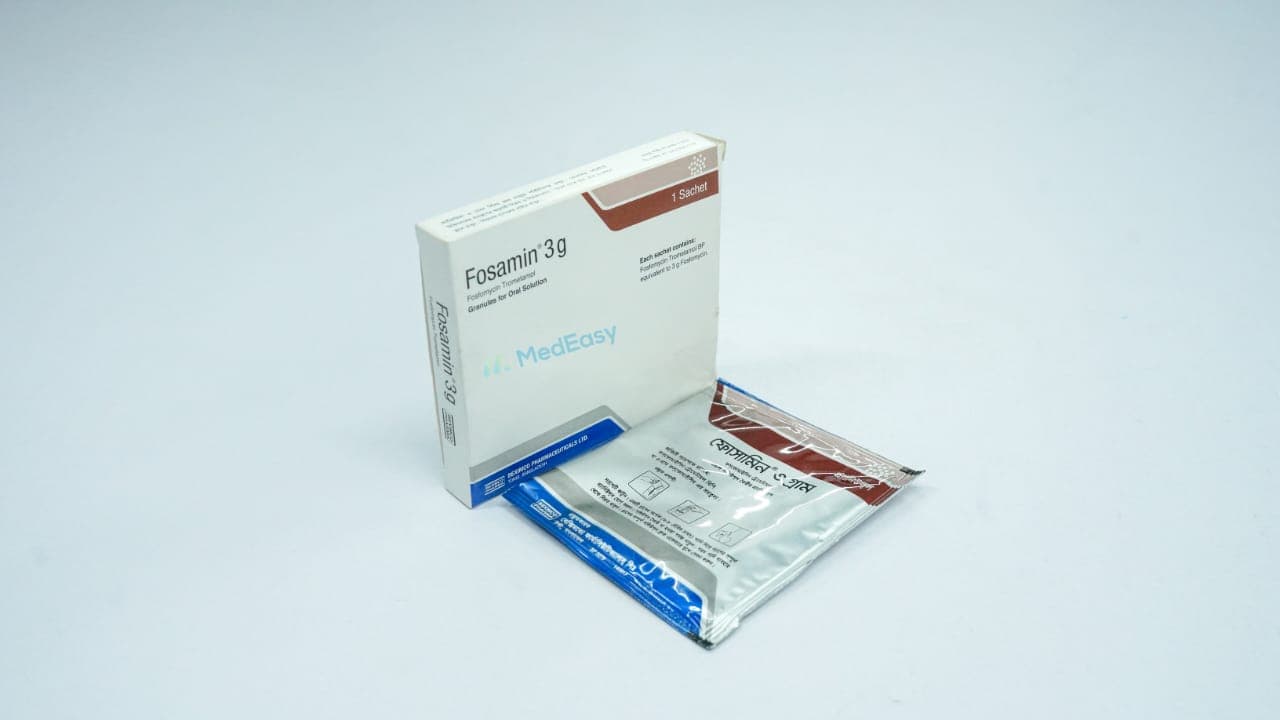

Fosamin is a broad-spectrum, bactericidal antibiotic belonging to the phosphonic acid derivative class. Its clinical use varies by evidence strength:
Fosamin is not indicated for pyelonephritis, perinephric abscess, or systemic/bloodstream infections when used as the single-dose oral formulation.
The oral formulation of Fosfomycin is supplied as fosfomycin tromethamine granules for oral solution, most commonly as a sachet containing the equivalent of 3 grams of fosfomycin (approximately 5.631 g of fosfomycin tromethamine salt), along with inactive ingredients such as flavoring agents, saccharin, and sucrose.
An intravenous form, fosfomycin disodium/fosfomycin for injection, is also available in some countries as a powder for reconstitution for hospital use.
Fosamin is a synthetic, broad-spectrum bactericidal antibiotic and the first agent in the phosphonic acid derivative class. It is structurally unrelated to other antibiotic classes, which limits cross-resistance with commonly used agents.
It is best known worldwide as a convenient single-dose oral treatment for uncomplicated urinary tract infections in women, marketed in Bangladesh as an oral powder/granule sachet (Fosamin trometamol, 3 g) under several brand names. An injectable disodium salt form also exists for more severe or resistant infections in hospital settings.
Fosamin belongs to the phosphonic acid derivative class of antibiotics, a distinct urinary anti-infective class not chemically related to penicillins, cephalosporins, fluoroquinolones, or other common antibiotic groups.
Fosfomycin is bactericidal. It inactivates the bacterial enzyme enolpyruvyl transferase (MurA), irreversibly blocking an early step in bacterial cell wall (peptidoglycan) synthesis. It also reduces the ability of bacteria such as E. coli to adhere to the uroepithelial lining of the urinary tract, which may contribute to its clinical effect in cystitis.
| Indication | Population | Typical Dose |
|---|---|---|
| Uncomplicated urinary tract infection (acute cystitis) | Women aged 18 years and older | One 3 g sachet of Fosamin (as Fosamin tromethamine) dissolved in 3-4 oz (about 90-120 mL) of water, taken as a single dose |
| Complicated UTI / resistant infections (hospital use, injectable form) | Adults, specialist-directed | Dose and frequency individualized by the treating physician based on renal function and culture sensitivity; not for self-administration |
| UTI prophylaxis (off-label) | Adults, as directed | Repeated single doses (e.g., every 3 days for 3 doses) only under physician guidance |
In patients with reduced kidney function, urinary concentrations of Fosamin are lower and may not be adequate to clear infection; efficacy is reduced with worsening renal function (see Contraindications for severe impairment).
Antibiotic stewardship: Take Fosamin exactly as prescribed by your physician; do not stop, extend, skip doses, or share this medicine with others without medical advice, even though it is often given as a single dose.
Fosamin granules must never be taken dry. Empty the entire contents of one sachet into a glass, dissolve in 3-4 ounces (approximately 90-120 mL) of cool water (not hot water), stir well, and drink immediately after dissolving.
Fosamin has a limited number of well-documented clinically significant interactions:
Always inform your physician or pharmacist of all medicines you are taking before starting Fosamin.
Because Fosamin for cystitis is usually given as a single dose, side effects are generally mild and self-limited.
Seek medical attention promptly for signs of severe allergic reaction (swelling of face/throat, difficulty breathing) or for severe or persistent diarrhea.
Pregnancy: Animal reproduction studies with Fosamin have not shown teratogenic effects even at high doses, and it has traditionally been assigned to pregnancy category B in older labeling. However, human data remain limited, so Fosamin should be used during pregnancy only if clearly needed and if the potential benefit justifies the potential risk to the fetus; consult a physician before use.
Lactation: It is not known whether Fosamin is excreted in human breast milk. A decision should be made, in consultation with a physician, whether to discontinue breastfeeding or discontinue the drug, weighing the benefit of treatment against the potential risk to the infant.
Reported human overdose experience with Fosamin is limited; symptoms such as vestibular disturbance (dizziness/imbalance), impaired hearing, metallic taste, and a general decline in taste perception have been described. Animal studies at very high multiples of the therapeutic dose showed minimal toxicity.
If an overdose of Fosamin is suspected, seek immediate medical attention or contact a poison control center/emergency services. Treatment is generally supportive and symptomatic; there is no specific antidote.
Store at room temperature (below 30°C), away from light and moisture. Keep out of reach of children. Once the granules are dissolved in water, drink the solution immediately; do not store the prepared solution for later use.
For uncomplicated cystitis, Fosamin is typically given as a single dose; no additional doses are usually required. If symptoms do not resolve within 2-3 days, or if they recur, a physician should be consulted for reassessment rather than repeating the dose independently. When used off-label for prophylaxis or in hospital-directed regimens for complicated infections, duration is determined individually by the prescribing physician.
The oral granules of Fosamin are not swallowed dry. Empty one sachet into a glass and dissolve completely in 3-4 ounces (approximately 90-120 mL) of cool (not hot) water; stir and drink the entire solution immediately after mixing. Do not prepare the solution in advance or store it for later use.
Fosfomycin is classified as an antibiotic, specifically a phosphonic acid derivative and urinary anti-infective agent.
Fosfomycin exerts its bactericidal effect by irreversibly inhibiting the bacterial enzyme enolpyruvyl transferase (MurA), which catalyzes an essential early step in bacterial cell wall (peptidoglycan) biosynthesis. This action, combined with reduced bacterial adherence to the uroepithelium, disrupts bacterial cell wall integrity and leads to bacterial cell death.
B
The safety and effectiveness of oral Fosamin (Fosamin tromethamine) have not been established in children 12 years of age and younger, and it is not FDA-approved for use in this age group. Use in adolescents and children should only occur under specialist pediatric guidance when no suitable alternative exists, with close monitoring. Parents/caregivers should not give Fosamin to a child without a physician's specific instruction.
Q: What is Fosamin 3 gm/sachet Oral Powder used for?
A: Fosamin 3 gm/sachet Oral Powder is an antibiotic most commonly used to treat uncomplicated urinary tract infections (bladder infections/cystitis) in women, typically given as a single oral dose.
Q: How do I take Fosamin 3 gm/sachet Oral Powder?
A: Dissolve the entire contents of one sachet of Fosamin 3 gm/sachet Oral Powder in 3-4 ounces of water (not hot water) and drink it right away, usually as a single one-time dose. Do not take it in dry/powder form.
Q: Can I take Fosamin 3 gm/sachet Oral Powder if I am pregnant?
A: Fosamin 3 gm/sachet Oral Powder should be used during pregnancy only if clearly needed and if your physician determines the benefit outweighs any potential risk to the baby; always consult your doctor before use in pregnancy.
Q: What are the common side effects of Fosamin 3 gm/sachet Oral Powder?
A: The most common side effects of Fosamin 3 gm/sachet Oral Powder are diarrhea, nausea, headache, vaginitis, and rhinitis. These are usually mild since the medicine is typically taken as a single dose. Seek medical care if you develop severe or persistent diarrhea or signs of an allergic reaction.
Q: Is one dose of Fosamin 3 gm/sachet Oral Powder really enough to treat my infection?
A: Yes, for uncomplicated cystitis, a single 3 g dose of Fosamin 3 gm/sachet Oral Powder achieves high concentrations in the urine that last more than 48 hours, which is usually sufficient. If your symptoms do not improve within 2-3 days, contact your physician instead of repeating the dose yourself.
Q: Who should not take Fosamin 3 gm/sachet Oral Powder?
A: Avoid Fosamin 3 gm/sachet Oral Powder if you have a known allergy to it, or if you have severe kidney impairment or are on hemodialysis, since the medicine will not reach adequate concentrations in the urine to work properly. Always take Fosamin 3 gm/sachet Oral Powder exactly as prescribed and never share it with others.
Disclaimer
The information provided is accurate to the best of our knowledge, but it does not replace professional medical advice. We cannot guarantee its completeness or accuracy, and the absence of specific information about a drug should not be taken as an endorsement. We are not responsible for any consequences arising from this information, so please consult a healthcare professional for any concerns or questions.
