
8% Off
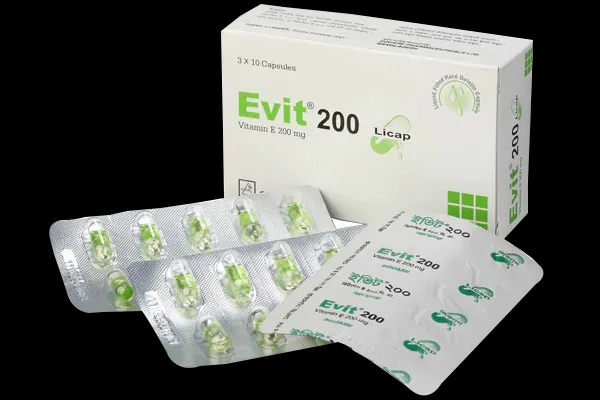
Evit Soft200 mg
Square Pharmaceuticals PLC.
৳55.20
Add to cart


Inovit E 200 mg is a fat-soluble vitamin used mainly to treat and prevent vitamin E deficiency and to meet the Recommended Dietary Allowance (RDA) as a general nutritional supplement.
Patients should discuss the specific reason for supplementation with a physician or pharmacist, since the appropriate dose differs substantially between deficiency treatment and general wellness use.
Each unit of Inovit E 200 mg contains alpha-tocopherol acetate (an ester form of vitamin E) as the active ingredient, commonly available in Bangladesh as oral soft gelatin capsules in strengths such as 200 IU and 400 IU, and occasionally as oral drops or topical preparations. The acetate ester form is more chemically stable than free alpha-tocopherol and is hydrolyzed to active alpha-tocopherol after absorption. Formulations may be synthetic (dl-alpha-tocopheryl acetate) or natural-source (d-alpha-tocopheryl acetate); potency and IU-to-mg conversion differ slightly between the two forms.
Inovit E 200 mg is the acetate ester of alpha-tocopherol, the most biologically active form of vitamin E, a fat-soluble vitamin essential for normal cell function. It is one of the body's principal lipid-soluble antioxidants, concentrated in cell membranes, where it helps protect polyunsaturated fatty acids and other oxygen-sensitive cell components from oxidative damage. Because it is fat-soluble, absorption depends on normal fat digestion and is taken up together with dietary fat via the intestinal lymphatic system.
Fat-soluble vitamin; antioxidant vitamin supplement. Inovit E 200 mg belongs to the vitamin E group of compounds (tocopherols and tocotrienols) and is classified therapeutically as a nutritional supplement/vitamin preparation rather than a conventional pharmacological drug.
Inovit E 200 mg is hydrolyzed in the intestine to free alpha-tocopherol, which is absorbed with dietary lipids, incorporated into chylomicrons, and distributed to tissues, with the liver preferentially retaining and redistributing the natural RRR-alpha-tocopherol stereoisomer via alpha-tocopherol transfer protein. Once in cell membranes, alpha-tocopherol acts as a chain-breaking antioxidant, donating a hydrogen atom to neutralize lipid peroxyl radicals and thereby limiting propagation of lipid peroxidation. This protects polyunsaturated fatty acids in membranes and helps preserve the function of other oxygen-sensitive nutrients such as vitamin A. Deficiency impairs this antioxidant defense and can manifest as peripheral neuropathy, ataxia, skeletal myopathy, retinopathy, and hemolytic anemia, particularly in premature infants and people with chronic fat malabsorption.
Dosing depends on the indication and should be individualized; the figures below reflect typical clinical and nutritional practice for Inovit E 200 mg.
See Precautions and Warnings for cautions regarding chronic high-dose use, and Use in Special Populations for pediatric and elderly dosing considerations.
Deficiency treatment requires medically supervised, weight-based dosing that is substantially higher than routine supplementation. For general supplementation, common over-the-counter strengths of Inovit E 200 mg in Bangladesh are 200 IU and 400 IU capsules taken once daily, which already exceed the RDA; intake should not routinely exceed the age-appropriate Tolerable Upper Intake Level without medical advice. Full per-indication dosing is provided under Dosage and Administration.
Inovit E 200 mg capsules are taken orally, generally swallowed whole with water, and are best absorbed when taken with a meal containing some dietary fat, since absorption is fat-dependent. Oral drops should be measured with the provided dropper. Doses are usually given once daily unless a physician directs a divided-dose schedule for deficiency treatment.
The most clinically important interaction with Inovit E 200 mg involves increased bleeding risk:
Patients should inform their physician about all supplements before starting or continuing Inovit E 200 mg, especially if they take blood thinners or are scheduled for surgery.
Inovit E 200 mg is contraindicated only in patients with known hypersensitivity to alpha-tocopherol, tocopherol derivatives, or any excipient of the specific product formulation.
Inovit E 200 mg is generally well tolerated at RDA and typical supplemental doses. At higher doses (commonly cited above 1,000 IU/day), side effects may include:
Serious allergic reactions are rare. Patients should seek medical attention for unusual bruising, bleeding, or signs of an allergic reaction.
Vitamin E is an essential nutrient in pregnancy and lactation, and RDA-level intake (15 mg/day in pregnancy; 19 mg/day while breastfeeding) from diet or standard prenatal supplements is considered safe and appropriate.
Evidence supporting safety of high-dose supplemental Inovit E 200 mg (well above the RDA) during pregnancy is limited, and some data have raised concerns without confirming harm; routine high-dose use in pregnancy, particularly in the first trimester, is not recommended and should be avoided unless specifically advised by an obstetrician. Whether high-dose vitamin E is excreted in breast milk in clinically significant amounts is not well established, so high-dose supplementation during lactation should also be discussed with a physician. See Precautions and Warnings for general high-dose cautions.
Chronic high-dose use of Inovit E 200 mg (generally ≥400 IU/day sustained over time) is the focus of several safety cautions:
Vitamin E has relatively low acute toxicity, but excessive or prolonged high-dose intake of Inovit E 200 mg can cause gastrointestinal disturbances (nausea, diarrhea, abdominal cramps), fatigue, headache, and — most importantly — an increased tendency to bleed or bruise due to interference with vitamin K-dependent clotting, which can be serious in patients also taking anticoagulants or before surgery. There is no specific antidote; management is supportive and includes stopping the supplement, monitoring coagulation status (e.g., INR) if bleeding risk is a concern, and general symptomatic care. Anyone with signs of unusual bleeding, black or bloody stools, or severe gastrointestinal symptoms after high-dose intake should seek prompt medical attention.
Store at room temperature (below 30°C), away from light and moisture. Keep out of reach of children.
Elderly: No specific dose adjustment is generally required, but the elderly are more likely to be on anticoagulant/antiplatelet therapy, so the bleeding-risk precautions above apply with particular importance.
Renal impairment: No specific dose adjustment is typically required at RDA-level doses; high-dose use should be discussed with a physician.
Hepatic impairment: Since vitamin E absorption and transport depend on normal fat and lipoprotein metabolism, and the liver plays a key role in its distribution, patients with significant liver disease may have altered vitamin E status and should be supplemented under medical guidance.
Fat-malabsorption disorders (cystic fibrosis, cholestatic liver disease, short bowel syndrome, chronic pancreatitis): These patients are at highest risk of true deficiency and often need specialist-guided, higher, sometimes water-miscible formulations of Inovit E 200 mg.
See Pediatric Uses for infants and children.
For confirmed vitamin E deficiency, treatment duration is guided by a physician based on correction of clinical signs and, where available, serum alpha-tocopherol levels, and may need to continue long-term in chronic malabsorption conditions. For general dietary supplementation with Inovit E 200 mg at RDA-level doses, use may continue indefinitely as part of a balanced diet. Continuous use of doses above the RDA for non-deficiency reasons should be periodically reviewed with a physician rather than continued indefinitely without medical reassessment, given the uncertainties around long-term high-dose safety.
Fat-soluble vitamins; Vitamin E preparations (tocopherols/tocopheryl esters); Antioxidant nutritional supplements.
As the acetate ester of alpha-tocopherol, Inovit E 200 mg is de-esterified in the gut to active alpha-tocopherol, which inserts into cell membrane phospholipid bilayers. There it functions as a chain-breaking, lipid-soluble antioxidant: it scavenges lipid peroxyl radicals generated during oxidative stress, donating a hydrogen atom from its chromanol ring to terminate free-radical chain reactions before they damage polyunsaturated fatty acids in membranes, lipoproteins, and other lipid structures. This membrane-stabilizing antioxidant action underlies its role in maintaining normal neurological, muscular, and hematological function, and its deficiency-related effects reflect loss of this protective mechanism.
In children, established use of Inovit E 200 mg is for prevention and treatment of vitamin E deficiency, particularly in premature or very low birth weight infants (who have low fat stores and immature absorption) and in children with chronic fat-malabsorption conditions such as cystic fibrosis or cholestatic liver disease, where dosing is individualized and supervised by a pediatrician. For general supplementation, intake should follow the age-based RDA (6 mg/day for ages 1–3, 7 mg/day for ages 4–8, 11 mg/day for ages 9–13), typically met through diet or a standard pediatric multivitamin. Routine high-dose supplementation in healthy children is not recommended and should only be used on a physician's advice, staying within the age-appropriate Tolerable Upper Intake Level.
Q: What is Inovit E 200 mg mainly used for?
A: It is mainly used to treat or prevent vitamin E deficiency and to supplement dietary intake when diet alone is insufficient. It is also widely used, with weaker evidence, for skin, hair, and general antioxidant purposes.
Q: Can I take Inovit E 200 mg every day for general health?
A: Taking a dose close to the RDA daily is generally considered safe for most healthy adults. However, routinely taking high doses (well above 400 IU/day) for general wellness is not strongly supported by evidence and carries some safety concerns, so it is best discussed with a doctor.
Q: Is Inovit E 200 mg safe to take with aspirin or warfarin?
A: High doses can increase bleeding risk when combined with blood thinners such as warfarin, aspirin, or clopidogrel. If you take any anticoagulant or antiplatelet medicine, consult your physician before starting or continuing vitamin E supplements, especially at doses above the RDA.
Q: Can pregnant or breastfeeding women take Inovit E 200 mg?
A: RDA-level intake during pregnancy and breastfeeding is generally considered safe and is often included in prenatal vitamins. High-dose supplementation beyond the RDA is not well studied in pregnancy and should only be used if specifically recommended by a doctor.
Q: What happens if I take too much Inovit E 200 mg?
A: Excessive or prolonged high-dose intake can cause stomach upset, fatigue, headache, and an increased tendency to bleed or bruise. Doses above the Tolerable Upper Intake Level should be avoided unless a physician is supervising your use.
Q: Do I need to stop Inovit E 200 mg before surgery?
A: Because high-dose vitamin E can increase bleeding risk, many surgeons recommend stopping high-dose supplements one to two weeks before a planned surgery. Always inform your surgeon and physician about any vitamin E supplement you are taking.
Disclaimer
The information provided is accurate to the best of our knowledge, but it does not replace professional medical advice. We cannot guarantee its completeness or accuracy, and the absence of specific information about a drug should not be taken as an endorsement. We are not responsible for any consequences arising from this information, so please consult a healthcare professional for any concerns or questions.

