
10% Off
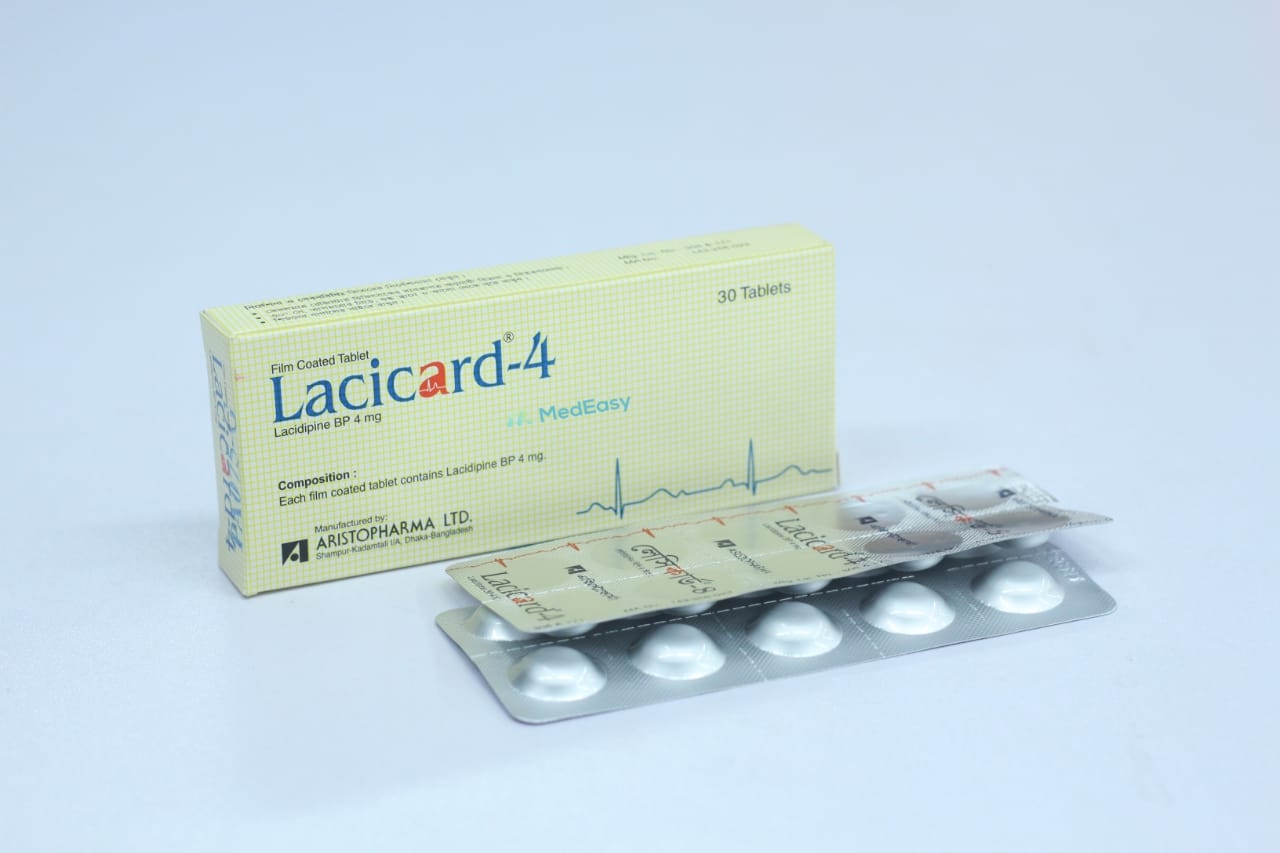
Lacicard4 mg
Aristopharma Ltd.
৳54.00
Add to cart

L-Cardin 4 mg Tablet is available on MedEasy for ৳4.50 per piece, with home delivery anywhere in Bangladesh. It is manufactured by Drug International Ltd. Its generic name is Lacidipine.

L-Cardin is a long-acting dihydropyridine calcium channel blocker indicated for the treatment of hypertension.
L-Cardin has not been shown to provide additional benefit for secondary prevention after myocardial infarction and is not indicated for this purpose. The safety and efficacy of L-Cardin in hypertensive emergencies (malignant hypertension) have not been established, and it should not be used for that indication.
Each tablet of Lacidipine typically contains 2 mg or 4 mg of lacidipine as the active ingredient, together with pharmaceutically inert excipients such as lactose, microcrystalline cellulose, magnesium stearate, and film-coating agents. Lacidipine is available only as an oral tablet; injectable, liquid, or reconstitutable forms of Lacidipine do not exist.
L-Cardin is a third-generation dihydropyridine calcium channel blocker used to treat high blood pressure (hypertension). L-Cardin is characterized by high lipophilicity and a slow, gradual onset of action, which allows for smooth, sustained blood pressure control with once-daily dosing and a lower incidence of reflex tachycardia compared with some shorter-acting dihydropyridines. L-Cardin works by relaxing and widening blood vessels, reducing the resistance the heart must pump against and thereby lowering blood pressure.
L-Cardin belongs to the dihydropyridine class of calcium channel blockers (CCBs), a subgroup of antihypertensive agents that act primarily on vascular smooth muscle rather than on cardiac tissue.
Lacidipine selectively blocks voltage-gated L-type calcium channels in vascular smooth muscle cell membranes, inhibiting the influx of extracellular calcium ions. This reduces intracellular calcium availability, leading to relaxation of arteriolar smooth muscle, vasodilation, and a consequent fall in peripheral vascular resistance and blood pressure.
Lacidipine is highly lipophilic and partitions extensively into the cell membrane, which accounts for its slow onset and long duration of action despite a relatively short plasma half-life (approximately 13–19 hours). Lacidipine undergoes extensive first-pass hepatic metabolism via the CYP3A4 enzyme system, has an oral bioavailability of roughly 10%, and is more than 95% bound to plasma proteins. Lacidipine has no clinically active metabolites, and elimination occurs via hepatic metabolism with excretion of metabolites in urine and feces.
| Step | Dose of L-Cardin | Notes |
|---|---|---|
| Starting dose | 2 mg once daily | Taken preferably in the morning |
| Titration | Increase to 4 mg once daily after 3–4 weeks if needed | Based on blood pressure response |
| Maximum dose | 6 mg once daily | Doses of L-Cardin above 6 mg daily provide no additional antihypertensive benefit |
The safety and efficacy of L-Cardin have not been established in children; L-Cardin is therefore not recommended for use in the pediatric population.
No dosage adjustment of L-Cardin is generally required in renal impairment, since L-Cardin and its metabolites are not significantly cleared by the kidney; caution is still advised in severe renal disease.
Because L-Cardin is extensively metabolized by the liver, plasma concentrations of L-Cardin are increased in hepatic impairment. A lower starting dose and careful monitoring are recommended, with dose adjustment as needed; L-Cardin should be used with particular caution in severe hepatic impairment (see Precautions and Warnings).
No specific dose adjustment of L-Cardin is generally required in elderly patients, but treatment should be initiated at the lowest dose with monitoring of blood pressure response.
L-Cardin tablets should be taken orally, once daily, preferably in the morning, at approximately the same time each day. L-Cardin may be taken with or without food; however, L-Cardin should not be taken with grapefruit or grapefruit juice, as this can significantly increase L-Cardin blood levels (see Drug Interactions). L-Cardin tablets should be swallowed whole with a glass of water and should not be crushed or chewed unless directed by a physician.
Grapefruit juice inhibits intestinal CYP3A4 metabolism of L-Cardin, significantly increasing plasma concentrations of L-Cardin and the risk of hypotension and other adverse effects. Patients taking L-Cardin should avoid grapefruit and grapefruit juice.
Strong CYP3A4 inhibitors (e.g., ketoconazole, itraconazole, ritonavir, cimetidine) can increase plasma levels of L-Cardin, increasing the risk of hypotension and other adverse effects; concurrent use should be undertaken with caution and, if needed, with dose adjustment of L-Cardin.
Strong CYP3A4 inducers (e.g., rifampicin, carbamazepine, phenytoin, St. John's Wort) can reduce plasma levels of L-Cardin and diminish its antihypertensive effect; blood pressure should be monitored closely if L-Cardin is used together with these agents.
Concomitant use of L-Cardin with other antihypertensive drugs, diuretics, or agents with hypotensive potential (e.g., alpha-blockers, nitrates) may produce additive blood-pressure-lowering effects; dose titration and monitoring are recommended.
Corticosteroids and tetracosactide may reduce the antihypertensive effect of L-Cardin due to fluid retention.
Lacidipine is contraindicated in patients with:
Side effects of L-Cardin are generally dose-related and reflect its vasodilatory action.
| Frequency | Side Effects |
|---|---|
| Common | Headache, dizziness, flushing, palpitations, peripheral (ankle) edema, tachycardia |
| Less Common | Syncope, worsening of angina, gastrointestinal discomfort, rash, gingival hyperplasia (with prolonged use) |
| Rare | Tremor, muscle cramps, urticaria, angioedema |
| Very Rare | Depression, elevated liver enzymes (alkaline phosphatase) |
Peripheral edema with L-Cardin is a recognized class effect of dihydropyridine calcium channel blockers and is dose-dependent; it is caused by arteriolar dilation rather than fluid overload and typically does not respond to diuretics.
The safety of L-Cardin in human pregnancy has not been established. L-Cardin should be used during pregnancy only if the potential benefit to the mother clearly justifies the potential risk to the fetus, and only under close medical supervision. Animal studies with L-Cardin have shown effects on uterine contractility; a physician should be consulted before using L-Cardin if pregnancy is confirmed or suspected.
It is not known whether L-Cardin is excreted in human breast milk, although related compounds are excreted into the milk of lactating animals. Because of the potential for adverse effects in a nursing infant, a decision should be made whether to discontinue breastfeeding or discontinue L-Cardin, taking into account the importance of L-Cardin to the mother. Consult a physician before using L-Cardin while breastfeeding.
Overdose with L-Cardin may cause pronounced peripheral vasodilation leading to marked and prolonged hypotension, reflex tachycardia, and, in severe cases, bradycardia and disturbances of cardiac conduction.
There is no specific antidote for L-Cardin overdose. Anyone suspected of having taken an overdose of L-Cardin should seek immediate medical attention or contact a poison control center/emergency services. Management of a L-Cardin overdose is supportive and includes monitoring of cardiovascular status (blood pressure, heart rate, ECG), elevation of the legs, and, if needed, intravenous fluids and vasopressor support administered under medical supervision. Do not attempt to manage a L-Cardin overdose at home.
Store L-Cardin tablets at room temperature (below 30°C), away from light and moisture. Keep out of reach of children.
The safety and efficacy of L-Cardin have not been established in children and adolescents; use of L-Cardin in this population is not recommended.
L-Cardin can be used in elderly patients; no specific dose adjustment is generally required, although it is prudent to start L-Cardin at the lowest effective dose given age-related changes in drug handling.
No dose adjustment of L-Cardin is generally necessary since it is not significantly renally cleared; caution is advised in severe renal impairment.
Dose reduction and close monitoring of L-Cardin are recommended (see Dosage and Administration and Precautions and Warnings).
L-Cardin is intended for long-term, continuous use in the management of chronic hypertension. Blood pressure control and treatment response to L-Cardin should be reassessed periodically by a physician, and L-Cardin should not be stopped abruptly without medical advice.
Calcium Channel Blocker – Dihydropyridine derivative (antihypertensive).
Lacidipine inhibits the transmembrane influx of calcium ions through L-type calcium channels in vascular smooth muscle, with high selectivity for vascular over cardiac tissue. This action of Lacidipine produces arteriolar vasodilation and a reduction in peripheral vascular resistance, lowering blood pressure without a clinically significant negative effect on cardiac contractility or conduction at therapeutic doses.
The safety and efficacy of L-Cardin in children and adolescents below 18 years of age have not been established. L-Cardin is therefore not recommended for use in pediatric patients until further clinical data become available.
Q: What is L-Cardin 4 mg Tablet used for?
A: L-Cardin 4 mg Tablet is used to treat high blood pressure (hypertension), either alone or together with other blood-pressure-lowering medicines.
Q: How should I take L-Cardin 4 mg Tablet?
A: L-Cardin 4 mg Tablet should be taken once daily, preferably in the morning, at the same time each day, with or without food. Avoid taking L-Cardin 4 mg Tablet with grapefruit or grapefruit juice, as this can significantly raise L-Cardin 4 mg Tablet levels in the body and increase the risk of side effects.
Q: What are the common side effects of L-Cardin 4 mg Tablet?
A: Common side effects of L-Cardin 4 mg Tablet include headache, dizziness, flushing, palpitations, and swelling of the ankles or feet. These are usually dose-related and tend to improve over time; contact your physician if they are troublesome or persistent.
Q: Can I take L-Cardin 4 mg Tablet during pregnancy or while breastfeeding?
A: The safety of L-Cardin 4 mg Tablet has not been established in pregnancy or breastfeeding. L-Cardin 4 mg Tablet should only be used in these situations if a physician determines that the potential benefit outweighs the possible risk to the baby. Always consult your physician before taking L-Cardin 4 mg Tablet if you are pregnant, planning pregnancy, or breastfeeding.
Q: Who should not take L-Cardin 4 mg Tablet?
A: L-Cardin 4 mg Tablet should not be used by people who are hypersensitive to L-Cardin 4 mg Tablet or other dihydropyridine calcium channel blockers, or by those with unstable angina, cardiogenic shock, significant aortic stenosis, or within one month of a heart attack. Discuss your full medical history with your physician before starting L-Cardin 4 mg Tablet.
Q: What should I do if I miss a dose or take too much L-Cardin 4 mg Tablet?
A: If you miss a dose of L-Cardin 4 mg Tablet, take it as soon as you remember unless it is almost time for your next dose – in that case, skip the missed dose and continue your normal schedule; do not double the dose. If you or someone else has taken too much L-Cardin 4 mg Tablet, seek immediate medical attention or contact emergency services, as overdose can cause dangerously low blood pressure.
Disclaimer
The information provided is accurate to the best of our knowledge, but it does not replace professional medical advice. We cannot guarantee its completeness or accuracy, and the absence of specific information about a drug should not be taken as an endorsement. We are not responsible for any consequences arising from this information, so please consult a healthcare professional for any concerns or questions.
