

10% Off
Lansec15 mg
Drug International Ltd.
৳3.20
Add to cart
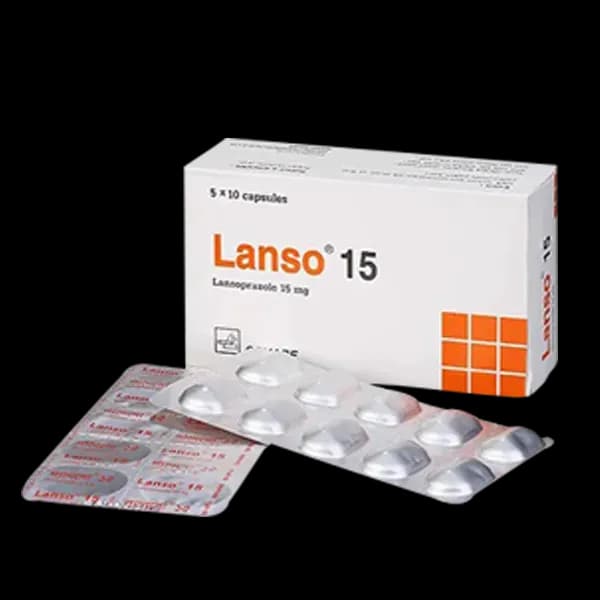

Lansodin is a proton pump inhibitor (PPI) approved for the following uses:
Each capsule/tablet contains Lansoprazole as the active ingredient, available in delayed-release (enteric-coated) formulations, typically as 15 mg and 30 mg capsules or orally disintegrating tablets. Formulation and available strengths may vary by manufacturer; check the product label for exact composition and excipients.
Lansodin is a substituted benzimidazole proton pump inhibitor that suppresses gastric acid secretion. It is prescribed for acid-related disorders of the upper gastrointestinal tract, including GERD, peptic ulcer disease, and as part of combination regimens for H. pylori eradication. Lansodin is formulated as a delayed-release preparation because it is acid-labile and is broken down rapidly in an acidic environment.
Lansodin belongs to the Proton Pump Inhibitor (PPI) class of anti-secretory, acid-suppressing drugs used in the management of acid-peptic disorders.
Lansoprazole is a prodrug that accumulates in the acidic secretory canaliculi of gastric parietal cells, where it is converted to an active sulfenamide form. This active form binds covalently to cysteine residues on the H+/K+-ATPase (the "proton pump") on the luminal surface of the parietal cell membrane, irreversibly inhibiting the final step of gastric acid secretion.
Because the inhibition is irreversible, acid suppression persists until new proton pumps are synthesized, giving Lansoprazole a duration of action longer than its plasma half-life. Lansoprazole is well absorbed after oral administration, extensively metabolized in the liver primarily by CYP2C19 and, to a lesser extent, CYP3A4, and eliminated mainly via the bile and, to a lesser extent, the kidneys.
Lansodin dosing is individualized by indication. Delayed-release capsules should generally be taken before a meal, preferably breakfast. Capsules should be swallowed whole; for patients unable to swallow capsules, the capsule may be opened and the intact granules sprinkled on a small amount of soft food or mixed with an appropriate liquid, per product labeling — the granules should not be crushed or chewed.
| Indication | Adult dose | Duration |
|---|---|---|
| GERD (symptomatic, non-erosive) | 15 mg once daily | Up to 8 weeks |
| Erosive esophagitis (healing) | 30 mg once daily | Up to 8 weeks |
| Erosive esophagitis (maintenance) | 15 mg once daily | Long-term, per physician |
| Duodenal ulcer (active) | 15 mg once daily | 4 weeks |
| Duodenal ulcer (maintenance) | 15 mg once daily | Long-term, per physician |
| Gastric ulcer (active, benign) | 30 mg once daily | Up to 8 weeks |
| NSAID-associated gastric ulcer (treatment) | 30 mg once daily | Up to 8 weeks |
| NSAID-associated gastric ulcer (risk reduction) | 15 mg once daily | Up to 12 weeks |
| H. pylori eradication (triple therapy) | 30 mg twice daily with amoxicillin 1 g twice daily and clarithromycin 500 mg twice daily | 10-14 days |
| Pathological hypersecretory conditions (e.g. Zollinger-Ellison syndrome) | Start 60 mg once daily; individualize up to 180 mg/day; doses above 120 mg/day given in divided doses | Per physician, based on gastric acid output |
In patients with severe hepatic impairment, dose reduction and close monitoring should be considered; consult a physician for individualized dosing.
See Precautions and Warnings for guidance on antibiotic stewardship when Lansodin is used as part of H. pylori combination therapy.
Take Lansodin before a meal, preferably in the morning. Swallow the delayed-release capsule whole with water; do not crush or chew. If unable to swallow capsules, the capsule may be opened and its granules sprinkled on a small amount of soft food (such as applesauce) or mixed with an appropriate liquid, and taken immediately without chewing, following product-specific instructions. Orally disintegrating tablet formulations, where available, dissolve on the tongue and can be taken with or without water.
Lansodin raises gastric pH, which can affect the absorption of certain co-administered drugs, and it is partly metabolized by CYP2C19, which can affect drugs sharing that pathway. Clinically significant interactions include:
Lansoprazole is contraindicated in:
Most patients tolerate Lansodin well. Reported adverse effects include:
Pregnancy: Available human data have not shown a clear increased risk of major birth defects with Lansodin use in pregnancy, but data remain limited. Lansodin should be used during pregnancy only if clearly needed and the potential benefit justifies the potential risk to the fetus; consult a physician before use.
Lactation: Lansodin is excreted into breast milk. Because the effects on a nursing infant are not fully established, Lansodin should be used during breastfeeding only after consulting a physician, weighing the benefits of treatment against potential risk to the infant.
The following precautions apply to Lansodin:
See Pregnancy and Lactation, and Side Effects, for additional related information.
Reported experience with Lansodin overdose is limited and no specific antidote is known. In case of suspected overdose, seek immediate medical attention or contact a poison control center/emergency services. Management is supportive and symptomatic, guided by a physician; do not attempt specific home treatment.
Store at room temperature (below 30°C), away from light and moisture. Keep out of reach of children.
Elderly: no overall dosage adjustment is generally required based on age alone, though elderly patients may be at greater risk of the long-term risks described under Precautions and Warnings (fracture, hypomagnesemia, B12 deficiency); use the lowest effective dose.
Renal impairment: no dosage adjustment is generally required, as Lansodin is primarily eliminated by hepatic metabolism.
Hepatic impairment: in severe hepatic impairment, dose reduction and closer monitoring should be considered; consult a physician for individualized dosing. See Dosage and Administration.
Pediatric: approved for GERD/erosive esophagitis in children 1 year and older using age/weight-based dosing (see Dosage and Administration); safety and efficacy for other indications in children have not been established.
Duration of Lansodin therapy depends on indication: typically 4 weeks for duodenal ulcer, up to 8 weeks for GERD/erosive esophagitis/gastric ulcer, 10-14 days as part of H. pylori triple therapy, and longer-term/maintenance dosing for erosive esophagitis maintenance or hypersecretory conditions under physician supervision. Do not continue therapy beyond the period advised by your physician without re-evaluation, given the risks of long-term use described under Precautions and Warnings.
Lansoprazole belongs to the Proton Pump Inhibitor (PPI) class, within the broader category of antisecretory / anti-ulcer agents.
Lansoprazole irreversibly inhibits the gastric H+/K+-ATPase (proton pump) in parietal cells, blocking the final common step of gastric acid secretion regardless of the stimulus (histamine, gastrin, or acetylcholine), resulting in profound and sustained suppression of gastric acid output.
B
Lansodin is approved for short-term treatment of GERD and erosive esophagitis in children 1 year of age and older, using weight-based dosing (15 mg once daily for children ≤30 kg, 30 mg once daily for children >30 kg, ages 1-11 years, for up to 12 weeks; 30 mg once daily for ages 12-17 years, for up to 8 weeks). Safety and efficacy of Lansodin have not been established for other indications or in children under 1 year of age. Use in children should be under close physician supervision.
Q: What is Lansodin 15 mg Capsule used for?
A: Lansodin 15 mg Capsule is a proton pump inhibitor used to treat acid-related conditions such as gastroesophageal reflux disease (GERD), duodenal and gastric ulcers, and — combined with antibiotics — to help eradicate H. pylori infection.
Q: How should I take Lansodin 15 mg Capsule?
A: Take Lansodin 15 mg Capsule before a meal, preferably breakfast, swallowing the capsule whole with water. Do not crush or chew it. Take it at the same time each day for best effect.
Q: Can I take Lansodin 15 mg Capsule long-term?
A: Lansodin 15 mg Capsule is generally used for the shortest duration needed for your condition. Long-term use (especially beyond one year) has been linked to increased risk of bone fracture, low magnesium levels, and vitamin B12 deficiency, so your physician should periodically review the need for continued therapy.
Q: Is Lansodin 15 mg Capsule safe during pregnancy or breastfeeding?
A: Lansodin 15 mg Capsule should be used in pregnancy or while breastfeeding only if your physician determines it is clearly needed, since the potential benefit must be weighed against any potential risk to the fetus or nursing infant. Always consult your physician before use in these situations.
Q: What should I do if I miss a dose or take too much Lansodin 15 mg Capsule?
A: If you miss a dose, take it as soon as you remember unless it is close to your next dose — do not double up. If you suspect you have taken too much Lansodin 15 mg Capsule, seek immediate medical attention or contact a poison control center/emergency services.
Q: Can I stop Lansodin 15 mg Capsule suddenly?
A: Stopping Lansodin 15 mg Capsule abruptly after prolonged use may cause a temporary rebound increase in stomach acid symptoms. Discuss with your physician whether your dose should be gradually reduced rather than stopped abruptly.
Disclaimer
The information provided is accurate to the best of our knowledge, but it does not replace professional medical advice. We cannot guarantee its completeness or accuracy, and the absence of specific information about a drug should not be taken as an endorsement. We are not responsible for any consequences arising from this information, so please consult a healthcare professional for any concerns or questions.
