
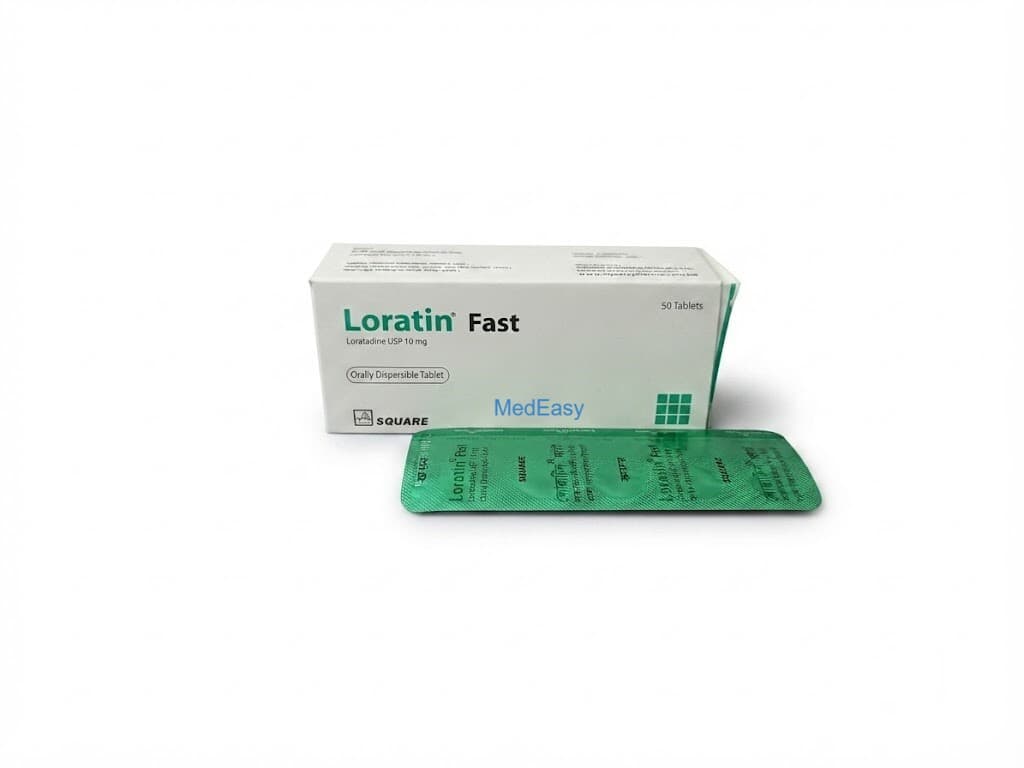

Medicine overview
Indications of Loratin Fast
Allergic Rhinitis
Loratin Fast is an established, guideline-supported treatment for the relief of symptoms associated with seasonal (hay fever) and perennial allergic rhinitis, including sneezing, runny nose, itchy or watery eyes, and itching of the nose or throat. Loratin Fast works alone (monotherapy) for these symptoms and does not require combination therapy for typical seasonal or perennial allergic rhinitis.
Chronic Urticaria (Hives)
Loratin Fast is established and guideline-recommended as a first-line option for chronic idiopathic urticaria, reducing the number, size, and itch of hives. Some patients with inadequate response may require dose adjustment or add-on therapy under a doctor's supervision (requires-combination-therapy in refractory cases) — this is a decision for the prescribing physician, not a self-directed change.
Other Allergic Skin Conditions
Loratin Fast may provide adjunct symptomatic relief of itching in other allergic skin conditions, but Loratin Fast is not a primary treatment for the underlying skin disease itself and should be used alongside, not instead of, condition-specific therapy directed by a doctor.
Off-Label Uses
Loratin Fast has limited off-label use (for example, adjunct management of certain drug-induced skin reactions or bone pain associated with certain treatments), based on small studies or case reports only; these uses are not FDA-approved and should only be considered under specialist guidance.
Composition
Description
Therapeutic Class
Pharmacology
Dosage & Administration of Loratin Fast
Administration of Loratin Fast
- Loratin Fast tablets can be taken with or without food, generally at the same time each day.
- Swallow the tablet with a glass of water; an orally disintegrating tablet form, if dispensed, should be allowed to dissolve on the tongue rather than chewed or swallowed whole.
- Loratin Fast oral suspension should be measured using the calibrated device provided, not a household spoon.
- Do not take more than one dose of Loratin Fast in a 24-hour period unless a doctor has directed otherwise.
- If a dose of Loratin Fast is missed, take the missed dose when remembered unless the next scheduled dose is almost due; do not double the dose.
Interaction of Loratin Fast
- CYP3A4/CYP2D6 inhibitors (e.g., ketoconazole, erythromycin, cimetidine): these medicines can raise blood levels of Loratin Fast by inhibiting the liver enzymes that break Loratin Fast down; in clinical studies this increased Loratin Fast plasma concentrations without a corresponding increase in sedation or other adverse effects, but caution and medical advice are still recommended when combining these agents with Loratin Fast.
- Central nervous system depressants (e.g., benzodiazepines, opioids, sedating antihistamines, alcohol): although Loratin Fast itself is minimally sedating, combining Loratin Fast with other CNS depressants may still add to drowsiness in some individuals, and caution is advised.
- Other H1-antihistamines or histamine-based therapies: combining Loratin Fast with other antihistamine products is generally unnecessary and can increase the risk of side effects without added benefit; discuss any such combination with a doctor or pharmacist.
Contraindications
Loratadine is contraindicated in patients with known hypersensitivity to Loratadine or to any component of the Loratadine formulation.
Side Effects of Loratin Fast
Common Side Effects
Headache, dry mouth, fatigue or tiredness, and gastrointestinal upset (such as nausea, abdominal discomfort) have been reported with Loratin Fast, generally at rates similar to placebo in clinical trials. Mild drowsiness can occur in some people even though Loratin Fast is classed as non-sedating.
Serious Side Effects — Seek Medical Attention
Seek prompt medical attention if any of the following occur with use of Loratin Fast: signs of an allergic reaction (rash, hives, swelling of the face/lips/tongue/throat, difficulty breathing); fast or irregular heartbeat; or fainting. These reactions are uncommon but require urgent evaluation. See Precautions and Warnings and Overdose Effects for further detail.
Pregnancy & Lactation
Pregnancy
Human pregnancy data on Loratin Fast are more extensive than for many other allergy medicines and are generally reassuring: several cohort and case-control studies, including large birth-defect surveillance data, have not found an increased risk of major birth defects (including an earlier reported hypospadias signal that was not confirmed in later, larger studies) or of miscarriage with first-trimester use of Loratin Fast. This differs from some older manufacturer labeling that classified Loratin Fast use in pregnancy as “not recommended unless clearly needed” based on limited data available at the time. Loratin Fast should still only be used in pregnancy if a doctor decides Loratin Fast is needed, since no medicine can be called completely risk-free in pregnancy.
Breastfeeding
Loratin Fast and desLoratin Fast, the active metabolite of Loratin Fast, pass into breast milk in small amounts. Available data suggest the amount is too low to be expected to cause problems in most breastfed infants, and Loratin Fast is often considered a preferred antihistamine choice during breastfeeding because Loratin Fast is less sedating than older agents. There is a theoretical possibility that Loratin Fast, particularly combined with other medicines, could reduce milk supply in some mothers; a doctor should be consulted, especially if milk supply concerns arise.
Precautions & Warnings
- Liver or kidney disease: Loratin Fast is broken down by the liver and cleared partly by the kidneys, so patients with significant hepatic impairment or severe renal impairment may need a reduced dosing frequency; consult a doctor before use — see Use in Special Populations.
- Driving or operating machinery: although Loratin Fast is classed as non-sedating and has performed comparably to placebo on driving and psychomotor tests in studies, individual sensitivity varies, and caution is advised until a person knows how Loratin Fast affects them.
- Known allergy to antihistamines: people with a prior allergic reaction to Loratin Fast or similar antihistamines should avoid Loratin Fast and inform their doctor or pharmacist.
- Use in young children: safety and effectiveness of Loratin Fast have not been well established in children younger than 2 years; use in this age group should only occur under a pediatrician's direction — see Use in Special Populations.
- Self-medication limits: if allergy symptoms do not improve after several days of Loratin Fast use, or worsen, or are accompanied by fever, a doctor should be consulted rather than continuing to increase or extend Loratin Fast use on one's own.
Overdose Effects of Loratin Fast
Reported effects of Loratin Fast overdose in adults have most commonly included drowsiness, fast heartbeat (tachycardia), and headache. In children, overdose has been associated with effects such as fast heartbeat and, less commonly, movement (extrapyramidal-type) symptoms; most reported pediatric ingestions have caused only mild, transient changes in vital signs. Do not induce vomiting unless specifically directed to do so by a doctor or Poison Control. If an overdose of Loratin Fast is suspected, contact a doctor, hospital emergency department, or a Poison Control Center immediately for guidance; treatment is generally supportive and may include activated charcoal if given soon after ingestion, under medical supervision.
Storage Conditions
Use In Special Populations
Children
Loratin Fast is approved for use from 2 years of age for allergic rhinitis and chronic urticaria, with a lower dose (5 mg once daily) used for children 2 to under 6 years and the adult dose (10 mg once daily) from 6 years. Use in children younger than 2 years is not established and should only be undertaken on a pediatrician's specific advice — see Pediatric Uses for detail.
Elderly
Studies have not shown significant differences in the effectiveness or overall safety profile of Loratin Fast between elderly and younger adults; no routine dose adjustment based on age alone is required, though age-related decline in liver or kidney function should be considered (see Renal and Hepatic Impairment below).
Renal Impairment
In patients with severe renal impairment, clearance of Loratin Fast and desLoratin Fast, the active metabolite of Loratin Fast, is reduced. A reduced-frequency dosing regimen (such as giving the usual age-appropriate dose every other day) is commonly recommended in this situation, but the exact adjustment should be individualized by the prescribing doctor rather than self-directed.
Hepatic Impairment
Because Loratin Fast is extensively metabolized by the liver, patients with significant hepatic impairment can have higher and longer-lasting blood levels of Loratin Fast. A reduced-frequency regimen similar to that used in renal impairment is commonly recommended, under a doctor's direction.
Pregnant and Breastfeeding Women
See Pregnancy and Lactation for detailed guidance; use should be directed by a treating doctor.
Duration Of Treatment
Drug Classes
Mode Of Action
Pediatric Uses
Frequently Asked Questions
What is Loratin Fast 10 mg Dispersible Tablet used for?
Loratin Fast 10 mg Dispersible Tablet is used to relieve symptoms of seasonal and year-round allergic rhinitis, such as sneezing, runny nose, and itchy watery eyes, and to reduce itching and hives associated with chronic urticaria.
How should Loratin Fast 10 mg Dispersible Tablet be taken?
Loratin Fast 10 mg Dispersible Tablet is usually taken as one tablet by mouth once daily, with or without food. The exact dose of Loratin Fast 10 mg Dispersible Tablet depends on age and the condition being treated, so Loratin Fast 10 mg Dispersible Tablet should be taken as directed by a doctor or the product label.
Can children take Loratin Fast 10 mg Dispersible Tablet?
Yes, Loratin Fast 10 mg Dispersible Tablet is approved for children 2 years of age and older, usually at a lower dose (5 mg) for children under 6 years. Loratin Fast 10 mg Dispersible Tablet is not recommended for children younger than 2 years unless specifically directed by a pediatrician.
Is Loratin Fast 10 mg Dispersible Tablet safe during pregnancy?
Human data on Loratin Fast 10 mg Dispersible Tablet use in pregnancy are relatively reassuring compared with many other medicines, without a confirmed increase in birth defects across larger studies, but Loratin Fast 10 mg Dispersible Tablet should still only be used in pregnancy if a doctor advises that Loratin Fast 10 mg Dispersible Tablet is needed, since no medicine is entirely without theoretical risk.
Can Loratin Fast 10 mg Dispersible Tablet be taken while breastfeeding?
Small amounts of Loratin Fast 10 mg Dispersible Tablet pass into breast milk, but available data suggest this is unlikely to affect most breastfed infants, and Loratin Fast 10 mg Dispersible Tablet is often preferred over more sedating antihistamines during breastfeeding; a doctor should still be consulted, particularly if milk supply concerns arise.
Does Loratin Fast 10 mg Dispersible Tablet interact with other medicines?
The blood levels of Loratin Fast 10 mg Dispersible Tablet can be raised by certain medicines such as ketoconazole, erythromycin, or cimetidine, and combining Loratin Fast 10 mg Dispersible Tablet with other sedating medicines or alcohol may add to drowsiness in some people. Always tell a doctor or pharmacist about all medicines being taken alongside Loratin Fast 10 mg Dispersible Tablet.
What are the common side effects of Loratin Fast 10 mg Dispersible Tablet?
The most commonly reported side effects of Loratin Fast 10 mg Dispersible Tablet include headache, dry mouth, fatigue, and mild stomach upset; these occur at rates similar to placebo in most studies. Serious allergic reactions are uncommon but require immediate medical attention.
Can Loratin Fast 10 mg Dispersible Tablet be taken with milk?
Yes, Loratin Fast 10 mg Dispersible Tablet can generally be taken with milk or other food, or on an empty stomach — food does not meaningfully affect how Loratin Fast 10 mg Dispersible Tablet works. Follow the specific instructions on the Loratin Fast 10 mg Dispersible Tablet product label or from a doctor.
What should be done if too much Loratin Fast 10 mg Dispersible Tablet is taken?
If an overdose of Loratin Fast 10 mg Dispersible Tablet is suspected, do not induce vomiting unless told to by a medical professional, and contact a doctor, hospital, or Poison Control Center right away, since overdose can cause drowsiness, a fast heartbeat, or headache, and children may show other effects requiring evaluation.
Disclaimer
The information provided is accurate to the best of our knowledge, but it does not replace professional medical advice. We cannot guarantee its completeness or accuracy, and the absence of specific information about a drug should not be taken as an endorsement. We are not responsible for any consequences arising from this information, so please consult a healthcare professional for any concerns or questions.
