

10% Off
Ocugel2%
Aristopharma Ltd.
৳108.00
Add to cart
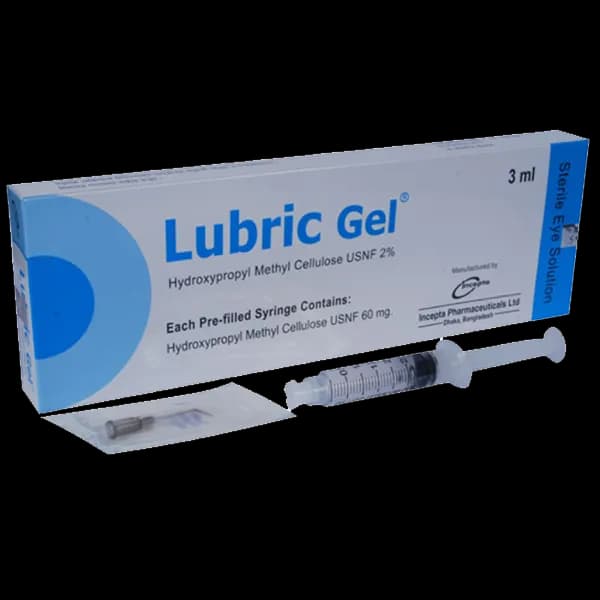

Lubric Gel (hypromellose) is an ophthalmic demulcent/lubricant. Its established and commonly accepted uses include:
Lubric Gel does not treat the underlying cause of dry eye; it provides symptomatic, temporary relief.
Ophthalmic products typically contain Hydroxypropyl Methylcellulose as the active ingredient at a concentration commonly ranging from 0.3% to 0.4% w/v (formulations from 0.2% to 0.67% w/v exist depending on the brand and indication), formulated as a sterile ophthalmic solution.
Inactive ingredients vary by brand and may include buffering agents, tonicity agents, and, in multi-dose bottles, a preservative (e.g., benzalkonium chloride); preservative-free single-use vials are also available.
Lubric Gel, also known as hypromellose, is a semi-synthetic, water-soluble cellulose derivative used in ophthalmology as a viscosity-enhancing lubricant and demulcent.
When instilled in the eye, Lubric Gel forms a thin, lubricating film over the ocular surface that helps stabilize the tear film, reduce evaporation, and relieve the sensation of dryness, grittiness, or irritation. It is available over-the-counter as artificial tears/lubricant eye drops and, in higher-viscosity surgical-grade formulations, as a viscoelastic aid used during eye surgery.
Lubric Gel belongs to the therapeutic class of ophthalmic lubricants and demulcents (artificial tear substitutes). It is classified pharmaceutically as a viscosity-increasing agent/cellulose derivative used topically in the eye.
Hydroxypropyl Methylcellulose is a hydrophilic, viscous polymer that, when applied to the ocular surface, increases the viscosity of the tear film and prolongs the residence (contact) time of tears on the eye. This helps to:
Hydroxypropyl Methylcellulose acts locally on the ocular surface. It is not intended for systemic absorption, and when used as directed in the eye, systemic absorption is minimal to negligible. It is not metabolized systemically to a clinically relevant extent when used ophthalmically.
| Population | Recommended Dose |
|---|---|
| Adults and children | Instill 1–2 drops of Lubric Gel ophthalmic solution into the affected eye(s) as needed, typically 3–4 times daily or as directed on the product label/by a physician. |
When used as a viscoelastic aid during ophthalmic surgery, Lubric Gel is administered intraocularly by the operating ophthalmologist in a controlled clinical/surgical setting; the amount and technique are determined by the surgeon based on the procedure.
For ophthalmic (eye) use only. Instill Lubric Gel drops directly into the conjunctival sac of the affected eye without touching the dropper tip to the eye, eyelid, or any other surface, to avoid contamination. Not for injection or oral use unless part of a specifically formulated surgical viscoelastic product administered by a healthcare professional.
Lubric Gel has minimal to no systemic absorption when used as an ophthalmic lubricant, so clinically significant systemic drug interactions are not expected.
Hydroxypropyl Methylcellulose ophthalmic products are contraindicated in patients with known hypersensitivity to Hydroxypropyl Methylcellulose or to any other ingredient in the specific formulation (e.g., preservatives such as benzalkonium chloride in some products).
Lubric Gel eye drops are generally very well tolerated. Reported effects are mostly local and transient:
If irritation, pain, or vision changes worsen or persist, discontinue use and consult a physician.
Pregnancy: Lubric Gel used as an ophthalmic lubricant has minimal systemic absorption. While formal reproductive studies in pregnant women are limited, topical ophthalmic use is generally considered to carry low risk; nonetheless, as with any medication, Lubric Gel should be used during pregnancy only if clearly needed, and it is advisable to consult a physician before use.
Lactation: Due to negligible systemic absorption, Lubric Gel is generally considered compatible with breastfeeding when used as directed for ophthalmic purposes; a physician should still be consulted if there is any concern.
Ocular overdose (excessive instillation) of Lubric Gel is unlikely to cause serious harm due to its minimal systemic absorption, but may cause temporary blurred vision or watering of the eyes. If Lubric Gel is accidentally ingested or if excessive/inappropriate use causes persistent eye irritation, pain, or vision changes, seek immediate medical attention or contact a poison control center. Do not attempt unsupervised home treatment beyond flushing the eye with clean water if irritation occurs.
Store at room temperature (below 30°C), away from light and moisture. Keep out of reach of children. Do not use if the solution has changed color or become cloudy. Discard multi-dose bottles after the period specified on the label once opened (commonly within 4 weeks), and discard single-use vials immediately after use.
Lubric Gel ophthalmic lubricant may be used in children for symptomatic relief of dry eye/ocular irritation; there is no well-established minimum age restriction for the OTC lubricant use, but a physician should be consulted for use in infants and young children.
No specific dose adjustment is required in elderly patients. Dry eye is common in this population, and Lubric Gel is commonly used for symptomatic relief.
Because systemic absorption of ophthalmic Lubric Gel is negligible, no dose adjustment is required in renal or hepatic impairment.
Lubric Gel may be used as needed for as long as symptoms of dryness or irritation persist. If symptoms do not improve, or if eye pain, vision changes, or redness persist beyond 72 hours of use, discontinue and consult a physician, as this may indicate an underlying condition requiring different treatment.
Ophthalmic lubricant / demulcent; artificial tear substitute; viscosity-enhancing cellulose derivative; ophthalmic viscosurgical device (surgical-grade formulations).
Hydroxypropyl Methylcellulose increases the viscosity and stability of the tear film on the ocular surface, prolonging tear contact time, reducing evaporation, and providing a lubricating, protective layer over the cornea and conjunctiva, thereby relieving dryness and irritation.
Lubric Gel ophthalmic lubricant drops can generally be used in children for symptomatic relief of dry eye or eye irritation, following label directions or a physician's guidance. Safety and efficacy of specific surgical viscoelastic formulations in pediatric surgical settings are established only within the professional/clinical use context supervised by an ophthalmologist. Parents should consult a physician before use in infants.
Q: What is Lubric Gel 2% Viscoelastic Solution eye drops used for?
A: Lubric Gel 2% Viscoelastic Solution is used as an ophthalmic lubricant (artificial tears) to relieve dryness, burning, irritation, and discomfort of the eyes caused by insufficient or unstable tear film, such as from wind, sun, screen use, or minor eye irritation.
Q: How often should I use Lubric Gel 2% Viscoelastic Solution eye drops?
A: Typically 1–2 drops are instilled into the affected eye(s) 3–4 times daily as needed, or as directed by a physician or the product label. Do not exceed the recommended frequency without medical advice.
Q: Can I wear contact lenses while using Lubric Gel 2% Viscoelastic Solution?
A: Contact lenses should generally be removed before instilling Lubric Gel 2% Viscoelastic Solution unless the product is specifically labeled safe for use with lenses in place. Wait as directed (commonly at least 15 minutes) before reinserting lenses to avoid interactions with preservatives.
Q: Is Lubric Gel 2% Viscoelastic Solution safe to use during pregnancy or breastfeeding?
A: Lubric Gel 2% Viscoelastic Solution has minimal systemic absorption when used as eye drops and is generally considered low-risk, but it should be used during pregnancy or breastfeeding only if clearly needed, and a physician should be consulted before use.
Q: What side effects can Lubric Gel 2% Viscoelastic Solution eye drops cause?
A: The most common effects are transient blurred vision right after use and mild stinging. Persistent redness, pain, or vision changes are not typical and should prompt discontinuation and medical evaluation.
Q: What should I do if I accidentally use too much Lubric Gel 2% Viscoelastic Solution?
A: Excess ophthalmic use is unlikely to cause serious harm, but if irritation persists or if the product is swallowed and you are concerned, seek immediate medical attention or contact a poison control center.
Disclaimer
The information provided is accurate to the best of our knowledge, but it does not replace professional medical advice. We cannot guarantee its completeness or accuracy, and the absence of specific information about a drug should not be taken as an endorsement. We are not responsible for any consequences arising from this information, so please consult a healthcare professional for any concerns or questions.
