
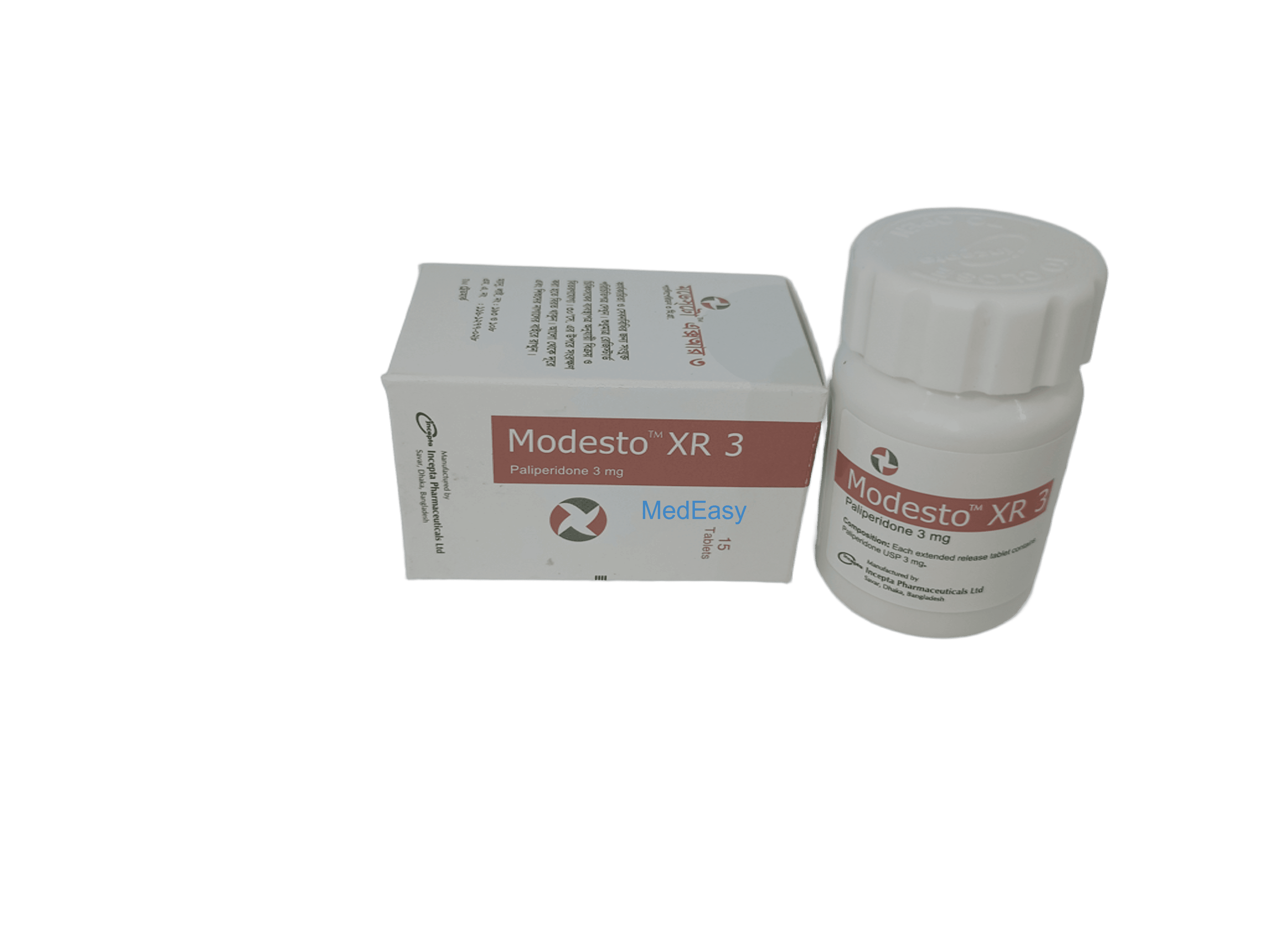

Medicine overview
Indications of Modesto XR
Modesto XR is an atypical (second-generation) antipsychotic, the major active metabolite of risperidone. Its evidence-based uses include:
- Established/FDA-approved uses:
- Treatment of schizophrenia in adults and in adolescents aged 12–17 years (acute treatment and prevention of recurrence).
- Treatment of schizoaffective disorder in adults, as monotherapy or as an adjunct to mood stabilizers or antidepressants.
- Maintenance/long-term use: Once stabilized, Modesto XR (oral extended-release) may be continued for relapse prevention; a long-acting injectable ester of Modesto XR (Modesto XR palmitate) is also available separately for once-monthly or longer-interval maintenance therapy.
- Off-label use (not FDA-approved, used in some clinical settings): Adjunctive management of treatment-resistant mood symptoms in bipolar disorder; this is not a standard first-line use and should only be undertaken by a specialist.
Modesto XR is not approved for treatment of dementia-related psychosis in elderly patients (see Precautions and Warnings for the boxed warning).
Composition
Each extended-release (prolonged-release, OROS-technology) film-coated tablet contains Paliperidone as the active ingredient, commonly available in strengths of 1.5 mg, 3 mg, 6 mg, and 9 mg. In Bangladesh, Paliperidone extended-release tablets are typically marketed in 1.5 mg, 3 mg, and 6 mg strengths.
Description
Modesto XR is a benzisoxazole-derivative, second-generation (atypical) antipsychotic and the principal active metabolite of risperidone. It is formulated as an extended-release oral tablet using an osmotic-controlled release (OROS) delivery system, allowing once-daily dosing with a relatively steady plasma concentration over 24 hours. Modesto XR is used mainly for schizophrenia and schizoaffective disorder. A long-acting injectable palmitate ester of Modesto XR exists for maintenance treatment but is marketed and labeled as a separate generic (Modesto XR palmitate).
Therapeutic Class
Modesto XR belongs to the atypical (second-generation) antipsychotic class of medicines, specifically a benzisoxazole derivative.
Pharmacology
Paliperidone acts as a central dopamine D2 receptor antagonist and serotonin 5-HT2A receptor antagonist, a combination believed to improve psychotic symptoms while reducing extrapyramidal effects compared with typical antipsychotics. It also has antagonist activity at alpha-1 and alpha-2 adrenergic receptors and H1 histaminergic receptors, but has little to no affinity for cholinergic muscarinic or beta-adrenergic receptors.
Pharmacokinetics: Oral extended-release Paliperidone is released gradually via an OROS osmotic pump tablet, reaching a relatively constant plasma concentration over approximately 24 hours; peak plasma levels occur about 24 hours after dosing. Plasma protein binding is approximately 74%. Paliperidone undergoes limited hepatic metabolism (via CYP2D6 and CYP3A4, among other minor pathways) and is eliminated largely unchanged in urine (about 80% of the dose), with an elimination half-life of approximately 23 hours. Because renal excretion is the major elimination pathway, dose adjustment is required in renal impairment.
Dosage & Administration of Modesto XR
Adults — Schizophrenia
| Parameter | Dose |
|---|---|
| Initial dose | 6 mg once daily, in the morning |
| Recommended range | 3–12 mg once daily |
| Titration | Increase by 3 mg increments; allow at least 5 days between dose increases |
| Maximum dose | 12 mg once daily |
Adults — Schizoaffective Disorder
| Parameter | Dose |
|---|---|
| Initial dose | 6 mg once daily, in the morning |
| Recommended range | 3–12 mg once daily |
| Titration | Increase by 3 mg increments; allow at least 4 days between dose increases |
Adolescents (12–17 years) — Schizophrenia
| Body weight | Dose |
|---|---|
| Initial dose (all weights) | 3 mg once daily |
| Less than 51 kg | Maximum 6 mg once daily |
| 51 kg or more | Maximum 12 mg once daily |
Modesto XR is not established as safe and effective for schizoaffective disorder in patients under 18 years of age.
Renal Impairment (Adults)
| Renal function | Dose |
|---|---|
| Mild impairment (CrCl 50 to <80 mL/min) | Initial 3 mg once daily; maximum 6 mg once daily |
| Moderate to severe impairment (CrCl 10 to <50 mL/min) | Initial 1.5 mg once daily; maximum 3 mg once daily |
Administration
Tablets must be swallowed whole with the aid of liquid and must not be chewed, divided, or crushed. Modesto XR extended-release tablets may be taken with or without food, at approximately the same time each day. Patients should be counselled that the tablet shell is non-deformable and may occasionally be seen intact in the stool — this is expected with the OROS delivery system and does not indicate the dose was not absorbed.
Administration of Modesto XR
Modesto XR extended-release tablets are for oral use only, once daily, preferably at the same time each day. Tablets must be swallowed whole with liquid and must never be chewed, crushed, or divided, as this would disrupt the controlled-release mechanism. They may be taken with or without food. If a dose is missed, it should generally be taken as soon as remembered unless it is nearly time for the next dose, in which case the missed dose should be skipped — do not double the dose. Any change in dose or discontinuation should be directed by the prescribing physician.
Interaction of Modesto XR
| Interacting agent(s) | Effect / clinical consequence |
|---|---|
| Strong CYP3A4/P-glycoprotein inducers (e.g., carbamazepine, rifampicin) | Can substantially decrease plasma concentrations of Modesto XR; dose adjustment may be needed if an inducer is added or withdrawn. |
| Valproate (divalproex sodium) | Can increase plasma concentrations of Modesto XR; a lower Modesto XR dose may be needed. |
| Other centrally-acting drugs and alcohol | Additive CNS depression, sedation, and psychomotor impairment; alcohol should be avoided. |
| Drugs that prolong the QT interval (e.g., certain antiarrhythmics, some antibiotics/antimalarials) | Additive risk of QT prolongation and arrhythmia; avoid combining where possible. |
| Antihypertensive agents | May potentiate orthostatic hypotension caused by Modesto XR. |
| Levodopa and other dopamine agonists | Modesto XR may antagonize the effects of dopamine agonists; concurrent use is generally avoided in Parkinson's disease. |
Contraindications
Paliperidone is contraindicated in patients with known hypersensitivity to Paliperidone or to risperidone, or to any component of the formulation. Hypersensitivity reactions, including anaphylaxis and angioedema, have been reported.
Side Effects of Modesto XR
| Category | Effects |
|---|---|
| Very common / common | Akathisia, somnolence/sedation, tremor, dystonia, cogwheel rigidity (extrapyramidal symptoms), tachycardia, weight gain, dyspepsia, constipation, anxiety, headache |
| Hyperprolactinemia-related | Menstrual irregularities, galactorrhea, gynecomastia, decreased libido, erectile dysfunction |
| Less common but clinically important (see Precautions and Warnings) | Neuroleptic malignant syndrome, tardive dyskinesia, QT prolongation, orthostatic hypotension and syncope, significant weight gain and metabolic changes (hyperglycemia, dyslipidemia), leukopenia/neutropenia (rare) |
Pregnancy & Lactation
Pregnancy
Modesto XR should be used during pregnancy only if the potential benefit justifies the potential risk to the fetus, and only under close medical supervision — do not stop or start Modesto XR in pregnancy without consulting a physician. Neonates exposed to antipsychotic drugs, including Modesto XR, during the third trimester are at risk of extrapyramidal and/or withdrawal symptoms after delivery (agitation, abnormal muscle tone, tremor, feeding difficulty, respiratory distress); such symptoms have varied in severity and have been self-limiting in some cases and required intensive care in others.
Lactation
Modesto XR is excreted in human breast milk. A decision on breastfeeding during treatment should weigh the benefits of breastfeeding against the mother's clinical need for Modesto XR and any potential effects on the breastfed infant, in consultation with a physician; the infant should be monitored for sedation, abnormal muscle tone, or feeding problems if breastfeeding is continued.
Precautions & Warnings
Boxed Warning
Elderly patients with dementia-related psychosis treated with antipsychotic drugs, including Modesto XR, are at an increased risk of death compared with placebo, most commonly from cardiovascular or infectious causes. Modesto XR is not approved for the treatment of dementia-related psychosis.
Other Precautions
- Cerebrovascular adverse events: Increased risk of stroke and transient ischemic attack in elderly patients with dementia-related psychosis.
- Neuroleptic malignant syndrome (NMS): A rare but potentially fatal reaction with hyperthermia, muscle rigidity, altered mental status, and autonomic instability; discontinue Modesto XR immediately if suspected.
- QT prolongation: Dose-dependent; avoid use with other QT-prolonging drugs and in patients with known cardiac conduction abnormalities, uncorrected electrolyte disturbances, or congenital long QT syndrome.
- Tardive dyskinesia: Risk of potentially irreversible, involuntary movements increases with duration of therapy and cumulative dose; use the lowest effective dose for the shortest duration consistent with treatment goals.
- Metabolic changes: Hyperglycemia, new-onset or worsening diabetes, dyslipidemia, and weight gain have been reported; monitor blood glucose, lipids, and body weight periodically.
- Hyperprolactinemia: May cause elevated prolactin levels with related effects (see Side Effects); use caution in patients with prolactin-dependent tumors.
- Orthostatic hypotension and syncope: Use with caution in patients with cardiovascular disease, cerebrovascular disease, or conditions predisposing to hypotension.
- Gastrointestinal narrowing: Because the tablet is non-deformable, caution is warranted in patients with severe pre-existing gastrointestinal narrowing (pathologic or iatrogenic).
- Esophageal dysmotility and aspiration: Use with caution in elderly patients with dementia, and in others at risk of aspiration pneumonia.
- Seizures: Use cautiously in patients with a history of seizure disorder or conditions that lower the seizure threshold.
- Patient counseling point: The extended-release tablet shell is non-deformable and may occasionally be seen intact in the stool; this is expected and does not indicate the Modesto XR dose was not absorbed.
Overdose Effects of Modesto XR
Overdose with Modesto XR can produce exaggerated pharmacologic effects, including extrapyramidal symptoms, drowsiness, sedation, tachycardia, hypotension, and QT prolongation; gait disturbance has also been reported at very high doses. Overdose is a medical emergency.
If overdose is suspected, seek immediate medical attention or contact emergency services/a poison control center right away. There is no specific antidote; treatment is supportive, with attention to airway maintenance, oxygenation, cardiac (ECG) monitoring, and symptomatic management under close medical supervision. Do not attempt to manage an overdose at home.
Storage Conditions
Store at room temperature (below 30°C), away from light and moisture. Keep out of reach of children.
Use In Special Populations
Renal Impairment
Modesto XR is cleared primarily by the kidneys, so dosing must be reduced in renal impairment (see Dosage and Administration for the renal dosing table). Modesto XR is not recommended in patients with severe renal impairment (CrCl less than 10 mL/min) who have not been evaluated by a physician, due to insufficient data.
Hepatic Impairment
No dose adjustment is required in mild-to-moderate hepatic impairment. Modesto XR has not been systematically studied in severe hepatic impairment; use with caution.
Elderly / Dementia-Related Psychosis
Modesto XR is not approved for elderly patients with dementia-related psychosis because of an increased risk of death (see Precautions and Warnings, Boxed Warning). Elderly patients may also be more susceptible to orthostatic hypotension and should generally start at the lower end of the renal-adjusted dosing range if renal function is reduced, which is common with age.
Pediatric Use
Safety and efficacy for schizophrenia have been established in adolescents 12–17 years of age using weight-based maximum doses (see Dosage and Administration). Safety and efficacy for schizoaffective disorder have not been established in patients under 18 years, and Modesto XR is not established as safe and effective in children under 12 years of age for any indication.
Duration Of Treatment
Duration of treatment with Modesto XR is individualized. Acute psychotic episodes typically require several weeks of treatment to assess response before further dose adjustment. Because schizophrenia and schizoaffective disorder are usually chronic conditions, maintenance therapy with Modesto XR is often continued long-term to prevent relapse, with the need for continued treatment reassessed periodically by the prescribing physician, weighing benefits against risks such as tardive dyskinesia and metabolic effects. Modesto XR should not be stopped abruptly without medical advice.
Drug Classes
Paliperidone belongs to the class of atypical (second-generation) antipsychotics, specifically the benzisoxazole derivatives, and is classified as a dopamine D2 / serotonin 5-HT2A receptor antagonist.
Mode Of Action
Paliperidone exerts its antipsychotic effect mainly through antagonism of central dopamine D2 receptors and serotonin 5-HT2A receptors. This combined dopamine-serotonin antagonism is thought to improve positive and negative symptoms of psychosis while producing a lower burden of extrapyramidal symptoms than older, purely dopamine-antagonist antipsychotics. Paliperidone also antagonizes alpha-1/alpha-2 adrenergic and H1 histaminergic receptors, contributing to effects such as orthostatic hypotension and sedation, but has minimal affinity for muscarinic cholinergic receptors.
Pregnancy
C
Pediatric Uses
Modesto XR is approved for the treatment of schizophrenia in adolescents aged 12 to 17 years, using an initial dose of 3 mg once daily with a maximum dose based on body weight (6 mg/day if under 51 kg; 12 mg/day if 51 kg or more). Safety and efficacy for schizoaffective disorder have not been established in patients under 18 years of age, and Modesto XR is not established as safe and effective in children under 12 years for any indication. As with other antipsychotics, adolescents should be monitored closely for extrapyramidal symptoms, metabolic changes, and effects on growth and prolactin levels during treatment.
Frequently Asked Questions
Q: What is Modesto XR 3 mg Tablet (Extended Release) used for?
A: Modesto XR 3 mg Tablet (Extended Release) is used to treat schizophrenia in adults and adolescents (12–17 years), and schizoaffective disorder in adults, either alone or together with mood stabilizers or antidepressants.
Q: How should I take Modesto XR 3 mg Tablet (Extended Release) tablets?
A: Modesto XR 3 mg Tablet (Extended Release) extended-release tablets should be swallowed whole with liquid, once daily at about the same time each day, with or without food. Never chew, crush, or split the tablet. It is normal to occasionally see the empty tablet shell in the stool — this does not mean the dose was not absorbed.
Q: Can Modesto XR 3 mg Tablet (Extended Release) be used in elderly patients with dementia?
A: No. Elderly patients with dementia-related psychosis treated with antipsychotic drugs, including Modesto XR 3 mg Tablet (Extended Release), have an increased risk of death. Modesto XR 3 mg Tablet (Extended Release) is not approved for this use.
Q: Is Modesto XR 3 mg Tablet (Extended Release) safe during pregnancy and breastfeeding?
A: Modesto XR 3 mg Tablet (Extended Release) should be used in pregnancy only if the potential benefit justifies the potential risk to the fetus, since third-trimester exposure has been linked to extrapyramidal and withdrawal symptoms in newborns. Modesto XR 3 mg Tablet (Extended Release) also passes into breast milk, so breastfeeding while taking it should only be done after discussing the risks and benefits with a physician.
Q: What are the common side effects of Modesto XR 3 mg Tablet (Extended Release)?
A: Common side effects of Modesto XR 3 mg Tablet (Extended Release) include restlessness (akathisia), drowsiness, tremor, muscle stiffness, fast heartbeat, weight gain, indigestion, and constipation. Serious but less common effects include neuroleptic malignant syndrome, tardive dyskinesia, QT prolongation, and significant metabolic changes — seek medical advice if any severe or unusual symptoms occur.
Q: What should I do if I miss a dose or suspect an overdose of Modesto XR 3 mg Tablet (Extended Release)?
A: If a dose of Modesto XR 3 mg Tablet (Extended Release) is missed, take it as soon as remembered unless it is close to the next scheduled dose, in which case skip the missed dose — do not double up. If an overdose is suspected, seek immediate medical attention or contact emergency services/poison control right away, as overdose can cause severe drowsiness, low blood pressure, fast heart rate, and abnormal heart rhythm.
Disclaimer
The information provided is accurate to the best of our knowledge, but it does not replace professional medical advice. We cannot guarantee its completeness or accuracy, and the absence of specific information about a drug should not be taken as an endorsement. We are not responsible for any consequences arising from this information, so please consult a healthcare professional for any concerns or questions.
