
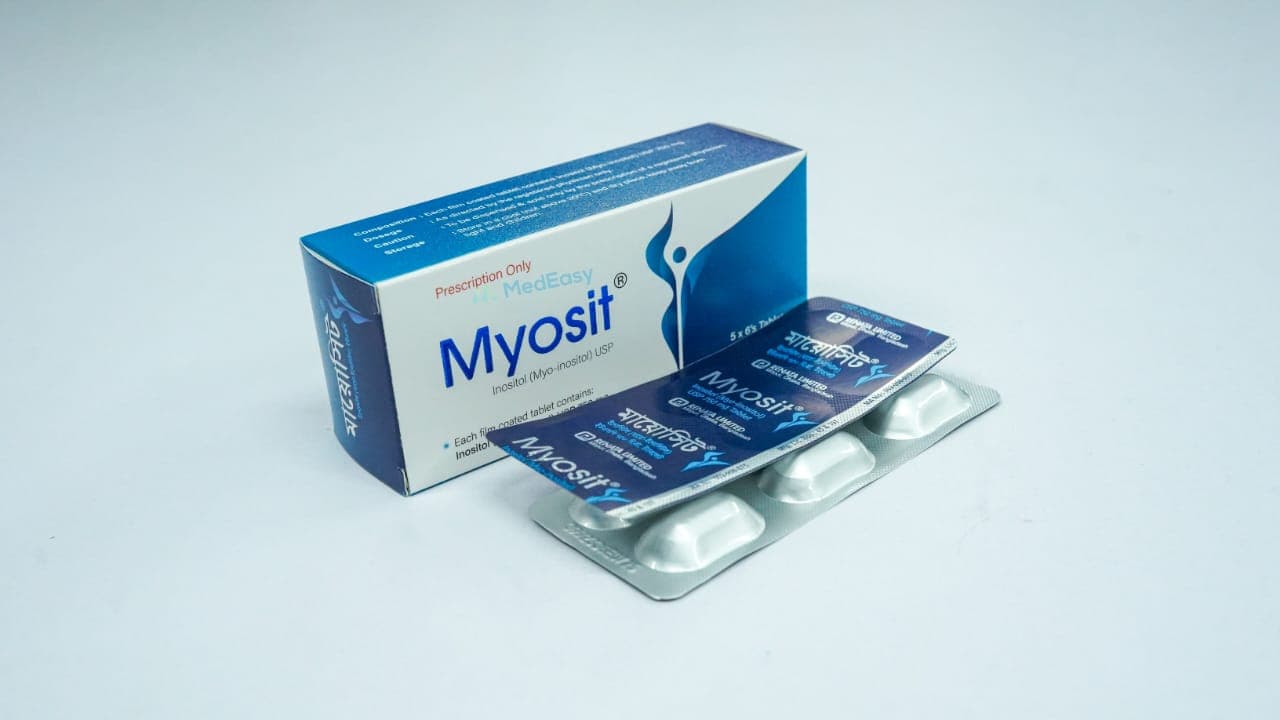
Key facts
Myosit 750 mg Tablet is available on MedEasy for ৳66.96 per 6's Strip, with home delivery anywhere in Bangladesh. It is manufactured by Renata Limited. Its generic name is Inositol Nicotinate.
- Pack sizes
- 6's Strip, 30's pack
- Prescription
- Required. Upload a valid doctor's prescription at checkout; a MedEasy pharmacist verifies it before dispatch.
- Delivery
- Home delivery across Bangladesh. Same-day delivery in Dhaka, Chattogram, Sylhet and Bogura city areas; 2-3 days elsewhere.
- Payment
- Cash on delivery, bKash, cards and mobile banking.
- Brand
- Myosit
- Generic name
- Inositol Nicotinate
- Manufacturer
- Renata Limited
- Form & strength
- Tablet 750 mg
- Availability
- In stock
- Authenticity
- Sourced from licensed suppliers and the manufacturer's authorised distributors in Bangladesh.

Medicine overview
Indications of Myosit
Myosit is an ester of inositol and nicotinic acid (niacin) used mainly as a peripheral vasodilator. Evidence for its clinical benefit is limited and dates largely from older studies, so it should be viewed as an adjunct option rather than a first-line, guideline-preferred therapy.
Guideline-Supported / Established Uses
- Symptomatic treatment of peripheral vascular disease, including Raynaud's phenomenon and Raynaud's syndrome (symptomatic relief of vasospasm-related coldness, pain, and discoloration of the extremities).
- Intermittent claudication associated with peripheral arterial disease, as an adjunct to lifestyle measures (exercise, smoking cessation) rather than as a replacement for them.
Evidence-Limited / Adjunct Uses
- Chilblains and other minor peripheral circulatory disturbances.
- Adjunctive use in some hyperlipidemia protocols historically, owing to its niacin component; however, this use is not well supported by modern evidence and is not a primary indication.
Because robust modern randomized-controlled-trial evidence is limited, Myosit is generally used as an adjunct alongside standard measures rather than as monotherapy for serious vascular disease.
Composition
Inositol Nicotinate is a chemical ester formed by combining inositol (a cyclic sugar alcohol) with six molecules of nicotinic acid (niacin, vitamin B3). It is typically formulated as oral tablets, with common strengths around 500 mg to 750 mg of Inositol Nicotinate per tablet.
Description
Myosit is an ester of inositol and nicotinic acid (niacin). It is classified as a peripheral vasodilator and is slowly hydrolyzed in the body to release nicotinic acid, which produces a more sustained and less intense flushing/vasodilator effect compared to plain nicotinic acid. Myosit has been used for decades in the symptomatic management of peripheral circulatory disorders, though contemporary high-quality clinical trial data supporting its efficacy remain limited.
Therapeutic Class
Myosit belongs to the therapeutic class of peripheral vasodilators (niacin/nicotinic acid ester derivatives).
Pharmacology
Mechanism of Action
Inositol Nicotinate is slowly hydrolyzed in the gastrointestinal tract and tissues to release free nicotinic acid (niacin) and inositol. The liberated nicotinic acid causes peripheral vasodilation, largely mediated through prostaglandin (prostacyclin)-related pathways and direct effects on vascular smooth muscle, which increases peripheral blood flow to the skin and extremities.
Pharmacokinetics
Inositol Nicotinate is absorbed from the gastrointestinal tract and undergoes gradual hydrolysis, producing a slower and more prolonged release of nicotinic acid than immediate-release nicotinic acid itself, which accounts for its comparatively milder flushing profile. Released nicotinic acid is metabolized in the liver and excreted mainly in urine as metabolites.
Dosage & Administration of Myosit
Adult Dose
| Indication | Typical Adult Dose |
|---|---|
| Peripheral vascular disease / Raynaud's phenomenon | 500 mg to 1000 mg (1–2 tablets) orally, three to four times daily, with or after meals |
| Intermittent claudication (adjunct) | 500 mg to 1000 mg orally, three to four times daily; response is assessed after several weeks of continuous use |
Pediatric Dose
Myosit is not established for use in children; safety and efficacy have not been demonstrated in the pediatric population (see Use in Special Populations).
Renal/Hepatic Impairment
No well-established dose adjustment has been defined for renal impairment. Myosit should be avoided in severe hepatic impairment (see Contraindications); in mild-to-moderate hepatic impairment, use with caution and physician supervision.
Duration
A clinical response, if any, is generally assessed after a trial of several weeks to a few months of regular use; continued use should be reviewed by a physician periodically.
Administration of Myosit
Myosit tablets should be swallowed whole with a glass of water. Taking Myosit with or immediately after food may help reduce gastrointestinal upset. Doses should be spaced evenly through the day as advised by the physician, and the tablets should not be crushed or chewed unless the product labeling specifically permits it.
Interaction of Myosit
The following interactions with Myosit are clinically relevant and should be discussed with a physician or pharmacist:
- Antihypertensive agents and other vasodilators: Concurrent use with Myosit may cause additive blood-pressure-lowering effects and increase the risk of postural hypotension and dizziness.
- Anticoagulants (e.g., warfarin): High-dose nicotinic acid derivatives, including Myosit, have been associated with altered bleeding tendency; monitor closely if used together.
- Antidiabetic agents (insulin, sulfonylureas): The niacin component of Myosit can impair glucose tolerance and may reduce the effectiveness of antidiabetic therapy, requiring closer glucose monitoring.
- Alcohol: Concurrent alcohol intake may intensify the flushing and hypotensive effects of Myosit.
Contraindications
Inositol Nicotinate is contraindicated in patients with:
- Known hypersensitivity to Inositol Nicotinate, nicotinic acid, or any component of the formulation.
- Severe hypotension.
- Active peptic ulcer disease.
- Severe hepatic impairment.
- Active arterial hemorrhage.
Side Effects of Myosit
The most common side effect of Myosit is a flushing sensation (warmth, redness of the skin, sometimes with mild itching or tingling), related to its nicotinic acid component; this typically lessens with continued regular use. Other reported side effects include:
- Gastrointestinal upset (nausea, dyspepsia, abdominal discomfort)
- Headache and dizziness
- Mild, transient hypotension
- Palpitations (uncommon)
- Skin rash or itching (uncommon)
Patients who experience severe or persistent side effects should seek medical advice.
Pregnancy & Lactation
There is insufficient well-controlled human data on the use of Myosit during pregnancy. Myosit should be used during pregnancy only if clearly needed and if the potential benefit justifies the potential risk to the fetus; a physician should be consulted before use.
It is not established whether Myosit or its metabolites pass into breast milk. As a precaution, breastfeeding mothers should consult a physician before using Myosit, and use should be avoided unless considered necessary and supervised by a doctor.
Precautions & Warnings
Myosit should be used with caution in the following situations:
- Diabetes mellitus: The niacin component of Myosit can impair glucose tolerance and may affect blood glucose control; monitor glucose levels closely.
- Gout or hyperuricemia: Nicotinic acid derivatives, including Myosit, can raise serum uric acid levels and may precipitate or worsen gout.
- Gallbladder disease: Use with caution, as niacin-related compounds have been associated with gallbladder effects.
- Hypotension-prone patients: Use cautiously in patients predisposed to low blood pressure, given the vasodilatory action of Myosit.
- Hepatic impairment: Use with caution in mild-to-moderate hepatic impairment and avoid in severe hepatic impairment (see Contraindications).
Myosit should be taken exactly as advised by a physician; do not exceed the prescribed dose or duration without medical advice.
Overdose Effects of Myosit
Overdose with Myosit may cause exaggerated flushing, pronounced hypotension, dizziness, fainting, and gastrointestinal upset. There is no specific antidote. In case of suspected overdose, seek immediate medical attention or contact a poison control center; supportive care and monitoring of blood pressure should be provided by medical professionals.
Storage Conditions
Store at room temperature (below 30°C), away from light and moisture. Keep out of reach of children.
Use In Special Populations
Elderly
Elderly patients may be more sensitive to the hypotensive and flushing effects of Myosit; use with caution and close monitoring, particularly if other blood-pressure-lowering medications are used concurrently.
Renal Impairment
No well-established specific dose adjustment is defined; use with caution and physician oversight.
Hepatic Impairment
Use with caution in mild-to-moderate hepatic impairment; contraindicated in severe hepatic impairment (see Contraindications).
Diabetic Patients
Monitor blood glucose closely, as the niacin component of Myosit may impair glucose tolerance.
Pediatric Patients
Safety and efficacy of Myosit have not been established in children; use is not recommended in this population.
Duration Of Treatment
The duration of Myosit therapy is individualized by the treating physician. Clinical response for peripheral vascular symptoms is typically assessed after several weeks to a few months of continuous use, and ongoing treatment should be periodically reviewed to confirm continued benefit and tolerability.
Drug Classes
Inositol Nicotinate belongs to the drug class of peripheral vasodilators, specifically niacin (nicotinic acid) ester derivatives.
Mode Of Action
Inositol Nicotinate acts as a prodrug that is gradually hydrolyzed to release nicotinic acid (niacin), which produces peripheral vasodilation through prostaglandin-mediated relaxation of vascular smooth muscle, thereby improving peripheral blood flow. The slow, sustained release of nicotinic acid from Inositol Nicotinate results in a milder and more prolonged vasodilatory and flushing effect compared to immediate-release nicotinic acid.
Pediatric Uses
The safety and efficacy of Myosit have not been established in pediatric patients. Myosit is not recommended for use in children unless specifically directed by a physician, and it should generally be avoided in this population due to the lack of adequate safety and efficacy data.
Frequently Asked Questions
Q: What is Myosit 750 mg Tablet used for?
A: Myosit 750 mg Tablet is used mainly as a peripheral vasodilator for conditions such as Raynaud's phenomenon and intermittent claudication associated with peripheral vascular disease, helping to improve blood flow to the extremities. Evidence for its benefit is limited, so it is generally used as an adjunct to standard care.
Q: Why does Myosit 750 mg Tablet cause flushing?
A: Myosit 750 mg Tablet is slowly broken down in the body to release nicotinic acid (niacin), which causes blood vessels near the skin to dilate, producing a warm, flushed sensation. This effect is usually mild with Myosit 750 mg Tablet compared to plain niacin and tends to lessen with continued regular use.
Q: Can I take Myosit 750 mg Tablet if I have diabetes?
A: Myosit 750 mg Tablet should be used with caution in people with diabetes because its niacin component can affect blood glucose control. Blood sugar should be monitored closely, and a physician should be consulted before starting Myosit 750 mg Tablet.
Q: Is Myosit 750 mg Tablet safe during pregnancy?
A: There is limited data on the use of Myosit 750 mg Tablet during pregnancy. It should only be used during pregnancy if clearly needed and if the potential benefit outweighs the potential risk, under a physician's supervision.
Q: Who should not take Myosit 750 mg Tablet?
A: Myosit 750 mg Tablet should not be taken by people with known hypersensitivity to Myosit 750 mg Tablet or nicotinic acid, severe hypotension, active peptic ulcer disease, severe hepatic impairment, or active arterial hemorrhage.
Q: What should I do if I miss a dose or take too much Myosit 750 mg Tablet?
A: If a dose is missed, take it as soon as remembered unless it is close to the next dose; do not double the dose. If an overdose is suspected, causing symptoms such as severe flushing, dizziness, or fainting, seek immediate medical attention or contact a poison control center.
Disclaimer
The information provided is accurate to the best of our knowledge, but it does not replace professional medical advice. We cannot guarantee its completeness or accuracy, and the absence of specific information about a drug should not be taken as an endorsement. We are not responsible for any consequences arising from this information, so please consult a healthcare professional for any concerns or questions.