10% Off
Cinaron Plus20 mg+40 m
Square Pharmaceuticals PLC.
৳25.20
Add to cart
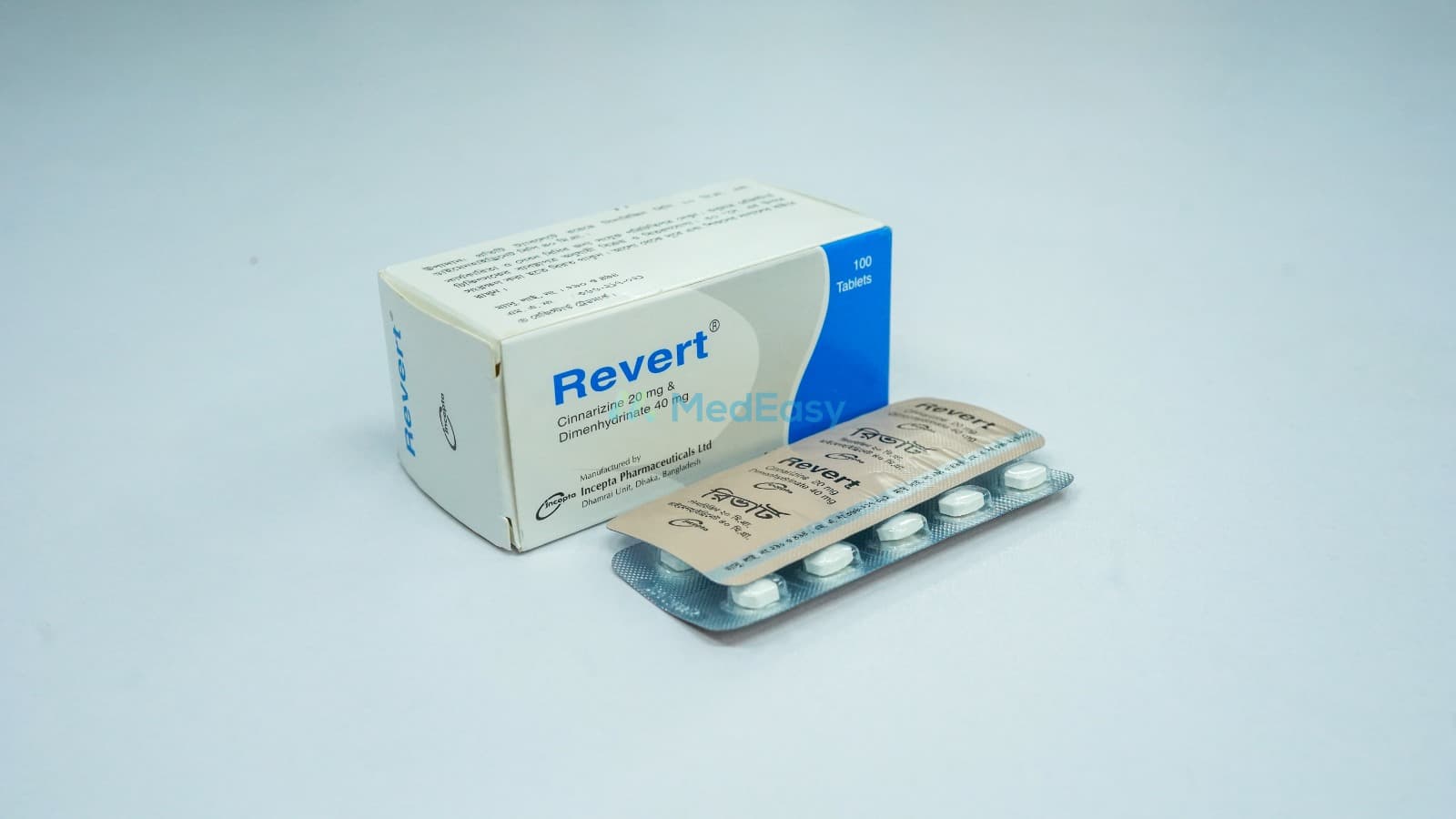

Revert is a fixed-dose combination antihistamine/antivertigo preparation indicated for:
Some formulations and clinical practice also use Revert for prevention and relief of motion sickness, although this is a less formally evaluated, adjunct/off-label use in several regulatory labels compared with the vertigo indication; patients should follow their physician's specific advice for this use.
Revert is indicated for adults; safety and efficacy in children and adolescents under 18 years have not been established.
Each tablet of Cinnarizine + Dimenhydrinate typically contains Cinnarizine 20 mg and Dimenhydrinate 40 mg as the active ingredients.
Revert is a combination medicine used to treat vertigo (a spinning sensation of dizziness) and the nausea/vomiting that often accompanies it. It combines two complementary agents that act on the vestibular (balance) system: cinnarizine, a piperazine-derivative calcium channel blocker with antihistamine properties, and dimenhydrinate, an antihistamine with antiemetic and anticholinergic activity. Together they reduce the excitability of the vestibular apparatus and suppress the vomiting reflex triggered by vestibular disturbance.
Revert is taken orally, generally after meals, and is intended for short-term, symptom-directed use rather than indefinite long-term therapy.
Revert belongs to the therapeutic class of antivertigo agents / antihistamines used for vestibular disorders. Cinnarizine is classified as a piperazine-derivative calcium channel blocker with H1-antihistaminic activity, and dimenhydrinate is an ethanolamine-derivative H1-antihistamine with antiemetic and anticholinergic properties.
Cinnarizine + Dimenhydrinate combines two agents with complementary and synergistic actions on the vestibular system:
The combination in Cinnarizine + Dimenhydrinate is designed to provide more complete relief of both the vertiginous sensation and its associated autonomic symptoms than either component alone. After oral administration, peak plasma concentrations of cinnarizine are reached in 1-3 hours; both components are hepatically metabolized and renally/faecally eliminated.
| Indication | Population | Recommended Dose |
|---|---|---|
| Vertigo of various origins, with associated nausea/vomiting | Adults and elderly | 1 tablet of Revert three times daily, taken with liquid after meals |
| Motion sickness (where used per physician's advice) | Adults | As directed by the prescribing physician; not established in all product labels |
| Any indication | Children/adolescents under 18 years | Not recommended - safety and efficacy not established |
Tablets should be swallowed unchewed with some liquid after meals to reduce gastric irritation. Treatment with Revert should generally not exceed 4 weeks continuously without physician reassessment. Patients should take Revert exactly as advised by their physician and should not adjust the dose or duration on their own.
Revert tablets should be swallowed whole (unchewed) with a sufficient amount of liquid, taken after meals to minimize gastric irritation. Do not take on an empty stomach.
Revert has the following clinically significant interactions:
Cinnarizine + Dimenhydrinate is contraindicated in the following situations:
Revert is generally well tolerated, but the following adverse effects have been reported:
Patients should seek medical attention if severe or persistent side effects occur while taking Revert.
Pregnancy: Revert is not recommended during pregnancy. Data on use in pregnant women are limited, and animal reproduction studies are insufficient to establish safety. Revert should be used in pregnancy only if clearly needed and if the potential benefit justifies the potential risk to the fetus; a physician must be consulted before use.
Lactation: Both cinnarizine and dimenhydrinate are excreted into breast milk. Revert should not be used during breast-feeding; if treatment is considered essential, a physician should advise on whether to interrupt breast-feeding.
Revert should be used with caution in the following situations:
Overdose with Revert may cause drowsiness, dizziness, ataxia, and anticholinergic effects such as dry mouth, facial flushing, dilated pupils, rapid heartbeat, fever, headache, and urinary retention. Severe overdose may lead to convulsions, hallucinations, excitement, respiratory depression, hypertension, tremor, or coma, particularly in children.
If overdose of Revert is suspected, seek immediate medical attention or contact a poison control centre/emergency services right away. Treatment is supportive and should be provided in a hospital setting; do not attempt specific home treatment.
Store Revert at room temperature (below 30°C), away from light and moisture. Keep out of reach of children.
Elderly: Use Revert with caution; elderly patients are more susceptible to sedation and extrapyramidal symptoms. No formal dose reduction is established, but monitor closely.
Renal impairment: Use with caution in mild-to-moderate impairment; contraindicated in severe renal impairment (creatinine clearance ≤25 mL/min).
Hepatic impairment: Use with caution in mild-to-moderate impairment; contraindicated in severe hepatic impairment.
Pregnant and breastfeeding women: See Pregnancy and Lactation section.
Children under 18 years: Safety and efficacy of Revert have not been established; not recommended.
Treatment with Revert is generally intended for short-term, symptom-directed use. Continuous use should generally not exceed 4 weeks unless a physician determines that longer treatment is necessary and appropriate, with periodic reassessment of ongoing need.
Cinnarizine + Dimenhydrinate is classified as an antihistamine-based antivertigo/antiemetic combination: cinnarizine (piperazine-derivative calcium channel blocker with antihistaminic activity) plus dimenhydrinate (ethanolamine-derivative H1-antihistamine with anticholinergic and antiemetic activity).
Cinnarizine + Dimenhydrinate acts through two complementary mechanisms: cinnarizine reduces the excitability of vestibular hair cells and inhibits vestibular nystagmus via calcium channel and H1-receptor antagonism, while dimenhydrinate blocks H1 receptors and exerts central anticholinergic activity to suppress signals from the vestibular apparatus to the chemoreceptor trigger zone and vomiting centre, thereby reducing both vertigo and associated nausea/vomiting.
Revert is not recommended for use in children and adolescents under 18 years of age. The safety and efficacy of Revert in this population have not been established, and paediatric use may carry a higher risk of paradoxical excitability and anticholinergic adverse effects. Use in children should only occur under direct physician supervision if no suitable alternative exists.
Q: What is Revert 20 mg+40 mg Tablet used for?
A: Revert 20 mg+40 mg Tablet is used mainly to treat vertigo (a spinning sensation of dizziness) of various causes and the nausea and vomiting that often accompany it. It is sometimes used, on a physician's advice, for motion sickness as well.
Q: How should I take Revert 20 mg+40 mg Tablet?
A: Take Revert 20 mg+40 mg Tablet exactly as prescribed by your physician, usually one tablet three times daily, swallowed whole with some liquid after meals to reduce stomach irritation. Do not exceed the prescribed dose or duration, which is generally limited to about 4 weeks unless your doctor advises otherwise.
Q: Can I drive or operate machinery while taking Revert 20 mg+40 mg Tablet?
A: Revert 20 mg+40 mg Tablet commonly causes drowsiness and can impair alertness. You should avoid driving or operating heavy or hazardous machinery until you know how this medicine affects you, and you should avoid alcohol and other sedating medicines while taking it.
Q: Is Revert 20 mg+40 mg Tablet safe during pregnancy or breastfeeding?
A: Revert 20 mg+40 mg Tablet is not recommended during pregnancy, as safety has not been established; it should be used only if clearly needed and if the potential benefit justifies the potential risk to the fetus, and only under medical advice. It should not be used during breastfeeding, since both components pass into breast milk. Always consult your physician before use in either situation.
Q: Who should not take Revert 20 mg+40 mg Tablet?
A: People with known hypersensitivity to cinnarizine, dimenhydrinate, or related antihistamines; those with severe kidney or liver impairment; angle-closure glaucoma; porphyria; or established Parkinson's disease should not take Revert 20 mg+40 mg Tablet. Always inform your doctor of your full medical history before starting this medicine.
Q: What should I do if I miss a dose or take too much Revert 20 mg+40 mg Tablet?
A: If you miss a dose, take it as soon as you remember unless it is nearly time for your next dose - do not double up. If you suspect an overdose of Revert 20 mg+40 mg Tablet, which can cause severe drowsiness, confusion, or convulsions, seek immediate medical attention or contact emergency services/poison control right away.
Disclaimer
The information provided is accurate to the best of our knowledge, but it does not replace professional medical advice. We cannot guarantee its completeness or accuracy, and the absence of specific information about a drug should not be taken as an endorsement. We are not responsible for any consequences arising from this information, so please consult a healthcare professional for any concerns or questions.