
10% Off
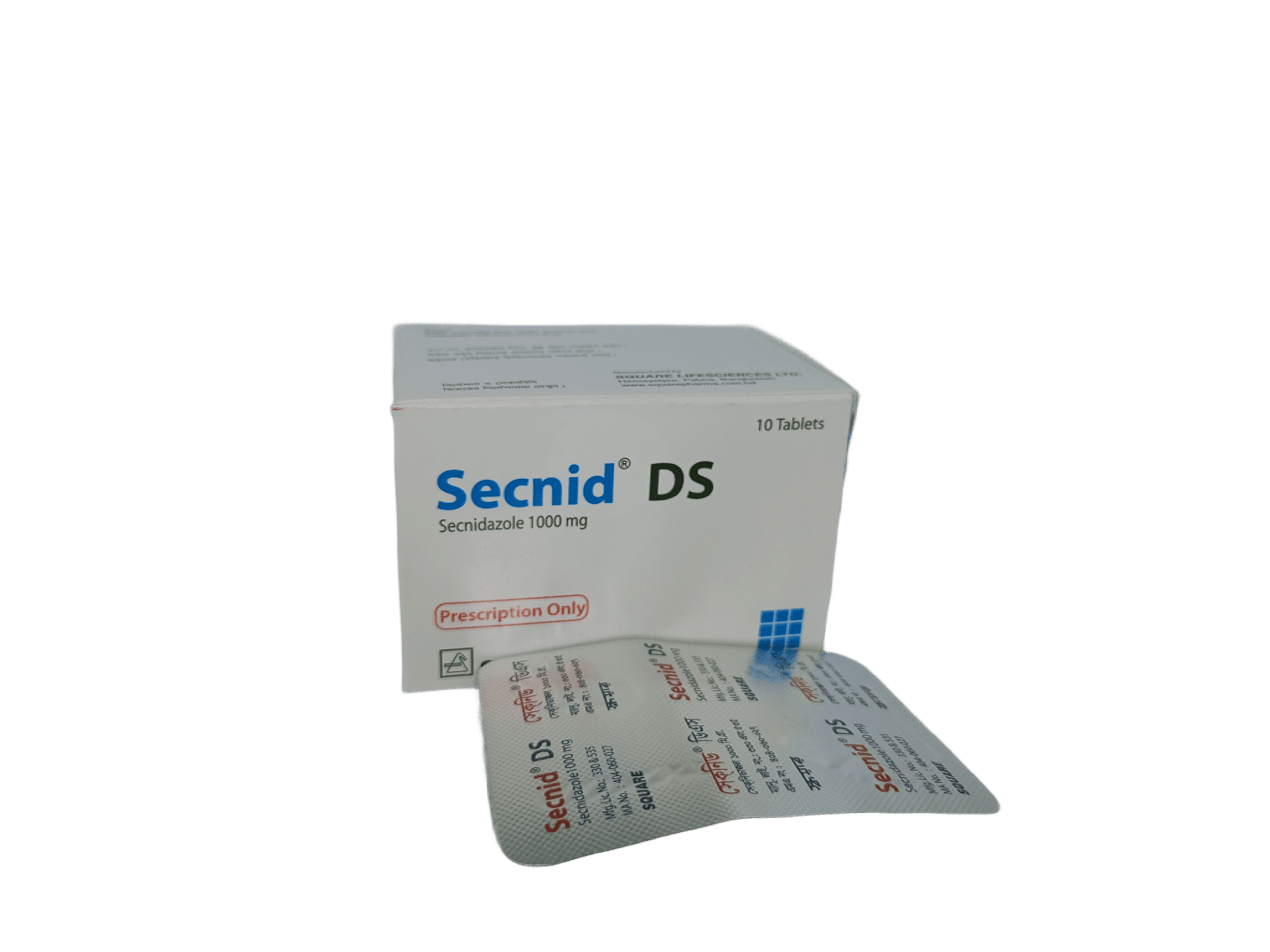
Secnid DS1 gm
Square Pharmaceuticals PLC.
৳36.00
Add to cart


Secnidal-DS is a nitroimidazole antimicrobial with antiprotozoal and antibacterial activity. Its indications differ somewhat by regulatory approval, but Secnidal-DS is used for the following:
Secnidal-DS is particularly valued because its long half-life allows effective single-dose regimens in several of these infections, which can improve patient adherence compared with multi-day nitroimidazole courses.
Each tablet contains Secnidazole INN 500 mg or 1000 mg. Secnidazole is also formulated internationally as oral granules (2 g single-dose sachet) intended to be sprinkled onto soft food. Strength and dosage form available depend on the specific brand.
Secnidal-DS is a synthetic second-generation 5-nitroimidazole derivative closely related to metronidazole and tinidazole, but with a substantially longer plasma half-life. This pharmacokinetic property allows Secnidal-DS to maintain therapeutically effective concentrations after a single oral dose, making it useful for single-dose treatment of certain protozoal and bacterial infections.
Secnidal-DS is rapidly and almost completely absorbed after oral administration, with peak plasma concentrations reached in about 3 to 4 hours and an elimination half-life of roughly 17–29 hours (commonly cited as approximately 20 hours), permitting sustained antimicrobial activity for up to 72 hours after a single dose.
Secnidal-DS belongs to the nitroimidazole class of antimicrobial agents (a second-generation nitroimidazole), structurally related to metronidazole and tinidazole. It is classified as an antiprotozoal and antibacterial agent, primarily active against anaerobic bacteria and certain protozoa.
Secnidazole enters susceptible anaerobic and microaerophilic organisms by passive diffusion. Inside the cell, the nitro group of Secnidazole is reduced by low-redox-potential electron transport proteins unique to anaerobic organisms and protozoa, generating cytotoxic intermediates and free radicals. These reactive species bind to and cause strand breakage and destabilization of the organism's DNA helix, inhibiting nucleic acid synthesis and leading to cell death.
This mechanism accounts for the activity of Secnidazole against protozoa such as Trichomonas vaginalis, Entamoeba histolytica, and Giardia lamblia, as well as against many anaerobic bacteria associated with bacterial vaginosis (e.g., Gardnerella vaginalis and other anaerobes), while aerobic organisms lacking this reductive pathway are generally unaffected.
Pharmacokinetics: Secnidazole is well absorbed orally (peak plasma levels around 3–4 hours), widely distributed into body tissues and fluids, partially metabolized in the liver, and eliminated with a half-life of approximately 17–29 hours, with a portion excreted unchanged in urine over several days.
Dosing of Secnidal-DS is indication-specific. Take Secnidal-DS exactly as prescribed by your physician; do not stop, extend, skip doses, or share this medicine with others without medical advice.
| Indication | Adult Dose | Pediatric Dose |
|---|---|---|
| Bacterial vaginosis | Single 2 g oral dose | Not established under 12 years; 2 g single dose in patients 12–17 years |
| Trichomoniasis | Single 2 g oral dose (treat sexual partner simultaneously) | Not established under 12 years; 2 g single dose in patients 12–17 years |
| Acute intestinal amoebiasis | Single 2 g oral dose | Approximately 30 mg/kg as a single dose (maximum per adult dose) |
| Asymptomatic (cyst-passer) amoebiasis | 2 g once daily for 3 days | Approximately 30 mg/kg once daily for 3 days |
| Hepatic amoebiasis | 1.5 g once daily for 5 days | Approximately 30 mg/kg once daily for 5 days |
| Giardiasis | Single 2 g oral dose | Approximately 30–50 mg/kg as a single dose |
Administration: Secnidal-DS tablets are taken orally, generally with food to minimize gastrointestinal upset. Where Secnidal-DS is supplied as oral granules, the entire contents of the packet should be sprinkled onto a spoonful of soft food such as applesauce, yogurt, or pudding and consumed within 30 minutes without chewing the granules; the granules should not be dissolved directly in liquid.
Hepatic impairment: Because Secnidal-DS undergoes hepatic metabolism, dose reduction or extended dosing intervals should be considered in patients with significant hepatic impairment, under physician supervision.
Secnidal-DS is administered orally. Tablets may be taken with or after food to reduce the chance of nausea. The oral granule formulation of Secnidal-DS must be sprinkled onto soft food (not dissolved in liquid) and eaten within 30 minutes without chewing the granules. Do not split or crush tablets of Secnidal-DS unless directed by a physician or pharmacist.
Secnidal-DS has a limited number of well-established clinically significant interactions:
Secnidazole is contraindicated in:
Most adverse effects of Secnidal-DS are mild and self-limiting.
Patients should seek medical attention if severe skin reactions, persistent neurological symptoms, or signs of blood dyscrasia (unusual bruising, bleeding, infection) occur while taking Secnidal-DS.
Pregnancy: Secnidal-DS is contraindicated in the first trimester of pregnancy. For later trimesters, data in humans are limited; Secnidal-DS should be used only if clearly needed and if the potential benefit justifies the potential risk to the fetus, and only under a physician's guidance.
Lactation: Secnidal-DS is excreted in breast milk. Breastfeeding is generally not recommended during treatment; when a single dose of Secnidal-DS is used, many guidelines advise interrupting breastfeeding for approximately 96 hours (about 4 days) after the dose. Consult a physician before breastfeeding while using Secnidal-DS.
Alcohol: Avoid alcohol during treatment with Secnidal-DS and for at least 3 days afterward due to the risk of a disulfiram-like reaction (see Interactions).
Blood dyscrasia: Use Secnidal-DS with caution in patients with a history of blood dyscrasias; periodic blood counts may be warranted with repeated or prolonged courses.
CNS disease: Use Secnidal-DS with caution in patients with active central nervous system disease such as epilepsy, particularly with high-dose or prolonged therapy, given the theoretical risk of neurotoxicity associated with nitroimidazoles.
Hepatic impairment: Dose adjustment (lower dose or extended interval) should be considered in patients with significant hepatic impairment (see Dosage and Administration).
Vulvovaginal candidiasis: Treatment with Secnidal-DS for bacterial vaginosis or trichomoniasis may increase the risk of subsequent yeast infection.
Carcinogenicity: Nitroimidazole compounds structurally related to Secnidal-DS have shown carcinogenicity in long-term animal studies; the clinical relevance of a single dose of Secnidal-DS in humans is unclear, but unnecessary or repeated use should be avoided.
Antimicrobial stewardship: Take Secnidal-DS exactly as prescribed by your physician; do not stop, extend, skip doses, or share this medicine with others without medical advice, and use it only for infections proven or strongly suspected to be caused by susceptible organisms.
There is limited clinical experience with overdosage of Secnidal-DS. Expected effects of an overdose would generally be an exaggeration of known adverse effects, such as severe nausea, vomiting, abdominal pain, and neurological symptoms (e.g., ataxia, dizziness, or numbness/tingling).
If an overdose of Secnidal-DS is suspected, seek immediate medical attention or contact a poison control center. There is no specific antidote; management is supportive and symptomatic, with treatment directed by a physician based on the patient's presentation.
Store at room temperature (below 30°C), away from light and moisture. Keep out of reach of children.
Renal impairment: Specific dose adjustment data for Secnidal-DS in renal impairment are limited; use with caution and physician supervision in patients with significant renal disease.
Hepatic impairment: Since Secnidal-DS is metabolized in the liver, patients with significant hepatic impairment may require a reduced dose or extended dosing interval (see Dosage and Administration).
Elderly: Data on the use of Secnidal-DS in patients 65 years and older are limited; use with caution, taking into account the greater likelihood of decreased hepatic or renal function.
Pediatric patients: Safety and effectiveness of Secnidal-DS for bacterial vaginosis and trichomoniasis have been established only in patients 12 years and older; it has not been studied for these indications in children under 12. For amoebiasis and giardiasis, weight-based dosing of Secnidal-DS has been used in children in some countries under medical supervision (see Dosage and Administration).
Duration varies by indication: a single dose of Secnidal-DS is used for bacterial vaginosis, trichomoniasis, acute intestinal amoebiasis, and giardiasis, while asymptomatic amoebiasis is treated for 3 days and hepatic amoebiasis for 5 days. Always complete the course of Secnidal-DS exactly as directed by your physician, even if symptoms improve earlier.
Nitroimidazole antimicrobials; Antiprotozoals; Antibacterials (anti-anaerobic agents).
Secnidazole is reduced intracellularly by susceptible anaerobic and protozoal organisms, generating cytotoxic free radicals and reactive intermediates that damage microbial DNA, causing strand breakage and inhibiting nucleic acid synthesis, which leads to cell death.
Secnidal-DS is approved in the United States for bacterial vaginosis and trichomoniasis only in patients 12 years of age and older; safety and effectiveness for these indications have not been established in children under 12 years of age.
Outside the United States, including in Bangladesh, Secnidal-DS has also been used in children for intestinal amoebiasis, hepatic amoebiasis, and giardiasis using weight-based dosing (approximately 30–50 mg/kg depending on indication), under the supervision of a physician. Use in young children should always follow specific medical guidance.
Q: What is Secnidal-DS 1 gm Tablet used for?
A: Secnidal-DS 1 gm Tablet is a nitroimidazole antimicrobial used to treat bacterial vaginosis and trichomoniasis (both usually as a single dose), as well as intestinal and hepatic amoebiasis and giardiasis, depending on local approval and medical advice.
Q: How is Secnidal-DS 1 gm Tablet taken?
A: Secnidal-DS 1 gm Tablet is usually given as a single oral dose, though some indications (such as hepatic or asymptomatic amoebiasis) require dosing once daily for 3 to 5 days. Tablets are typically taken with food, and any granule formulation should be sprinkled on soft food and eaten within 30 minutes, without chewing. Always follow your physician's specific instructions and complete the full course as directed.
Q: Can I drink alcohol while taking Secnidal-DS 1 gm Tablet?
A: No. Alcohol should be avoided during treatment with Secnidal-DS 1 gm Tablet and for at least 3 days after the last dose, because combining them can cause a disulfiram-like reaction with flushing, nausea, vomiting, and headache.
Q: Is Secnidal-DS 1 gm Tablet safe during pregnancy or breastfeeding?
A: Secnidal-DS 1 gm Tablet is contraindicated in the first trimester of pregnancy. In later trimesters it should be used only if clearly needed, as advised by a physician, since human safety data are limited. Breastfeeding is generally not recommended during treatment, and many guidelines advise interrupting breastfeeding for about 96 hours after a single dose of Secnidal-DS 1 gm Tablet; always consult your physician first.
Q: What are the common side effects of Secnidal-DS 1 gm Tablet?
A: Common side effects of Secnidal-DS 1 gm Tablet include nausea, a metallic or altered taste, headache, abdominal discomfort, and vulvovaginal yeast infection. Less common effects include hives, dizziness, and reversible reductions in white blood cell counts. Rare effects with prolonged or high-dose use include vertigo, unsteady gait, and nerve tingling/numbness.
Q: Who should not take Secnidal-DS 1 gm Tablet?
A: Secnidal-DS 1 gm Tablet should not be used by anyone with a known allergy to Secnidal-DS 1 gm Tablet or other nitroimidazole drugs (such as metronidazole or tinidazole), by anyone with Cockayne syndrome, or during the first trimester of pregnancy. Discuss your full medical history with your physician before starting Secnidal-DS 1 gm Tablet.
Disclaimer
The information provided is accurate to the best of our knowledge, but it does not replace professional medical advice. We cannot guarantee its completeness or accuracy, and the absence of specific information about a drug should not be taken as an endorsement. We are not responsible for any consequences arising from this information, so please consult a healthcare professional for any concerns or questions.

