10% Off
Tenil3 mg
ACME Laboratories Ltd.
৳81.00
Add to cart
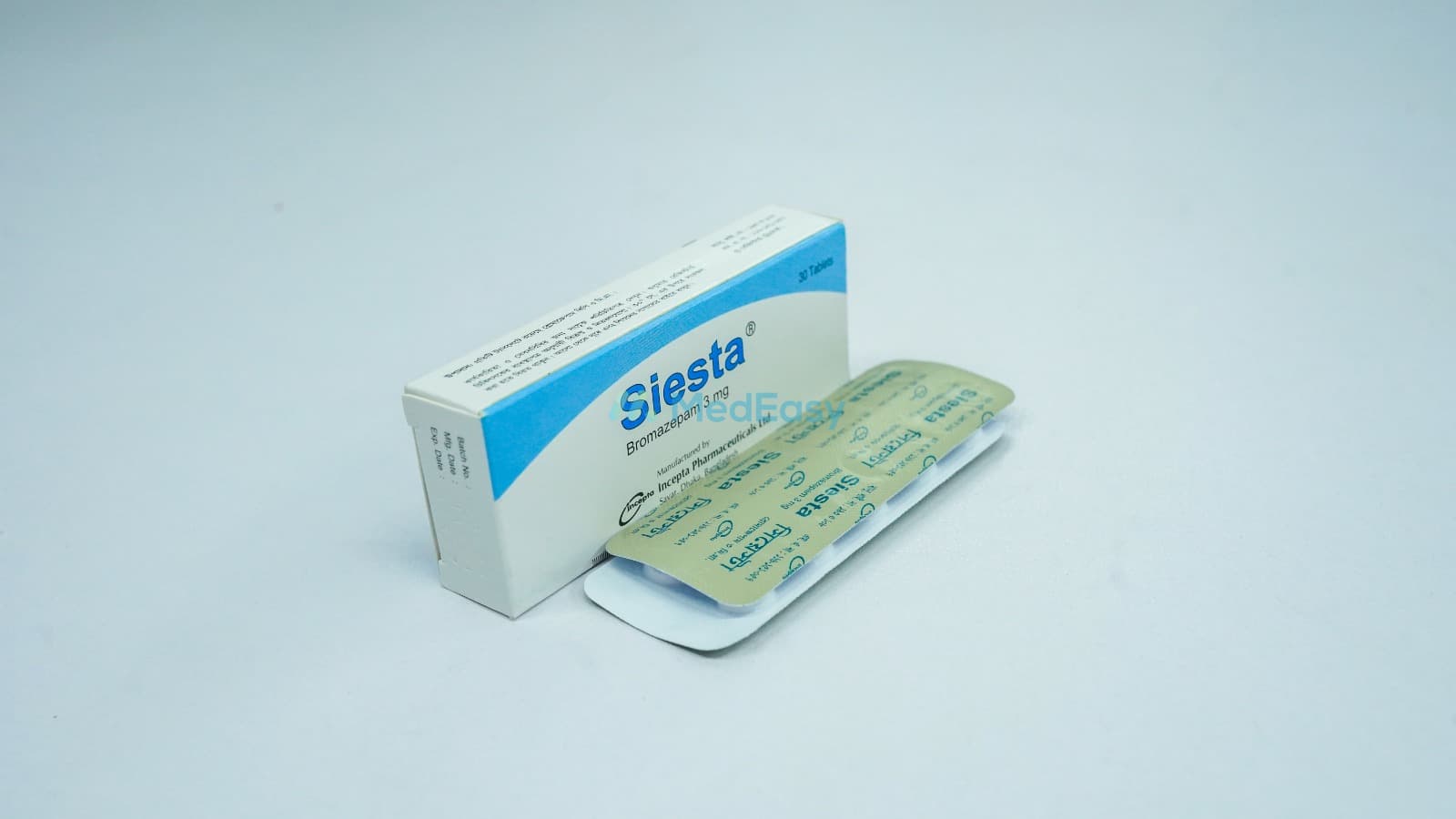

Siesta is indicated for the short-term symptomatic treatment of anxiety, including severe, disabling anxiety, tension, and agitation associated with acute emotional or situational stress. Siesta is intended for short-term use only; current psychiatric guidance does not support routine long-term or continuous use of Siesta because of the risk of tolerance and dependence.
Siesta may be used as an adjunct for the short-term symptomatic relief of anxiety-related functional and psychosomatic complaints, such as anxiety-associated irritable bowel syndrome, functional cardiovascular or respiratory symptoms, anxiety-related insomnia, and anxiety accompanying certain organic disorders, when anxiety is a significant contributing component. This adjunctive use of Siesta should also be limited to the shortest duration necessary.
Each tablet contains Bromazepam INN 3 mg.
Siesta is a medicine belonging to the benzodiazepine group, used for the short-term relief of anxiety, tension, and related symptoms. Siesta works by calming overactive signaling in the brain, helping reduce feelings of nervousness and restlessness so that anxiety symptoms become more manageable. Siesta is intended for short courses of treatment under a doctor's supervision and is not meant for long-term or everyday use. Because Siesta can cause drowsiness and dependence and interacts with alcohol and other sedating medicines, it should be taken only exactly as prescribed. In Bangladesh, Siesta is available as a 3 mg oral tablet.
Anxiolytic (Benzodiazepine)
Bromazepam is a benzodiazepine that acts on the central nervous system by binding to a specific site on the GABA-A receptor complex. This binding produces a conformational change that enhances the inhibitory effect of gamma-aminobutyric acid (GABA), the principal inhibitory neurotransmitter in the brain, without directly affecting other neurotransmitter systems. The enhanced GABA-ergic inhibition produced by Bromazepam underlies its anxiolytic, sedative, muscle-relaxant, and anticonvulsant properties. At lower doses, Bromazepam predominantly reduces tension and anxiety, while at higher doses sedative and muscle-relaxant effects of Bromazepam become more prominent.
Dosing with Siesta must be individualized by a qualified healthcare professional based on the severity of symptoms, treatment response, and patient factors such as age and hepatic function. Treatment with Siesta should always use the lowest effective dose for the shortest duration necessary to control symptoms, with gradual dose reduction rather than abrupt discontinuation when Siesta is stopped.
Bromazepam is contraindicated in patients with:
Drowsiness, fatigue, muscle weakness, reduced alertness, confusion, headache, and unsteadiness (ataxia) are common with Siesta, particularly at the start of treatment or with higher doses, and often lessen with continued use. Short-term memory problems (anterograde amnesia) can also occur with Siesta.
Contact a doctor or emergency services if Siesta causes: severe drowsiness, confusion, or difficulty waking up; slow, shallow, or labored breathing (especially if Siesta is combined with opioids, alcohol, or other sedatives); paradoxical reactions such as increased agitation, aggression, hallucinations, or unusual excitability; signs of a severe allergic reaction (swelling of the face, lips, or throat, difficulty breathing, rash); or, on stopping Siesta after prolonged use, withdrawal symptoms such as seizures, severe anxiety, tremor, or confusion.
The safety of Siesta during pregnancy has not been established, and Siesta should generally be avoided during pregnancy unless considered clearly necessary by a physician. Benzodiazepines cross the placenta; use of Siesta in late pregnancy or during labor has been associated with neonatal hypotonia, reduced respiratory function, and hypothermia in the newborn ("floppy infant syndrome"), and infants born to mothers who used Siesta or other benzodiazepines regularly in late pregnancy may develop neonatal withdrawal symptoms. If Siesta has been used during pregnancy, the newborn should be monitored accordingly.
Siesta is excreted into breast milk, and breastfeeding should be avoided during treatment with Siesta.
Overdose with Siesta commonly causes drowsiness, confusion, slurred speech, and unsteadiness (ataxia), which can progress to impaired reflexes, low blood pressure, respiratory depression, and coma in more severe cases, particularly when Siesta is taken together with alcohol or other central nervous system depressants. Do not induce vomiting unless specifically directed to do so by a doctor or poison control. If an overdose of Siesta is suspected, contact emergency medical services or a poison control center immediately, or go to the nearest hospital, taking the medicine packaging if possible. Management of Siesta overdose is generally supportive; in a hospital setting, flumazenil, a specific benzodiazepine-reversal agent, may be used by medical staff for severe central nervous system depression under close monitoring, but it is not for self-administration.
Store Siesta according to the instructions on the product label, out of reach of children, and away from moisture and direct light. Do not use Siesta after the expiry date printed on the pack.
The use of Siesta in children is not recommended; the safety and efficacy of Siesta have not been established in the pediatric population.
Elderly patients should receive lower doses of Siesta, as clearance is reduced and the risk of excessive sedation, confusion, unsteadiness, and falls is increased.
Siesta should be used with caution in patients with renal impairment, starting at the lowest effective dose, since specific dose-adjustment data for Siesta are limited.
Siesta should be used with caution and at reduced doses in mild-to-moderate hepatic impairment; Siesta is contraindicated in severe hepatic insufficiency due to the risk of encephalopathy.
Siesta should be used with caution in patients with a history of alcohol or drug dependence, and in those with respiratory disease, due to increased sensitivity to the sedative and respiratory-depressant effects of Siesta.
Treatment with Siesta should be as short as possible; current guidance generally limits regular use of Siesta to about 2 to 4 weeks, including a gradual tapering period, with an overall course of Siesta (including tapering) typically not exceeding 8 to 12 weeks. Continuous long-term use of Siesta is not recommended, and the need for continued treatment with Siesta should be reviewed regularly by a doctor.
Benzodiazepine; Anxiolytic/Sedative
Bromazepam binds to a specific benzodiazepine binding site on the GABA-A receptor complex in the central nervous system, producing a conformational change that enhances the effect of gamma-aminobutyric acid (GABA) on chloride channel opening. This action of Bromazepam increases inhibitory neurotransmission, producing anxiolytic, sedative, muscle-relaxant, and anticonvulsant effects.
Siesta is not recommended for use in children. The safety and efficacy of Siesta have not been established in the pediatric population, so Siesta should not be given to children.
Q: What is Siesta 3 mg Tablet used for?
A: Siesta 3 mg Tablet is used for the short-term symptomatic relief of anxiety, tension, and agitation. Siesta 3 mg Tablet is not intended for routine long-term or everyday use.
Q: How should I take Siesta 3 mg Tablet?
A: Siesta 3 mg Tablet should be taken exactly as prescribed by a doctor, at the lowest effective dose and for the shortest duration necessary, usually two to three times daily depending on the indication.
Q: Can I take Siesta 3 mg Tablet with alcohol?
A: No. Alcohol increases the sedative effects of Siesta 3 mg Tablet and can cause dangerous drowsiness and impaired breathing; alcohol should be avoided while taking Siesta 3 mg Tablet.
Q: Is it safe to take Siesta 3 mg Tablet with opioid painkillers?
A: Taking Siesta 3 mg Tablet together with opioid medicines can cause profound sedation, breathing problems, coma, and death, so this combination should be avoided unless specifically directed and closely supervised by a doctor.
Q: Can Siesta 3 mg Tablet be taken during pregnancy?
A: The safety of Siesta 3 mg Tablet during pregnancy has not been established, and Siesta 3 mg Tablet should generally be avoided in pregnancy unless a doctor decides it is clearly necessary, because of possible effects on the newborn.
Q: Can children take Siesta 3 mg Tablet?
A: No. Siesta 3 mg Tablet is not recommended for children because its safety and effectiveness have not been established in this age group.
Q: What are the common side effects of Siesta 3 mg Tablet?
A: Common side effects of Siesta 3 mg Tablet include drowsiness, fatigue, muscle weakness, reduced alertness, confusion, headache, and unsteadiness, especially early in treatment.
Q: Can I stop taking Siesta 3 mg Tablet suddenly?
A: No. Siesta 3 mg Tablet should not be stopped suddenly after regular use, as this can cause withdrawal symptoms including rebound anxiety and, rarely, seizures; your doctor will guide a gradual reduction of Siesta 3 mg Tablet.
Q: Will Siesta 3 mg Tablet affect my ability to drive?
A: Yes. Siesta 3 mg Tablet can cause drowsiness and slowed reactions that may impair your ability to drive or operate machinery, even the day after taking Siesta 3 mg Tablet, so caution is advised, especially if combined with alcohol.
Disclaimer
The information provided is accurate to the best of our knowledge, but it does not replace professional medical advice. We cannot guarantee its completeness or accuracy, and the absence of specific information about a drug should not be taken as an endorsement. We are not responsible for any consequences arising from this information, so please consult a healthcare professional for any concerns or questions.