10% Off
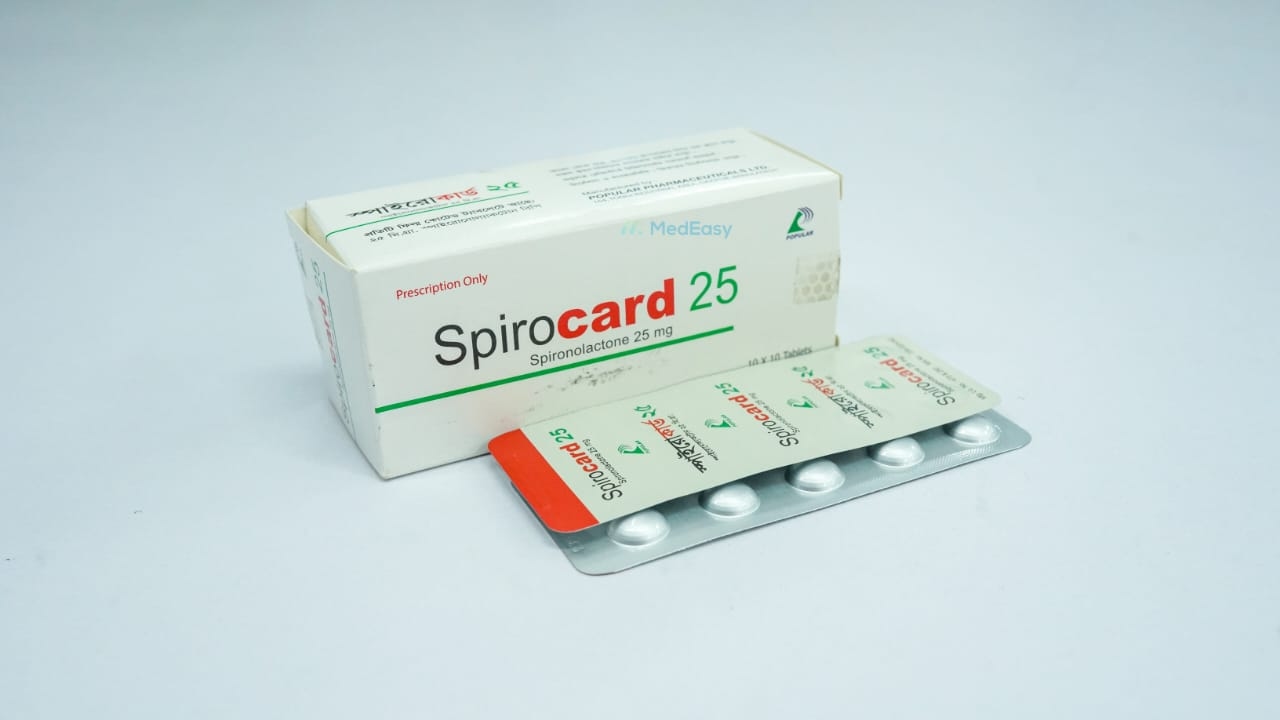
Spirocard25 mg
Popular Pharmaceuticals Ltd.
৳49.50
Add to cart
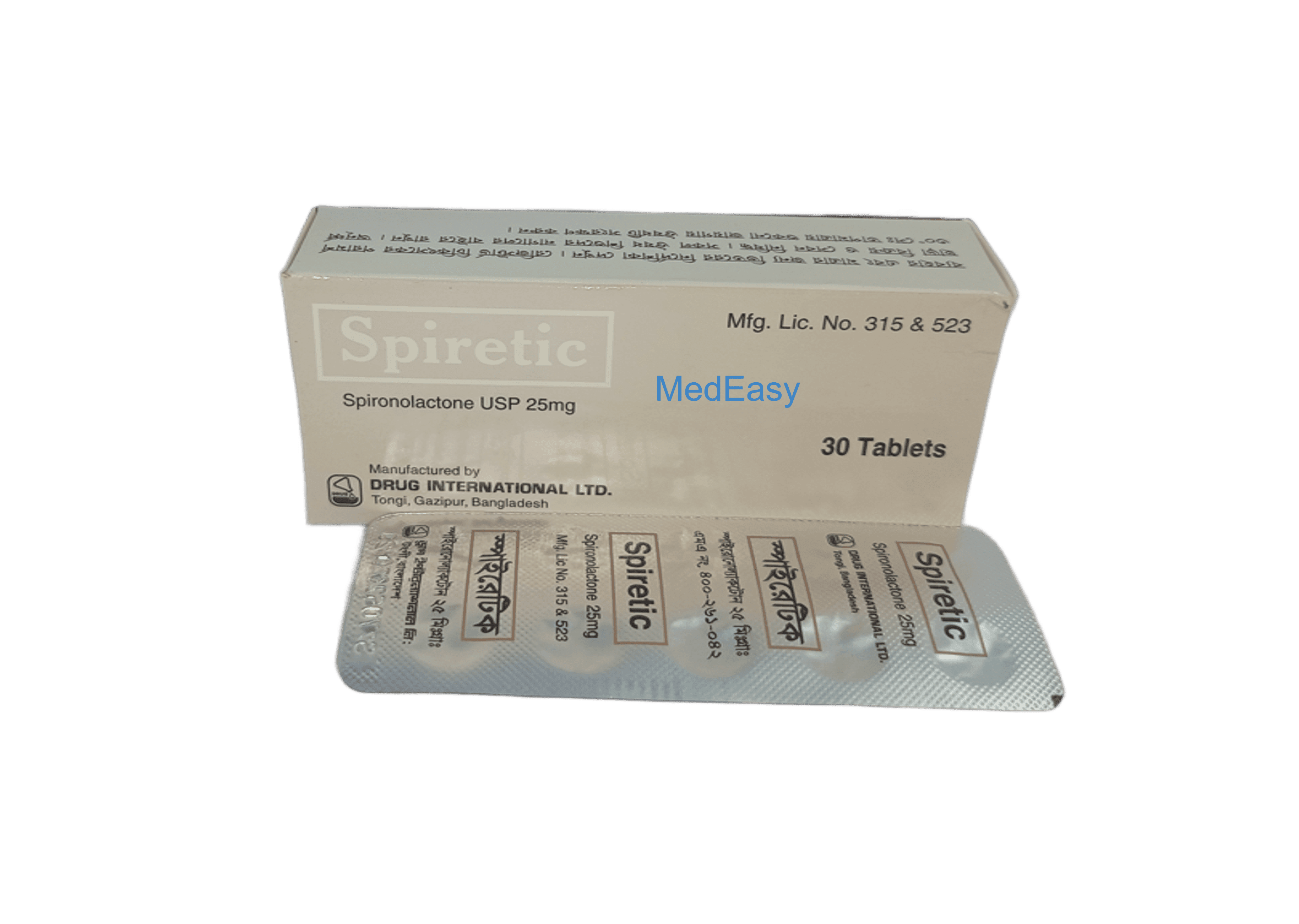
Spiretic 25 mg Tablet is available on MedEasy for ৳46.46 per 10's Strip, with home delivery anywhere in Bangladesh. It is manufactured by Drug International Ltd. Its generic name is Spironolactone.

Spiretic is an aldosterone receptor antagonist (potassium-sparing diuretic) used for the following indications, classified by strength of evidence:
Spironolactone is formulated as oral tablets, commonly available in strengths of 25 mg, 50 mg, and 100 mg. In some markets an oral suspension is also available. Each dosage form contains Spironolactone as the active pharmaceutical ingredient, together with standard pharmaceutical excipients.
Spiretic is a synthetic steroidal aldosterone antagonist that has been used clinically for decades as a potassium-sparing diuretic. Unlike thiazide or loop diuretics, Spiretic works by directly blocking the action of aldosterone in the kidney, promoting sodium and water excretion while conserving potassium. Spiretic is used in the management of edematous conditions, hypertension, primary hyperaldosteronism, and as part of guideline-directed therapy for heart failure with reduced ejection fraction. It also has antiandrogenic properties that make it useful, off-label, for conditions such as hirsutism and acne in women.
Spiretic belongs to the therapeutic class of potassium-sparing diuretics and is specifically an aldosterone receptor (mineralocorticoid receptor) antagonist.
Spironolactone is a synthetic 17-lactone steroid that acts as a specific pharmacological antagonist of aldosterone, competitively binding to mineralocorticoid receptors at the aldosterone-dependent sodium-potassium exchange site in the distal convoluted renal tubule. By blocking aldosterone, Spironolactone increases the excretion of sodium and water while reducing the excretion of potassium and hydrogen ions, producing a mild diuretic and antihypertensive effect. Spironolactone also possesses antiandrogenic activity, partly by competing with androgens for receptor binding and by mild inhibition of androgen biosynthesis, which is the basis for its off-label use in hyperandrogenic skin conditions. In heart failure, blockade of aldosterone's effects on cardiac and vascular remodeling is thought to contribute to the mortality benefit seen with Spironolactone.
Dosage of Spiretic should be individualized and adjusted according to indication, clinical response, and monitoring of serum potassium and renal function.
| Indication | Typical Adult Dose | Notes |
|---|---|---|
| Edema (heart failure, cirrhosis, nephrotic syndrome) | 25-200 mg/day, single or divided doses; often started at 100 mg/day for about 5 days, then titrated | Doses above 50 mg/day may be divided to reduce gastrointestinal upset |
| Essential hypertension | 25-100 mg/day, single or divided doses; may be adjusted after 2 weeks based on response | Usually combined with other antihypertensive agents |
| Primary hyperaldosteronism | Diagnostic testing: 400 mg/day for 4 days (short test) or 3-4 weeks (long test); Maintenance: lowest effective dose, individualized | Specialist (endocrinology)-directed therapy |
| Hypokalemia | 25-100 mg/day | Used when other potassium-conserving measures are inadequate |
| Heart failure, NYHA Class III-IV with reduced ejection fraction | Start 12.5-25 mg once daily; may increase to 25-50 mg once daily based on response and potassium/renal monitoring | Given in addition to standard heart failure therapy |
Pediatric dose (edema): approximately 1-3.3 mg/kg/day given in divided doses, individualized and adjusted based on response and tolerability; safety and efficacy for indications other than edema have not been well established in children (see Use in Special Populations and Pediatric Uses).
Dose adjustment in renal or hepatic impairment is required (see Precautions and Warnings and Use in Special Populations).
Spiretic tablets should be taken by mouth, preferably with food, which can enhance absorption and reduce gastrointestinal discomfort. Spiretic should be taken at the same time(s) each day as advised by the physician. Doses greater than 50 mg/day are often split into two doses. Spiretic should not be stopped abruptly without medical advice, particularly when used for heart failure or cirrhosis, as this may worsen the underlying condition.
Pregnancy: Animal studies with Spiretic and its active metabolites have shown antiandrogenic effects, including feminization of male fetuses at high doses. Human data are limited. Spiretic should be used during pregnancy only if clearly needed and if the potential benefit justifies the potential risk to the fetus; a physician should always be consulted before use in pregnancy or if pregnancy is suspected while taking Spiretic.
Lactation: Spiretic's active metabolite (canrenone) is excreted in breast milk. Because of the potential for adverse effects in the nursing infant, a decision should be made, in consultation with a physician, whether to discontinue breastfeeding or discontinue Spiretic, taking into account the importance of the drug to the mother.
Acute overdose of Spiretic may present with drowsiness, mental confusion, gastrointestinal disturbances (nausea, vomiting, diarrhea), skin rash, and signs of electrolyte disturbance such as hyperkalemia (muscle weakness, irregular heartbeat) or, less commonly, hyponatremia and dehydration. There is no specific antidote for Spiretic overdose. If overdose is suspected, seek immediate medical attention or contact emergency services / a poison control center right away. Management is supportive and should be provided in a medical facility, including monitoring and correction of electrolyte and fluid balance and cardiac monitoring; Spiretic is not effectively removed by hemodialysis.
Store at room temperature (below 30°C), away from light and moisture. Keep out of reach of children.
Spiretic is contraindicated in anuria and severe/acute renal impairment (see Contraindications). In milder renal impairment, use Spiretic with caution, at reduced doses, with frequent monitoring of serum potassium and renal function.
Use Spiretic with caution in patients with hepatic cirrhosis due to increased risk of electrolyte disturbance and metabolic acidosis; close monitoring is required.
Elderly patients are more susceptible to hyperkalemia and decline in renal function with Spiretic; start at lower doses and monitor closely.
See Pediatric Uses for age- and weight-based dosing information for Spiretic.
Duration of treatment with Spiretic varies by indication: a short initial trial (e.g., about 5 days) may be used to assess response in edema, while chronic conditions such as heart failure, cirrhotic ascites, primary hyperaldosteronism, and resistant hypertension typically require long-term or indefinite maintenance therapy. The prescribing physician should periodically review the continued need for Spiretic based on clinical response and monitoring of serum potassium and renal function.
Aldosterone Receptor Antagonists; Potassium-Sparing Diuretics.
Spironolactone acts as a competitive antagonist of aldosterone at mineralocorticoid receptors in the distal convoluted renal tubule, blocking aldosterone-mediated sodium reabsorption and potassium/hydrogen ion excretion. This results in increased sodium and water excretion with potassium conservation. Spironolactone also exerts antiandrogenic effects through androgen receptor antagonism and mild inhibition of androgen synthesis.
C
Spiretic is used in pediatric patients for edema associated with conditions such as nephrotic syndrome, congestive heart failure, and hepatic cirrhosis, typically at a dose of about 1-3.3 mg/kg/day given in divided doses, individualized to response and tolerability. Safety and efficacy of Spiretic for indications other than edema (e.g., hypertension, primary hyperaldosteronism, or off-label antiandrogenic use) have not been well established in children, and use for these purposes should occur only under specialist supervision. Regular monitoring of serum potassium and renal function is essential in pediatric patients receiving Spiretic.
Q: What is Spiretic 25 mg Tablet used for?
A: Spiretic 25 mg Tablet is used to treat fluid retention (edema) caused by heart failure, liver cirrhosis, or nephrotic syndrome, to treat high blood pressure, and to diagnose and manage primary hyperaldosteronism. It is also used off-label for hormonal acne and excess hair growth (hirsutism) in women.
Q: How should I take Spiretic 25 mg Tablet?
A: Take Spiretic 25 mg Tablet by mouth exactly as prescribed by your physician, preferably with food to reduce stomach upset. Do not change your dose or stop Spiretic 25 mg Tablet suddenly without consulting your doctor, especially if you are being treated for heart failure or liver disease.
Q: Can Spiretic 25 mg Tablet cause high potassium levels?
A: Yes. Spiretic 25 mg Tablet is a potassium-sparing diuretic and can cause hyperkalemia (high blood potassium), which can be serious and affect the heart. Your doctor will check your blood potassium and kidney function periodically, and you should avoid potassium supplements and salt substitutes containing potassium unless your doctor tells you otherwise.
Q: Can I take Spiretic 25 mg Tablet during pregnancy or while breastfeeding?
A: Spiretic 25 mg Tablet should be used during pregnancy only if clearly needed, because animal studies suggest a potential risk of antiandrogenic effects on a male fetus; always consult your physician before using Spiretic 25 mg Tablet if you are pregnant or planning pregnancy. Spiretic 25 mg Tablet's metabolite passes into breast milk, so discuss the risks and benefits with your doctor before breastfeeding while taking Spiretic 25 mg Tablet.
Q: What are the common side effects of Spiretic 25 mg Tablet?
A: Common side effects of Spiretic 25 mg Tablet include gynecomastia (breast enlargement/tenderness, mainly in men), menstrual irregularities, gastrointestinal upset, headache, dizziness, and elevated potassium levels. Contact your doctor if you notice irregular heartbeat, severe weakness, or signs of an allergic reaction while taking Spiretic 25 mg Tablet.
Q: Are there foods or medicines I should avoid while taking Spiretic 25 mg Tablet?
A: While taking Spiretic 25 mg Tablet, avoid potassium supplements, salt substitutes containing potassium, and excessive intake of potassium-rich foods unless advised by your doctor. Tell your doctor about all medicines you take, especially ACE inhibitors, ARBs, NSAIDs, lithium, and eplerenone, since these can interact with Spiretic 25 mg Tablet.
Disclaimer
The information provided is accurate to the best of our knowledge, but it does not replace professional medical advice. We cannot guarantee its completeness or accuracy, and the absence of specific information about a drug should not be taken as an endorsement. We are not responsible for any consequences arising from this information, so please consult a healthcare professional for any concerns or questions.