10% Off
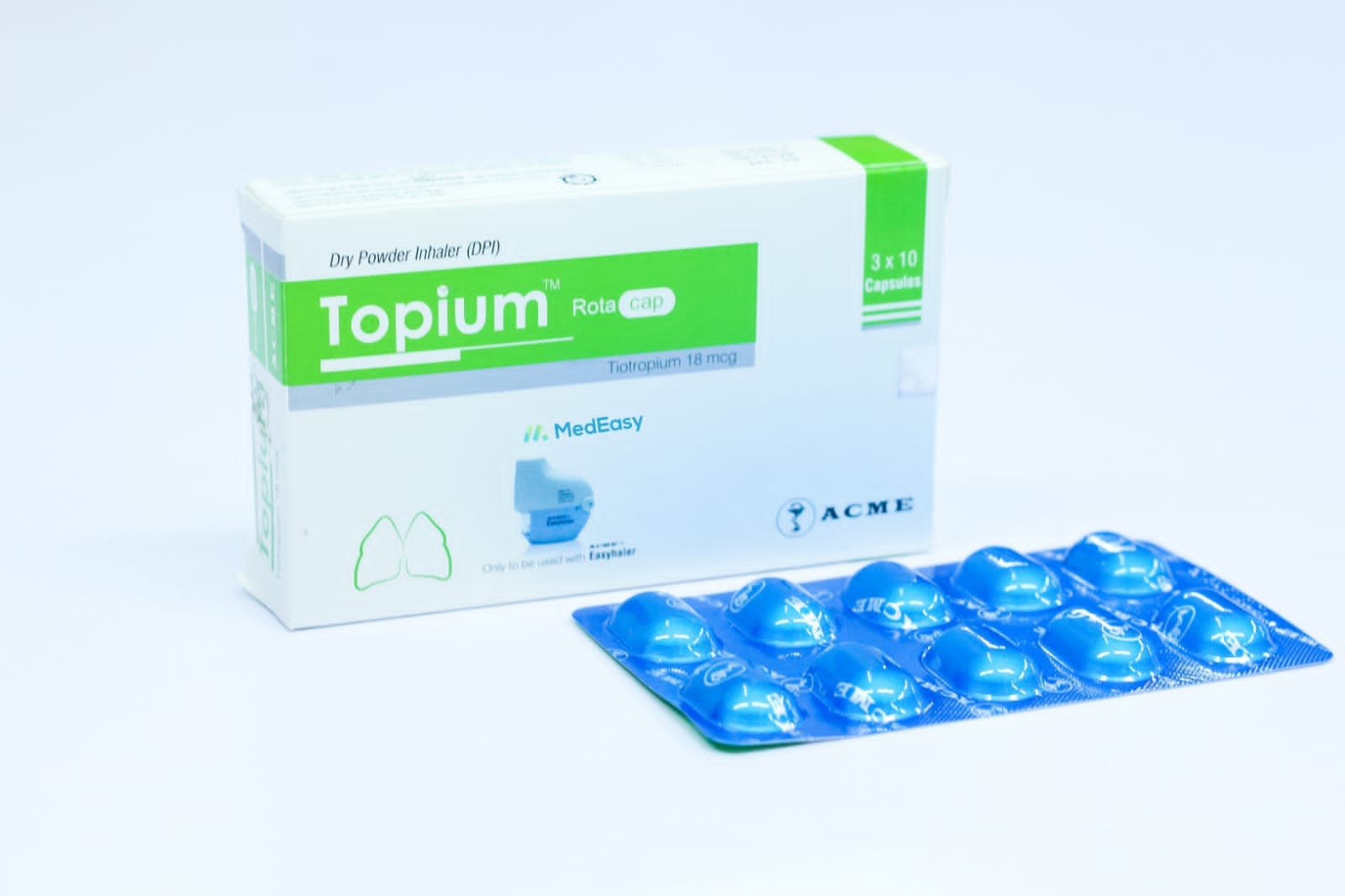
Topium18 mcg
ACME Laboratories Ltd.
৳72.00
Add to cart
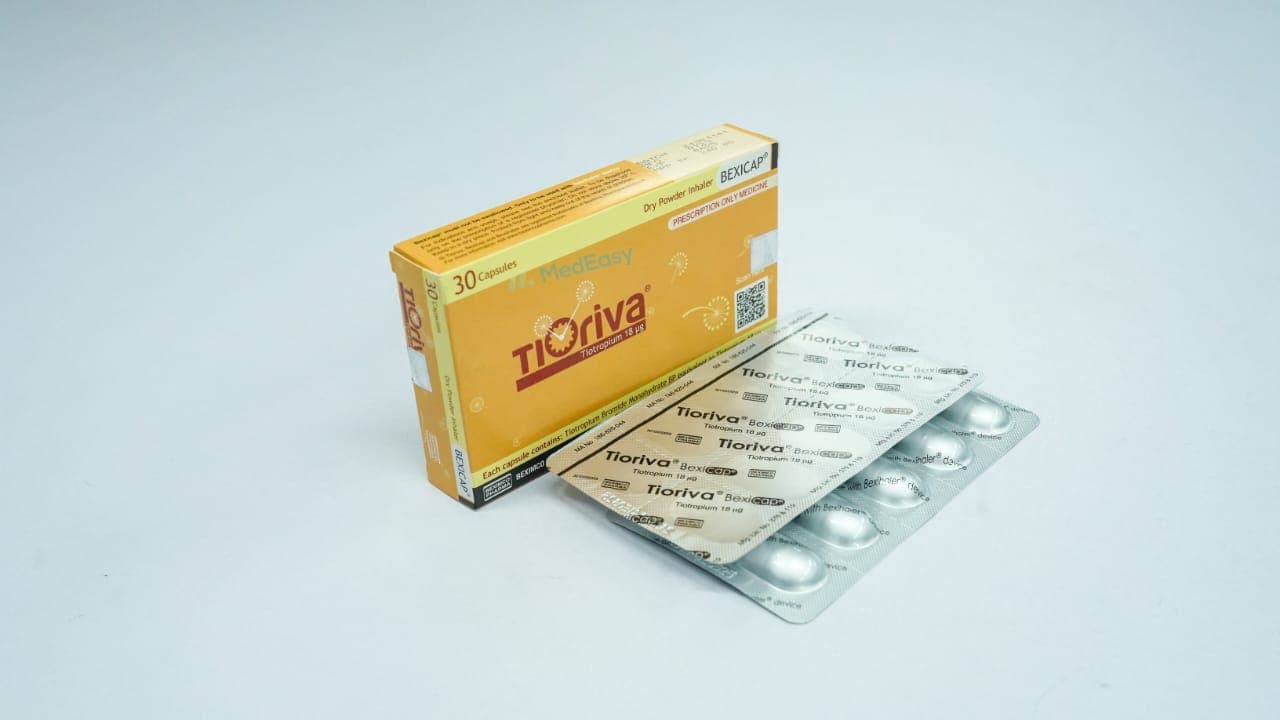

Tioriva is a long-acting anticholinergic (antimuscarinic) bronchodilator delivered by oral inhalation. Its uses are classified below by strength of evidence:
Tioriva is not a rescue medication. It has a slow onset of action and is not indicated for the initial treatment of acute episodes of bronchospasm, i.e., as rescue therapy for sudden shortness of breath.
Each formulation contains Tiotropium (as tiotropium bromide monohydrate) as the active ingredient. Marketed dosage forms and strengths include:
Inactive ingredients vary by manufacturer and formulation and may include lactose monohydrate (in the dry-powder capsule form; contains trace milk protein) or water, benzalkonium chloride, and edetate disodium (in the soft mist spray form).
Tioriva is a long-acting, synthetic quaternary ammonium anticholinergic (antimuscarinic) compound structurally related to atropine and ipratropium, used as a once-daily inhaled bronchodilator for chronic respiratory disease.
Because it carries a permanent positive charge (quaternary ammonium structure), Tioriva is poorly absorbed across biological membranes, which limits its pharmacologic action largely to the lungs and airways and minimizes systemic anticholinergic effects relative to non-selective antimuscarinics such as atropine.
Tioriva is available as a dry powder for oral inhalation via a capsule-based handheld device, and as a solution delivered through a soft mist inhaler. It is used for long-term maintenance therapy and is not intended for as-needed or acute symptom relief.
Anticholinergic (antimuscarinic) bronchodilator; Tioriva belongs to the long-acting muscarinic antagonist (LAMA) class of respiratory drugs.
Tiotropium is a long-acting muscarinic receptor antagonist that binds with similar affinity to M1, M2, and M3 muscarinic receptor subtypes but dissociates much more slowly from M3 and M1 receptors than from M2 receptors. Because bronchial smooth muscle tone is mediated mainly by M3 receptors, this kinetic selectivity produces sustained inhibition of acetylcholine-induced bronchoconstriction, resulting in prolonged bronchodilation with once-daily dosing. Reduced mucus gland secretion also occurs due to M3 receptor blockade.
After inhalation, Tiotropium is absorbed from the lung, with absolute bioavailability of approximately 19–33% depending on the device. Peak plasma concentrations occur within 5–7 minutes (soft mist inhaler) after dosing. Plasma protein binding is low (72%), and steady state is reached after about 2–3 weeks of once-daily dosing. Tiotropium undergoes minimal hepatic metabolism; the majority of the absorbed dose is excreted unchanged in the urine, with a terminal half-life of approximately 5–6 days (capsule form) to 25 hours (soft mist inhaler), consistent with once-daily maintenance dosing. Onset of clinically meaningful bronchodilation begins within 30 minutes, with peak effect at 3 hours, and effects are sustained over 24 hours.
| Indication | Population | Typical Dose |
|---|---|---|
| COPD maintenance (dry powder capsule inhaler) | Adults | Contents of one 18 mcg capsule, inhaled once daily via the inhalation device, at the same time each day. |
| COPD maintenance (soft mist inhaler) | Adults | 2 inhalations (puffs) once daily, at the same time each day, delivering a total dose of 5 mcg of Tioriva. |
| Asthma, add-on maintenance therapy (soft mist inhaler only) | Adults and adolescents/children ≥6 years (per approved labeling for this indication) | 2 inhalations once daily, at the same time each day, as add-on to inhaled corticosteroid-based therapy. |
Renal impairment: Tioriva is predominantly renally eliminated; patients with moderate-to-severe renal impairment (creatinine clearance ≤60 mL/min) should be monitored closely for anticholinergic side effects, as systemic exposure is increased, although no specific dose reduction has been formally established.
Hepatic impairment: No dose adjustment is considered necessary, as Tioriva undergoes minimal hepatic metabolism.
Tioriva is for oral inhalation only and must never be swallowed or injected. Capsules must not be swallowed — they are placed into the inhalation device provided, punctured within the device, and the released powder is inhaled through the mouthpiece; capsules should be kept in the blister and removed immediately before use, protected from moisture. The soft mist inhaler cartridge must be inserted and primed according to the manufacturer's instructions before first use. Tioriva is a once-daily, fixed-schedule maintenance medication and should be taken at the same time each day; it should not be used more often than prescribed, and additional doses do not provide additional benefit for acute symptoms.
Tioriva is administered exclusively by oral inhalation using the specific device supplied with the product (a capsule-based handheld inhaler or a soft mist inhaler); the two device/formulation types are not interchangeable, and capsules intended for the dry powder device must never be swallowed. Patients should be trained in correct inhaler technique by a healthcare professional or pharmacist, as inadequate technique substantially reduces lung deposition and clinical effect. Care should be taken to avoid spraying or allowing the powder or mist to contact the eyes.
Clinically significant, well-verified interactions with Tioriva include:
Because systemic absorption of Tioriva is limited, clinically significant interactions with systemically-acting drugs metabolized via cytochrome P450 pathways have not been well established.
Tiotropium is contraindicated in patients with a known hypersensitivity to Tiotropium, atropine or its derivatives (such as ipratropium), or to any component of the specific formulation. Reported hypersensitivity reactions have included urticaria, angioedema (including of the pharynx, larynx, tongue, lips, and face), anaphylaxis, and bronchospasm, some occurring after the first dose.
The most commonly reported adverse effects of Tioriva are related to its local and systemic anticholinergic action:
Pregnancy: There are no adequate and well-controlled studies of Tioriva in pregnant women. Because systemic absorption is limited, fetal systemic exposure is expected to be low, but Tioriva should be used during pregnancy only if the potential benefit justifies the potential risk to the fetus; a physician should be consulted before use in pregnancy.
Lactation: It is not known whether Tioriva is excreted in human breast milk, although it has been detected in the milk of lactating animals. A decision should be made to discontinue breastfeeding or discontinue Tioriva, taking into account the importance of the drug to the mother; a physician or lactation specialist should be consulted before use while breastfeeding.
Because systemic absorption of Tioriva is limited after inhaled use, severe systemic toxicity from accidental overdose is uncommon; however, high doses may produce exaggerated anticholinergic effects such as dry mouth, blurred vision, tachycardia, urinary retention, and constipation. If overdose is suspected, particularly with accidental ingestion of the inhalation solution or multiple capsules, or if severe or unusual symptoms occur, seek immediate medical attention or contact a poison control center; treatment is supportive and symptomatic, as there is no specific antidote for Tioriva.
Store at room temperature (below 30°C), away from light and moisture. Keep capsules in the blister until immediately before use. Do not freeze the soft mist inhaler cartridge. Keep out of reach of children.
Tioriva is intended for long-term, regular, once-daily maintenance therapy in COPD and, where used, as asthma add-on therapy, for as long as the prescribing physician determines it is needed to control symptoms and reduce exacerbations. It is not intended to be stopped and started intermittently for symptom relief, and effectiveness depends on consistent daily use. Any decision to stop or change Tioriva therapy should be made by the prescribing physician, generally based on ongoing symptom control and periodic reassessment.
Tiotropium belongs to the anticholinergic (antimuscarinic) bronchodilator class, specifically the long-acting muscarinic antagonist (LAMA) subclass; related classes include short-acting muscarinic antagonists (e.g., ipratropium) and beta-2 agonist bronchodilators, with which Tiotropium is often used concurrently.
Tiotropium works by binding to muscarinic acetylcholine receptors (M1, M2, M3) in the airway, with prolonged (kinetically selective) dissociation from M3 and M1 receptor subtypes relative to M2. Because bronchoconstriction is chiefly mediated through M3 receptors on airway smooth muscle, this slow dissociation produces sustained, once-daily inhibition of vagally-mediated bronchoconstriction and mucus secretion, resulting in prolonged bronchodilation. Because Tiotropium is a quaternary ammonium compound with poor lipid solubility, its action is largely confined to the lungs, with minimal systemic anticholinergic effect at recommended doses.
Use of Tioriva in children is indication- and formulation-specific:
Q: What is Tioriva 18 mcg Inhalation Capsule used for?
A: Tioriva 18 mcg Inhalation Capsule is a long-acting inhaled anticholinergic bronchodilator used for once-daily maintenance treatment of chronic obstructive pulmonary disease (COPD), including chronic bronchitis and emphysema, and, in a specific soft mist inhaler formulation, as add-on maintenance therapy for asthma in patients who remain symptomatic on inhaled corticosteroid-based treatment.
Q: Can Tioriva 18 mcg Inhalation Capsule be used to relieve a sudden asthma or COPD flare-up?
A: No. Tioriva 18 mcg Inhalation Capsule has a slow onset of action and is a once-daily maintenance medication, not a rescue inhaler. It must not be used for the initial treatment of acute, sudden shortness of breath or wheezing — a fast-acting rescue bronchodilator prescribed by your doctor should be used for that purpose, and Tioriva 18 mcg Inhalation Capsule should be continued on its regular schedule.
Q: Who should not use Tioriva 18 mcg Inhalation Capsule?
A: Tioriva 18 mcg Inhalation Capsule should not be used by anyone with a known hypersensitivity (allergy) to Tioriva 18 mcg Inhalation Capsule itself, to atropine, or to related anticholinergic derivatives such as ipratropium, as this can cause reactions such as swelling of the face, lips, tongue, or throat (angioedema), hives, or a severe allergic reaction. Always tell your doctor about any known drug allergies before starting Tioriva 18 mcg Inhalation Capsule.
Q: What are the common side effects of Tioriva 18 mcg Inhalation Capsule?
A: The most common side effect of Tioriva 18 mcg Inhalation Capsule is dry mouth. Other reported effects include constipation, cough, symptoms of upper respiratory or urinary tract infection, dizziness, and, less commonly, blurred vision or difficulty passing urine, especially in men with an enlarged prostate. If you notice sudden worsening of wheezing or breathing difficulty right after using Tioriva 18 mcg Inhalation Capsule (paradoxical bronchospasm), stop use and contact your doctor immediately.
Q: Is Tioriva 18 mcg Inhalation Capsule safe to use during pregnancy or breastfeeding?
A: There is limited human data on Tioriva 18 mcg Inhalation Capsule in pregnancy and breastfeeding. Because only a small amount of the drug is absorbed into the bloodstream after inhaled use, exposure to a fetus or breastfed infant is expected to be low, but Tioriva 18 mcg Inhalation Capsule should be used during pregnancy or breastfeeding only if your physician determines that the benefit outweighs any potential risk. Always consult your doctor before using Tioriva 18 mcg Inhalation Capsule if you are pregnant, planning pregnancy, or breastfeeding.
Q: Can Tioriva 18 mcg Inhalation Capsule be used in children?
A: Tioriva 18 mcg Inhalation Capsule is not approved for pediatric COPD, since COPD is a disease of adults. However, the soft mist inhaler formulation of Tioriva 18 mcg Inhalation Capsule is approved as an add-on asthma treatment in children 6 years of age and older who remain symptomatic despite inhaled corticosteroid therapy, at the same dose used in adults. Tioriva 18 mcg Inhalation Capsule has not been studied and is not approved for children under 6 years of age, and pediatric use should always be directed by a doctor.
Disclaimer
The information provided is accurate to the best of our knowledge, but it does not replace professional medical advice. We cannot guarantee its completeness or accuracy, and the absence of specific information about a drug should not be taken as an endorsement. We are not responsible for any consequences arising from this information, so please consult a healthcare professional for any concerns or questions.