
8% Off
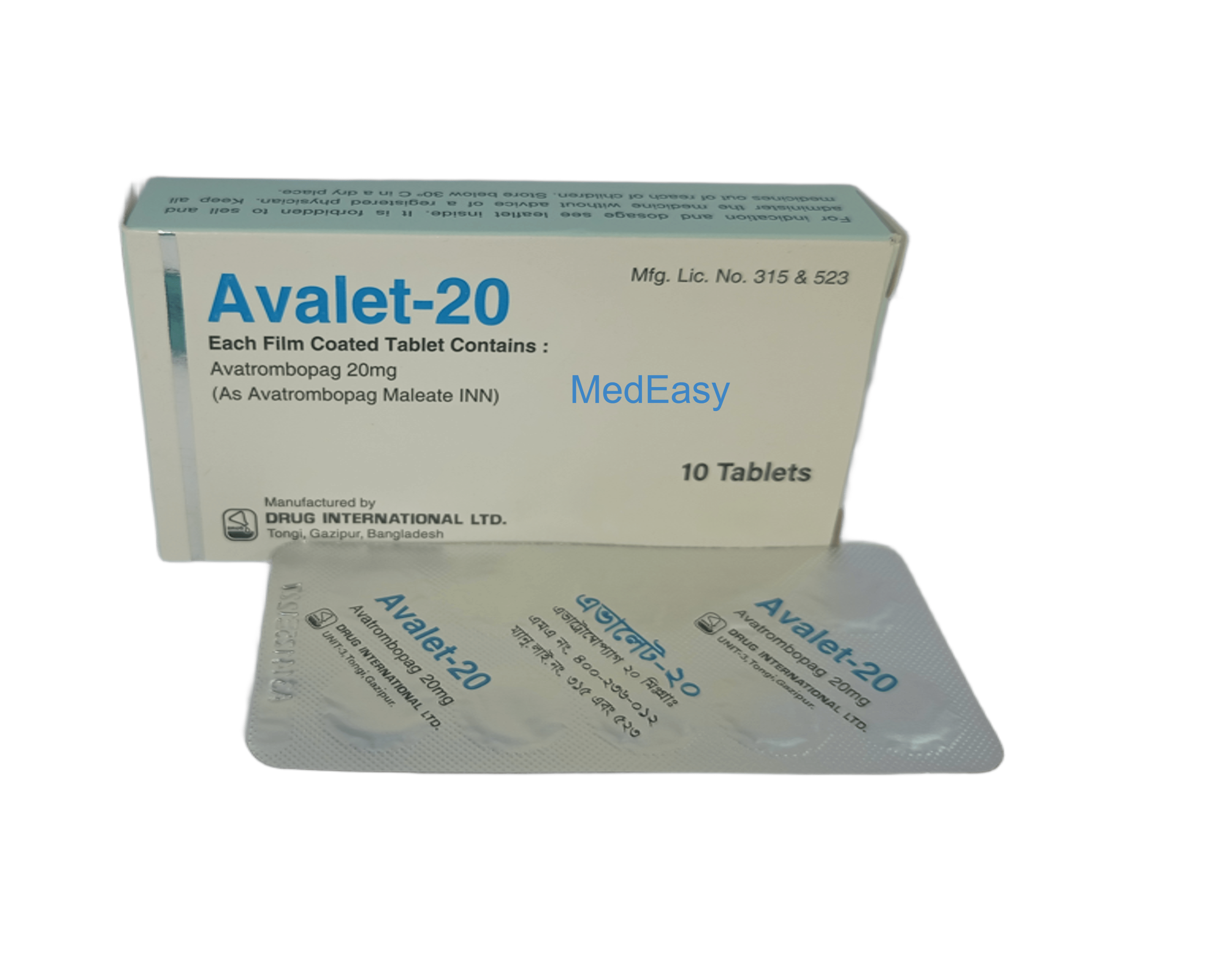
Avalet20 mg
Drug International Ltd.
৳2530.00
Add to cart
Avatrombopag is indicated for the treatment of thrombocytopenia in patients scheduled to undergo a procedure and more.
Avatrombopag is indicated for the treatment of thrombocytopenia in patients scheduled to undergo a procedure, and for the treatment of chronic immune thrombocytopenia (ITP) in patients who have had an insufficient response to a previous treatment.
Avatrombopag does not address the underlying cause of thrombocytopenia. It is intended to be used as part of a broader treatment plan, under the supervision of a specialist (hepatologist for chronic liver disease, or hematologist for ITP).
Dosing of Avatrombopag differs substantially by indication and must be individualized to the patient's baseline platelet count and treatment goal. The lowest dose needed to achieve the desired platelet count for the intended purpose should be used - the goal is not to normalize the platelet count.
| Baseline platelet count | Avatrombopag dose | Duration |
|---|---|---|
| Less than 40 x 10^9/L | 60 mg once daily | 5 consecutive days |
| 40 to less than 50 x 10^9/L | 40 mg once daily | 5 consecutive days |
Dosing should begin 10 to 13 days before the scheduled procedure, with the procedure performed 5 to 8 days after the last dose. Platelet count should be checked on the day of, or immediately before, the procedure. This regimen is not intended for patients with chronic ITP.
Starting dose: 20 mg once daily. The dose is titrated in 20 mg increments/decrements (maximum 40 mg once daily) at intervals of at least 2 weeks, based on platelet count response, aiming for a platelet count sufficient to reduce bleeding risk (generally at or above 50 x 10^9/L) rather than a normal count. If an adequate response is not seen after 2 weeks at the maximum dose, discontinue Avatrombopag.
| Age group | Formulation | Starting dose | Maximum dose |
|---|---|---|---|
| 1 to less than 6 years | Oral granules (sprinkle) | 10 mg once daily | 20 mg once daily |
| 6 years and older | Tablet or granules | 20 mg once daily | 40 mg once daily |
Doses are titrated based on platelet count response at intervals of at least 2 weeks. See Pediatric Uses for further detail.
Avatrombopag must be taken with food; taking it on an empty stomach substantially reduces absorption. Tablets should be swallowed whole. Oral granules should be sprinkled onto a small amount (one tablespoon) of soft food (e.g., pudding, yogurt, applesauce) or mixed into a small amount of water or milk immediately before administration and consumed within a short period - do not prepare in advance.
If a dose is missed, it may be taken the same day once remembered; the patient should not double the dose the next day to make up for a missed one.
No dose adjustment is required based on renal impairment or hepatic impairment (avatrombopag has been studied specifically in patients with chronic liver disease, including more advanced Child-Pugh classes, for the CLD indication).
Most common: pyrexia (fever), abdominal pain, nausea/vomiting, headache, fatigue, and peripheral edema.
Most common: headache, fatigue, contusion (bruising), epistaxis (nosebleed), petechiae, myalgia (muscle pain), and upper respiratory tract infection.
Most common: viral infection, pyrexia, cough, oropharyngeal pain (sore throat), upper respiratory tract infection, and vomiting.
With Avatrombopag, thrombotic/thromboembolic events (see Precautions and Warnings) and hepatic decompensation in patients with chronic liver disease have been reported; seek prompt medical attention for symptoms such as leg swelling/pain, chest pain, shortness of breath, or worsening confusion/jaundice.
Avatrombopag is contraindicated in patients with known hypersensitivity to avatrombopag or to any component of the formulation.
Disclaimer
The information provided is accurate to the best of our knowledge, but it does not replace professional medical advice. We cannot guarantee its completeness or accuracy, and the absence of specific information about a drug should not be taken as an endorsement. We are not responsible for any consequences arising from this information, so please consult a healthcare professional for any concerns or questions.