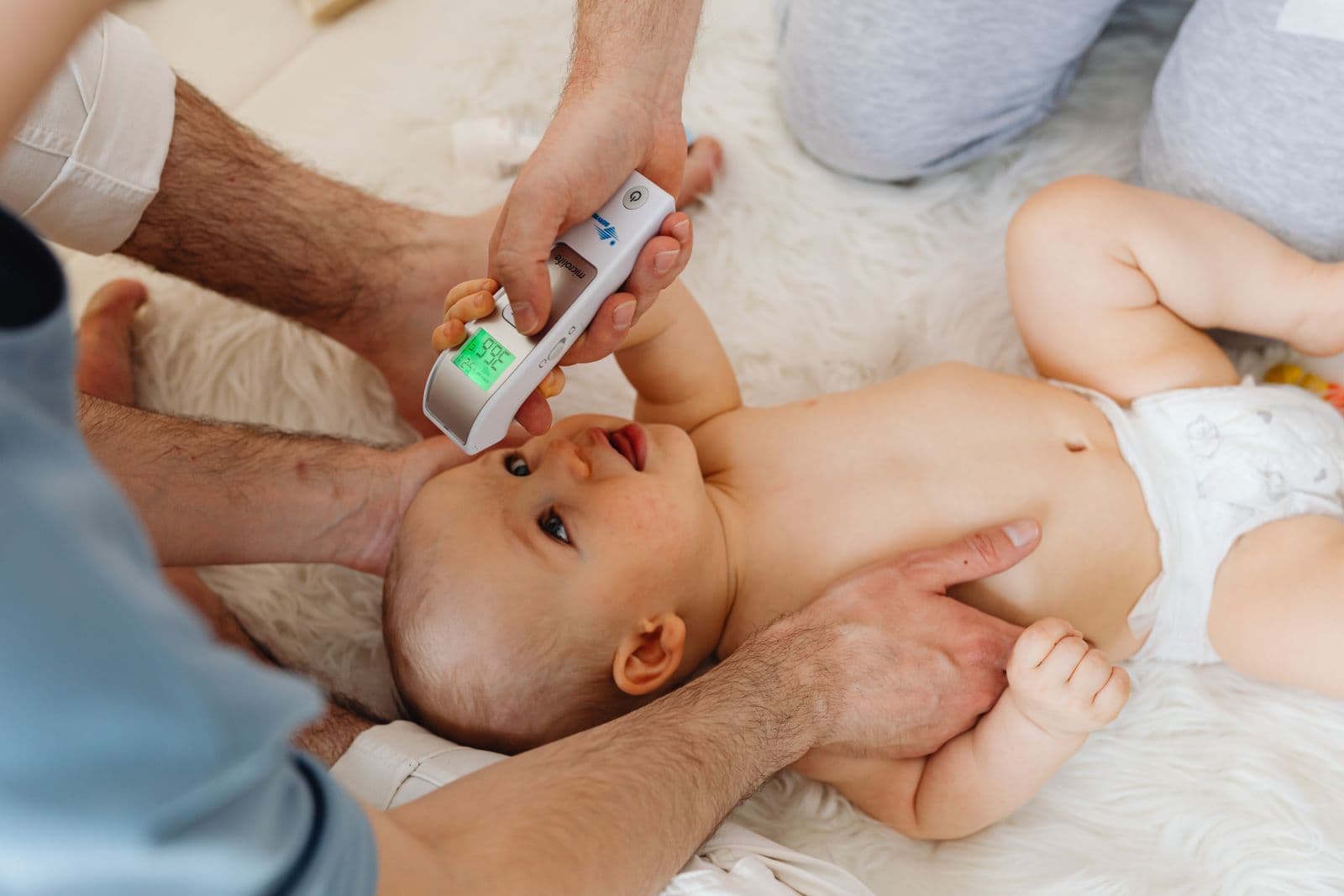
Quick answer: A fever in a baby is a temperature of 38 C (100.4 F) or higher. If your baby is under 3 months old, take them to a doctor or emergency care straight away and do not give medicine first. In older babies, keep them comfortable, offer extra fluids and feeds, and use paediatric paracetamol only in a weight-based dose confirmed by a doctor or pharmacist.
What temperature counts as a fever in a baby?
A fever is a temperature of 38 C (100.4 F) or above. Use a digital thermometer. An underarm reading is fine for screening, while a rectal reading is the most accurate in infants (only if you have been shown how). Touching the forehead is not reliable.
A fever itself is the body fighting an infection. The aim is to keep the child comfortable and to watch for danger signs, not to push the number down at any cost.
How to measure temperature by age
| Age | Recommended method (AAP/NHS) |
|---|---|
| Birth to 3 months | Rectal is most accurate; underarm (axillary) for screening |
| 3 months to 3 years | Rectal still most accurate; underarm or forehead for screening; ear (tympanic) from 6 months |
| 4 years and older | Oral, ear or underarm |
Do not use a mercury thermometer.
What should I do first if my baby under 3 months has a fever?
Go to a doctor or hospital immediately if a baby younger than 3 months has a temperature of 38 C or above. Young babies can have serious infections without looking very ill. Do not give paracetamol or any other medicine before they are examined unless a doctor tells you to. If you are reading our newborn care guide, note that in the first 28 days even a temperature of 37.5 C or above is a danger sign.
Between 3 and 6 months, a temperature of 39 C or higher, or any fever with poor feeding or unusual sleepiness, also needs medical advice the same day.
How can I make a feverish baby comfortable at home?
For a baby over 3 months who is alert, feeding and has no danger signs:
- Keep up fluids. Breastfeed more often; babies over 6 months can also have small sips of water or ORS. Check for fewer wet nappies.
- Dress lightly and keep the room comfortable. One thin cotton layer is enough; do not wrap the baby up to "sweat out" the fever.
- Never use cold water, ice or alcohol rubs; they cause shivering, which raises the core temperature. Routine lukewarm sponging is not recommended either.
- Give paracetamol only if the baby is uncomfortable, not just because of the number. Never give aspirin.
Can I give paracetamol to my baby, and how much?
Paracetamol can ease discomfort in a child older than 3 months, but the dose must suit the child's weight.
- Use only a paediatric formulation (drops or suspension), never an adult tablet.
- The usual dose is about 10-15 mg per kg of body weight per dose, but confirm the exact amount with a doctor or pharmacist.
- Leave at least 4-6 hours between doses and give no more than 4 doses in 24 hours.
- Always measure with the syringe or cup supplied with that product.
- For babies under 3 months, give it only on medical advice.
- Drops and syrups come in different strengths (for example 80 mg per ml versus 120 mg per 5 ml), so read the label every time.
- Do not give it for more than 3 days without seeing a doctor.
Adult 500 mg tablets such as Napa 500 mg are not for babies and young children. Ask your pharmacist for the right paediatric form of paracetamol; you can read about paracetamol or browse the baby care section, but check the pack strength before you buy.
Which fever medicines should I avoid?
- Aspirin: never give it to children with fever.
- Ibuprofen: not for babies under 3 months or under 5 kg (the AAP prefers to wait until 6 months), and only if the doctor agrees. Avoid it if dengue is possible or the baby is dehydrated, because it can strain the kidneys and increase bleeding.
- Do not alternate or combine fever medicines without a doctor's advice.
- Antibiotics bought without a prescription, "fever injections" and steroid syrups: most baby fevers are viral, and none of these treat a virus.
Most childhood fevers are viral, and antibiotics do nothing for them while adding side effects; read when antibiotics are needed and why resistance matters.
What about fever fits (febrile seizures)?
Febrile seizures can happen between 6 months and 5 years. They are frightening but usually last less than 5 minutes and do not harm the brain. During a fit:
- lay the child on their side on a safe surface;
- put nothing in the mouth and do not hold the child down;
- note the time.
Call emergency help (999) if it lasts more than 5 minutes, it is the child's first seizure, it happens again, or the child does not wake up normally afterwards.
Afterwards, keep the child on their side and give nothing by mouth until they are fully awake. Also call 999 if the twitching was on one side only. Paracetamol does not prevent febrile seizures, and the child should still see a doctor.
What should I keep track of during a fever?
Write down the temperature and the time, any medicine given (name, amount and time), how many wet nappies the baby has had, and whether the baby is alert, feeding and playing between fevers. A child who is alert and drinking well is usually less worrying than one who is limp or hard to wake, even if the temperature is lower. Take these notes to the doctor.
A digital thermometer helps you check your baby's temperature reliably; see digital thermometers on MedEasy.
What tests will the doctor order and what do the results mean?
Tests are needed only when the cause is unclear, the baby is very young, or the fever has lasted more than 2-3 days.
- Urine test (routine and culture): a urinary tract infection (UTI) is a common hidden cause of fever in babies under 1 year. White cells or nitrites on the dipstick suggest infection; the culture confirms the bacteria and the right antibiotic.
- Complete blood count (CBC): a high white cell count points towards bacterial infection; a falling platelet count raises suspicion of dengue.
- Dengue tests in season: NS1 antigen in the first 5 days of fever, dengue IgM after day 5.
- CRP, blood culture or chest X-ray if the baby is very unwell, and a lumbar puncture in a very young or very ill baby to rule out meningitis; this is a standard, safe test.
Fever after vaccination
A mild fever within 24-48 hours of the 6-, 10- and 14-week EPI vaccines is common and settles within 1-2 days; after the measles-rubella (MR) vaccine at 9 months, fever can appear 7-11 days later. Give paediatric paracetamol only if the baby is uncomfortable. A baby under 3 months with 38 C or higher should still be checked the same day.
Common myths and questions in Bangladesh
- "Teething causes high fever." Teething may cause drooling and a very slight rise in temperature, but not a true fever of 38 C or above; a real fever has another cause.
- "Fever will damage the brain." Fever from an infection does not cause brain damage; that happens only with extreme overheating such as heatstroke, above about 42 C.
- "Wrap the baby up so the fever sweats out." Wrapping holds heat in, raises the temperature further and increases the risk of a febrile seizure.
- "Every fever needs an antibiotic or an injection." Most fevers are viral and clear in 2-3 days; antibiotics help only for a bacterial infection such as a UTI, pneumonia or an ear infection.
When should I see a doctor urgently?
See a doctor the same day, or go to emergency care, if the child with a fever has any of these:
- age under 3 months with 38 C or above;
- age 3 to 6 months with 39 C or above;
- a stiff neck, or a rash that does not fade when a glass is pressed on it;
- trouble breathing or fast breathing;
- unusual drowsiness, floppiness or unbearable crying;
- refusing feeds, or fewer wet nappies than usual;
- blue lips, or a bulging soft spot (fontanelle) on the head;
- a temperature of 40 C or above that keeps returning;
- fever lasting more than 3 days;
- fever in dengue season with warning signs such as persistent vomiting, severe abdominal pain, bleeding or lethargy (see our dengue guide).
Fever for a day or two after vaccination is common, but a baby under 3 months with fever should still be seen. If you are unsure whether to go in person, an online doctor consultation can help you decide, but it cannot replace a physical examination for a very young or very sick baby.
References
- High temperature (fever) in children - NHS
- Fever: When to Call the Pediatrician - HealthyChildren.org (AAP)
- Febrile seizures - NHS
- How to Take a Child's Temperature - HealthyChildren.org (AAP)
- Paracetamol for children - NHS
- Ibuprofen for children - NHS
This article is for general awareness only and is not a substitute for advice from a qualified doctor. If your baby seems unwell, seek medical care promptly.