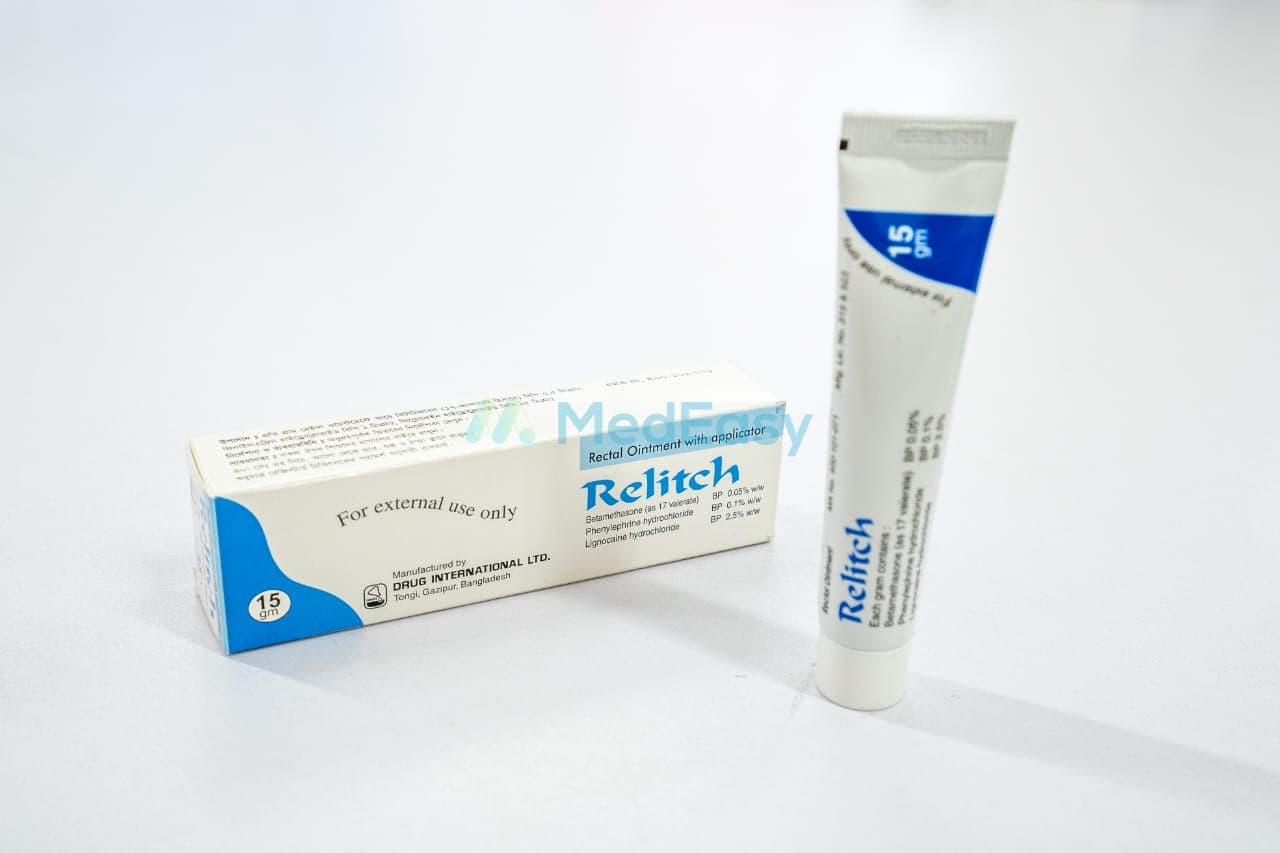
Product gallery
MRP 30.1010 % Off
Best PriceTk 27.09/15 mg tube
1
Section

Medicine overview

Indications of Relitch

Relitch is a fixed-dose topical combination of a corticosteroid, an alpha-adrenergic vasoconstrictor, and a local anesthetic, formulated as an anorectal (perianal/rectal) ointment or cream.

Established / Guideline-Supported Uses

  • Symptomatic relief of pain, itching, burning, and swelling associated with internal and external hemorrhoids (piles).
  • Symptomatic relief of anal fissures and pruritus ani (anal itching) of inflammatory origin.
  • Short-term relief of local inflammation and congestion in proctitis and other benign anorectal conditions, as labeled by the marketing authorization holder.

Adjunct Use

  • Short-term adjunct symptom control before or after minor anorectal procedures (e.g., sclerotherapy, banding, or hemorrhoidectomy), used only under medical supervision.

Relitch provides symptomatic relief only; it does not cure the underlying cause of hemorrhoids or anorectal disease, and it is not intended for long-term or unsupervised use.

Composition

Each gram of Betamethasone + Phenylephrine + Lignocaine ointment/cream typically contains: Betamethasone (as valerate or dipropionate) 0.05%–0.1% w/w, Phenylephrine Hydrochloride 0.25%–0.5% w/w, and Lignocaine (Lidocaine) Hydrochloride 2%–5% w/w, in a suitable ointment/cream base. Exact strengths vary by manufacturer and brand; refer to the specific product's labeling for its precise composition.

Description

Relitch is a combination anorectal preparation that brings together three complementary actions in one topical product: an anti-inflammatory corticosteroid (betamethasone), a vasoconstrictor/decongestant (phenylephrine), and a fast-acting local anesthetic (lignocaine). It is applied externally to the perianal skin or intrarectally with an applicator, for short-term relief of the pain, itching, swelling, and congestion of hemorrhoids and related anorectal conditions.

Therapeutic Class

Anorectal preparation — combination of a topical corticosteroid, a sympathomimetic (alpha-adrenergic) vasoconstrictor, and an amide-type local anesthetic. Relitch is a representative fixed-dose combination of this class.

Pharmacology

Betamethasone + Phenylephrine + Lignocaine combines three distinct mechanisms of action at the site of application:

  • Betamethasone is a potent synthetic corticosteroid that reduces local inflammation by inhibiting phospholipase A2 and the release of inflammatory mediators, decreasing redness, swelling, and itching.
  • Phenylephrine is a direct-acting alpha-1 adrenergic agonist that produces local vasoconstriction, reducing venous congestion and swelling of hemorrhoidal tissue.
  • Lignocaine (lidocaine) is an amide local anesthetic that blocks voltage-gated sodium channels in sensory nerve endings, producing rapid, temporary relief of pain and itching.

Together these actions provide combined anti-inflammatory, decongestant, and analgesic effects for anorectal symptoms. Systemic absorption of all three components through intact anorectal mucosa/skin is normally low with recommended short-term use, but increases with prolonged use, occlusion, or application to large or broken areas.

Dosage & Administration of Relitch

Dosing of Relitch is for external/topical (perianal) and intrarectal (with applicator, where provided) use only, in adults, for short-term symptomatic treatment.

IndicationTypical FrequencyTypical Duration
External hemorrhoids / anal fissure / pruritus aniApply a thin layer 2–3 times daily and after each bowel movementUsually up to 7 days; reassess if no improvement
Internal hemorrhoids (with rectal applicator, if provided)Once or twice daily, as directedUsually up to 7 days; reassess if no improvement

Take Relitch exactly as prescribed by a physician; do not stop, extend, apply more often, or share this medicine with others without medical advice. Do not use continuously for prolonged periods without medical reassessment (see Precautions and Warnings).

Administration of Relitch

Clean and dry the perianal area gently before applying Relitch. Apply a thin layer to the affected external skin, or introduce a small amount intrarectally using the applicator supplied with the product (if any), as directed by a physician. Wash hands thoroughly before and after application. Relitch is for anorectal use only and must not be applied to the eyes, taken orally, or used on broken or infected skin unless specifically directed by a physician.

Interaction of Relitch

Because Relitch is applied topically/intrarectally and systemic absorption is normally low with short-term recommended use, well-established systemic drug interactions are limited. Clinically relevant considerations include:

  • Other corticosteroids (topical, inhaled, or systemic): concurrent use may increase the total corticosteroid burden and the risk of systemic effects; avoid combining multiple corticosteroid-containing products without medical advice.
  • Monoamine oxidase inhibitors (MAOIs) or tricyclic antidepressants: if significant systemic absorption of the phenylephrine component occurs (e.g., with prolonged/excessive use), there is a theoretical risk of exaggerated pressor (blood pressure-raising) effect.
  • Other local anesthetics or antiarrhythmic drugs: concomitant use with other products containing local anesthetics, or with Class I antiarrhythmics, may have additive effects on cardiac conduction if substantial systemic absorption of the lignocaine component were to occur.

Inform the physician of all other medicines being used before starting Relitch.

Contraindications

Betamethasone + Phenylephrine + Lignocaine is contraindicated in:

  • Known hypersensitivity to betamethasone, phenylephrine, lignocaine (or other amide-type local anesthetics), or any excipient of the formulation.
  • Untreated local infection of the anorectal area of viral (e.g., herpes, varicella), fungal, or tuberculous origin, where the corticosteroid component could mask or worsen the infection.
  • Narrow-angle glaucoma or severe uncontrolled cardiovascular disease in which sympathomimetic agents are specifically contraindicated, if there is a risk of significant systemic absorption of the phenylephrine component.

Side Effects of Relitch

Adverse effects of Relitch are generally local and mild when used as directed for short courses.

  • Local burning, stinging, or tingling sensation on application
  • Itching or contact dermatitis at the application site
  • Skin thinning (atrophy), striae, or telangiectasia with prolonged or excessive use of the corticosteroid component
  • Rebound congestion or irritation if the phenylephrine-containing product is used for longer than recommended
  • Rarely, systemic effects (e.g., adrenal suppression from the corticosteroid, or palpitations/elevated blood pressure from the phenylephrine component) if used excessively, on broken skin, or under occlusion
  • Rare hypersensitivity reactions to the lignocaine component

Discontinue Relitch and consult a physician if irritation worsens or signs of infection or systemic effects appear.

Pregnancy & Lactation

Relitch should be used during pregnancy only if clearly needed and if the potential benefit justifies the potential risk to the fetus; a physician should be consulted before use, particularly for anything beyond brief, limited-area application, as systemic absorption of the corticosteroid and vasoconstrictor components could theoretically affect the fetus with extensive or prolonged use.

It is not established whether clinically significant amounts of the components of Relitch pass into breast milk after topical anorectal use. Caution is advised, and a physician should be consulted before use while breastfeeding.

Precautions & Warnings

Relitch is intended for short-term use only, per product labeling.

  • Do not use for longer than about 7 days without medical reassessment; prolonged corticosteroid use in the anorectal area may cause local tissue thinning and other local corticosteroid-related effects (see Side Effects).
  • Avoid applying to a larger area, more frequently, or under occlusive dressing than directed, to limit systemic absorption of all three components.
  • Avoid contact with the eyes; if accidental contact occurs, rinse thoroughly with water.
  • Rebound congestion or irritation can occur with excessive or prolonged use of the decongestant (phenylephrine) component; discontinue if this occurs and consult a physician.
  • Do not use on skin with untreated infection (viral, fungal, or bacterial) unless directed by a physician (see Contraindications).
  • Take Relitch exactly as prescribed; do not stop, extend, use more often, or share this medicine with others without medical advice.
  • If bleeding, a lump, or symptoms persist or worsen after 7 days of use, stop use and seek medical evaluation, as these may indicate a condition other than simple hemorrhoids.

Overdose Effects of Relitch

Significant systemic toxicity from topical/intrarectal overdose of Relitch is unlikely with appropriate short-term use, but excessive or prolonged application, use on broken skin, or accidental ingestion could increase the risk of systemic corticosteroid, sympathomimetic (e.g., raised blood pressure, palpitations), or local anesthetic effects (e.g., dizziness, numbness, in severe cases cardiac or central nervous system effects). If overdose, accidental ingestion, or a significant adverse reaction is suspected, seek immediate medical attention or contact a poison control center. Do not attempt unsupervised home treatment.

Storage Conditions

Store at room temperature (below 30°C), away from light and moisture. Keep out of reach of children.

Use In Special Populations

Renal/Hepatic Impairment: No specific dose adjustment is well established for topical/intrarectal use of Relitch, as systemic absorption is normally low; use with caution and medical supervision if impairment is significant.

Elderly: No specific dose adjustment is generally required; use with the same short-term precautions as in other adults, particularly if cardiovascular disease is present (see Contraindications).

Pediatric: Safety and efficacy of Relitch in children have not been established; avoid use in children unless specifically directed and supervised by a physician (see Pediatric Uses).

Duration Of Treatment

Treatment with Relitch is intended to be short-term, typically up to about 7 days. If symptoms do not improve, or worsen, within this period, treatment should be reassessed by a physician rather than continued or repeated without supervision, since underlying anorectal disease may require other treatment.

Drug Classes

Corticosteroid (topical) + alpha-adrenergic sympathomimetic (vasoconstrictor/decongestant) + amide-type local anesthetic — combined as an anorectal preparation.

Mode Of Action

Betamethasone + Phenylephrine + Lignocaine acts through three complementary mechanisms: betamethasone suppresses local inflammatory mediator release to reduce swelling, redness, and itching; phenylephrine stimulates alpha-1 adrenergic receptors in local blood vessels to produce vasoconstriction and reduce venous congestion; and lignocaine blocks sodium channels in sensory nerve fibers to produce rapid local anesthesia. Together, these actions relieve the pain, itching, swelling, and congestion associated with hemorrhoids and related anorectal conditions.

Pediatric Uses

The safety and efficacy of Relitch have not been established in children. Use in pediatric patients is generally avoided and should only be considered under direct medical supervision if a physician judges the potential benefit to outweigh the risk, given the potential for greater systemic absorption of the corticosteroid and other components through a child's proportionally larger skin surface area.

Frequently Asked Questions

Q: What is Relitch 0.05%+0.1%+2.5% Rectal Ointment used for?

A: Relitch 0.05%+0.1%+2.5% Rectal Ointment is a combination anorectal ointment/cream used for short-term symptomatic relief of pain, itching, swelling, and inflammation caused by internal and external hemorrhoids, anal fissures, and pruritus ani.

Q: How should I apply Relitch 0.05%+0.1%+2.5% Rectal Ointment?

A: Clean and dry the affected area, then apply a thin layer of Relitch 0.05%+0.1%+2.5% Rectal Ointment externally 2–3 times daily and after bowel movements, or intrarectally with the applicator provided (if any), as directed by your physician. Wash your hands before and after use.

Q: How long can I use Relitch 0.05%+0.1%+2.5% Rectal Ointment?

A: Relitch 0.05%+0.1%+2.5% Rectal Ointment is intended for short-term use, usually no more than about 7 days. If your symptoms do not improve or get worse, stop use and see a physician, since prolonged use of the corticosteroid component can cause local skin thinning and other side effects.

Q: Can Relitch 0.05%+0.1%+2.5% Rectal Ointment be used during pregnancy or breastfeeding?

A: Relitch 0.05%+0.1%+2.5% Rectal Ointment should be used in pregnancy or while breastfeeding only if clearly needed and after consulting a physician, as there is limited data on its effects when used extensively or for a long time in these situations.

Q: What are the side effects of Relitch 0.05%+0.1%+2.5% Rectal Ointment?

A: Common side effects of Relitch 0.05%+0.1%+2.5% Rectal Ointment include local burning, stinging, or itching at the application site. Prolonged or excessive use can cause skin thinning, rebound congestion, or, rarely, systemic effects such as raised blood pressure or adrenal suppression.

Q: Who should not use Relitch 0.05%+0.1%+2.5% Rectal Ointment?

A: Relitch 0.05%+0.1%+2.5% Rectal Ointment should not be used by anyone with a known allergy to betamethasone, phenylephrine, lignocaine, or similar local anesthetics, or by anyone with an untreated viral, fungal, or tuberculous infection in the anorectal area (see Contraindications).

Disclaimer

The information provided is accurate to the best of our knowledge, but it does not replace professional medical advice. We cannot guarantee its completeness or accuracy, and the absence of specific information about a drug should not be taken as an endorsement. We are not responsible for any consequences arising from this information, so please consult a healthcare professional for any concerns or questions.

Doctor
Cart
Account