10% Off
Belinta90 mg
Ziska Pharmaceuticals Ltd.
৳432.00
Add to cart
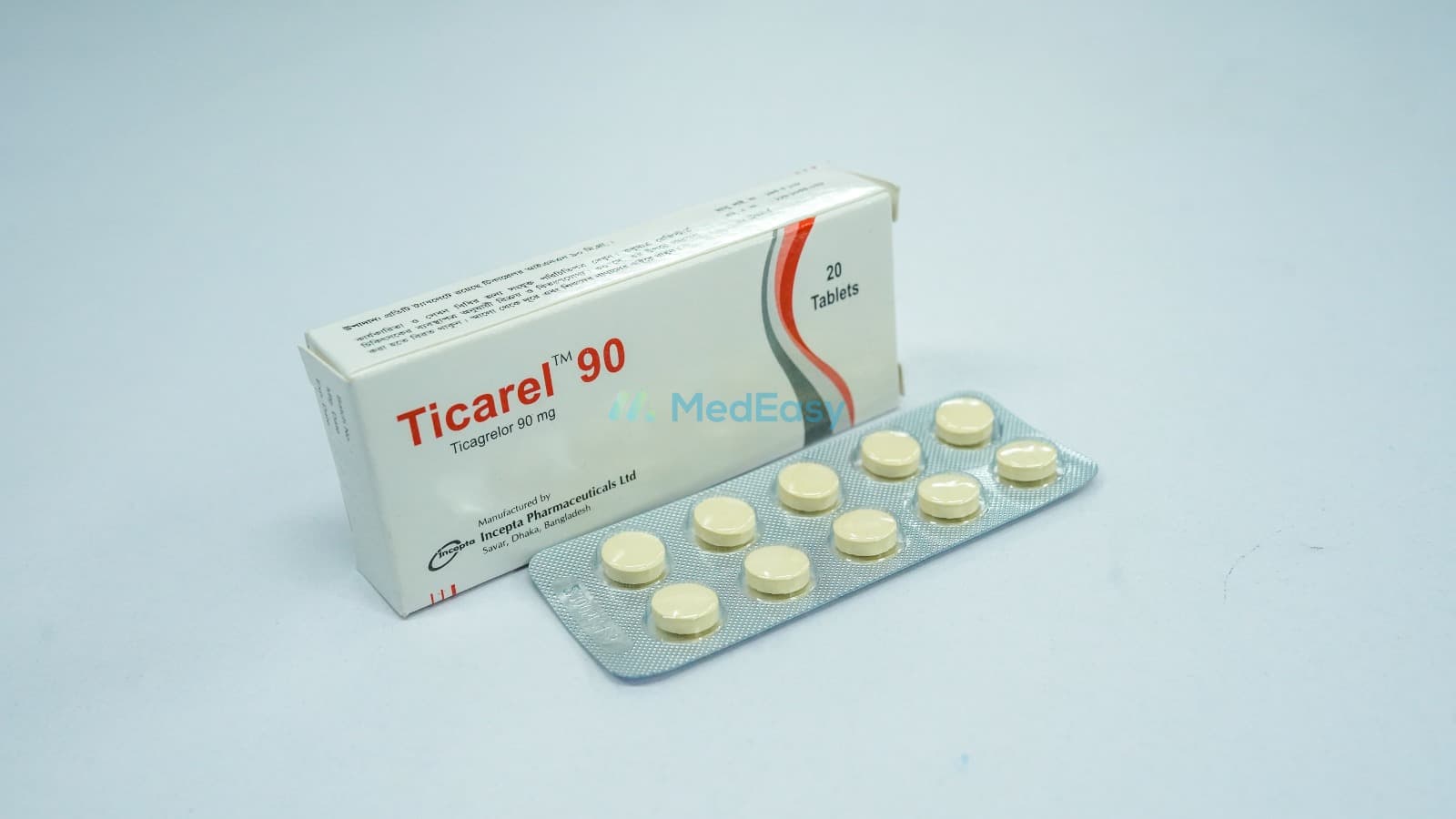
Ticarel 90 mg Tablet is available on MedEasy for ৳697.50 per 10's Strip, with home delivery anywhere in Bangladesh. It is manufactured by Incepta Pharmaceuticals Ltd. Its generic name is Ticagrelor.

Ticarel is an antiplatelet medicine used, in combination with low-dose aspirin, to lower the risk of thrombotic (clot-related) cardiovascular events.
Ticarel must always be used together with a maintenance dose of aspirin, as directed by a physician (see Dosage and Precautions).
Each film-coated tablet contains Ticagrelor 60 mg or 90 mg as the active ingredient, along with standard pharmaceutical excipients.
Ticarel is an oral antiplatelet agent belonging to the cyclopentyltriazolopyrimidine chemical class. Unlike thienopyridine P2Y12 inhibitors (such as clopidogrel), Ticarel reversibly binds to the platelet P2Y12 receptor without requiring metabolic activation, giving it a rapid onset of action and a more predictable antiplatelet effect.
Ticarel is used together with aspirin to reduce the risk of serious cardiovascular events in people with acute coronary syndrome or a prior heart attack.
Ticarel belongs to the antiplatelet drug class, specifically the P2Y12 platelet receptor inhibitors (non-thienopyridine subclass).
Ticagrelor and its major active metabolite reversibly interact with the platelet P2Y12 ADP-receptor to prevent ADP-mediated platelet activation and aggregation. Because binding is reversible, platelet function recovers as drug levels decline, without needing new platelet production.
| Phase | Dose |
|---|---|
| Loading dose | 180 mg (two 90 mg tablets) as a single oral dose |
| Maintenance (first 12 months) | 90 mg twice daily |
| Maintenance (beyond 12 months, long-term secondary prevention) | 60 mg twice daily, as advised by the treating physician |
60 mg of Ticarel twice daily, taken with aspirin.
Ticarel must be taken together with a daily maintenance dose of aspirin of 75–100 mg. Aspirin maintenance doses above 100 mg reduce the effectiveness of Ticarel and must be avoided (see Precautions and Warnings).
If a dose of Ticarel is missed, the next dose should be taken at its regular scheduled time; a double dose should not be taken to make up for a missed one.
Ticarel tablets can be taken with or without food. Tablets should be swallowed whole with water. Patients unable to swallow whole tablets may crush the tablet and mix it in water and drink immediately; the crushed tablet may also be given via a nasogastric tube, as directed by a physician. Do not stop taking Ticarel without consulting the prescribing physician, as premature discontinuation increases the risk of cardiovascular events.
Pregnancy: Data on the use of Ticarel in pregnant women are limited. Ticarel should be used during pregnancy only if clearly needed and if the potential benefit to the mother justifies the potential risk to the fetus. A physician should be consulted before use in pregnancy.
Lactation: It is not known whether Ticarel or its metabolites are excreted in human breast milk. Because many drugs are excreted in breast milk and the potential for adverse effects on the infant is unknown, a decision should be made, in consultation with a physician, whether to discontinue breastfeeding or discontinue Ticarel, taking into account the importance of the medicine to the mother.
Ticarel, like other antiplatelet agents, can cause significant, and sometimes fatal, bleeding. Do not use Ticarel in patients with active pathological bleeding or a history of intracranial hemorrhage (see Contraindications). Use with caution in patients with an increased risk of bleeding (e.g., recent trauma, recent surgery, recent gastrointestinal bleeding, or coagulation disorders), and in those taking other medications that increase bleeding risk.
After any initial loading dose of aspirin, Ticarel must be used with a daily aspirin maintenance dose of 75–100 mg. Maintenance aspirin doses above 100 mg reduce the effectiveness of Ticarel and should be avoided.
If possible, Ticarel should be discontinued at least 5 days before elective surgery to reduce the risk of bleeding, unless urgent revascularization is required. Discontinuation should only be done on medical advice, as stopping Ticarel increases the risk of cardiovascular events.
Dyspnea has been reported with Ticarel; it is usually mild and self-limiting, but other causes of breathlessness should be evaluated if severe or persistent.
Ticarel is not recommended in patients with severe hepatic impairment and should be used with caution in moderate hepatic impairment.
Do not stop taking Ticarel without first talking to the prescribing physician, and always take it exactly as prescribed.
There is no known antidote to reverse the antiplatelet effect of Ticarel. Overdose with Ticarel may increase the risk of bleeding complications. Any suspected overdose of Ticarel should be treated as a medical emergency — seek immediate medical attention or contact the nearest hospital/emergency services. Management is supportive and based on clinical presentation; platelet transfusion may be considered by a physician if clinically significant bleeding occurs, though its benefit may be limited due to circulating active metabolite.
Store at room temperature (below 30°C), away from light and moisture. Keep out of reach of children.
No dose adjustment of Ticarel is generally required in patients with renal impairment. Limited data are available in patients on dialysis; caution is advised.
Ticarel is contraindicated in severe hepatic impairment and should be used with caution in moderate hepatic impairment; no dose adjustment is needed in mild hepatic impairment.
No specific dose adjustment of Ticarel is required based on age alone, though elderly patients may have a higher baseline risk of bleeding.
Safety and efficacy of Ticarel in pediatric patients have not been established.
The duration of treatment with Ticarel depends on the indication and should be determined by the treating physician. In acute coronary syndrome, Ticarel 90 mg twice daily is typically continued for up to 12 months, after which the physician may continue therapy at a reduced dose (60 mg twice daily) for extended secondary prevention. Patients with a history of myocardial infarction may continue 60 mg twice daily long-term as advised by their physician. Ticarel should not be stopped early without medical advice, as this increases the risk of cardiovascular events.
Ticagrelor belongs to the antiplatelet agent class; specifically the P2Y12 platelet receptor inhibitor (cyclopentyltriazolopyrimidine class).
Ticagrelor reversibly binds to and inhibits the platelet P2Y12 ADP-receptor, blocking ADP-induced platelet activation and aggregation, thereby reducing the risk of clot formation in blood vessels.
C
The safety and efficacy of Ticarel in pediatric patients (below 18 years) have not been established. Ticarel is therefore not recommended for use in children and adolescents outside of clinical trial settings.
Q: What is Ticarel 90 mg Tablet used for?
A: Ticarel 90 mg Tablet, taken together with low-dose aspirin, is used to reduce the risk of heart attack, stroke, and cardiovascular death in people with acute coronary syndrome or a history of heart attack.
Q: How should I take Ticarel 90 mg Tablet?
A: Ticarel 90 mg Tablet is usually taken twice daily, with or without food, together with a low-dose aspirin (75–100 mg/day) as prescribed by your physician. Do not take more than 100 mg of aspirin daily while on Ticarel 90 mg Tablet, as higher aspirin doses reduce its effectiveness.
Q: What are the main side effects of Ticarel 90 mg Tablet?
A: The most common side effects of Ticarel 90 mg Tablet are bleeding (bruising, nosebleeds, or gastrointestinal bleeding) and shortness of breath (dyspnea), which is usually mild and improves over time. Contact your doctor immediately if you notice unusual or severe bleeding.
Q: Can I stop taking Ticarel 90 mg Tablet on my own?
A: No. You should not stop Ticarel 90 mg Tablet without consulting your physician, even before planned procedures, as stopping early significantly increases the risk of heart attack or stent-related complications. Your doctor will advise if and when it should be stopped, such as about 5 days before elective surgery.
Q: Is Ticarel 90 mg Tablet safe during pregnancy or breastfeeding?
A: Data on Ticarel 90 mg Tablet use in pregnancy are limited, so it should be used in pregnancy only if clearly needed, under medical supervision. It is not known if Ticarel 90 mg Tablet passes into breast milk, so breastfeeding mothers should consult their physician before use.
Q: Who should not take Ticarel 90 mg Tablet?
A: Ticarel 90 mg Tablet should not be used by people with a known allergy to it, those with active bleeding, those with a past history of bleeding inside the brain, or those with severe liver disease. Always inform your doctor of your full medical history before starting Ticarel 90 mg Tablet.
Disclaimer
The information provided is accurate to the best of our knowledge, but it does not replace professional medical advice. We cannot guarantee its completeness or accuracy, and the absence of specific information about a drug should not be taken as an endorsement. We are not responsible for any consequences arising from this information, so please consult a healthcare professional for any concerns or questions.