10% Off
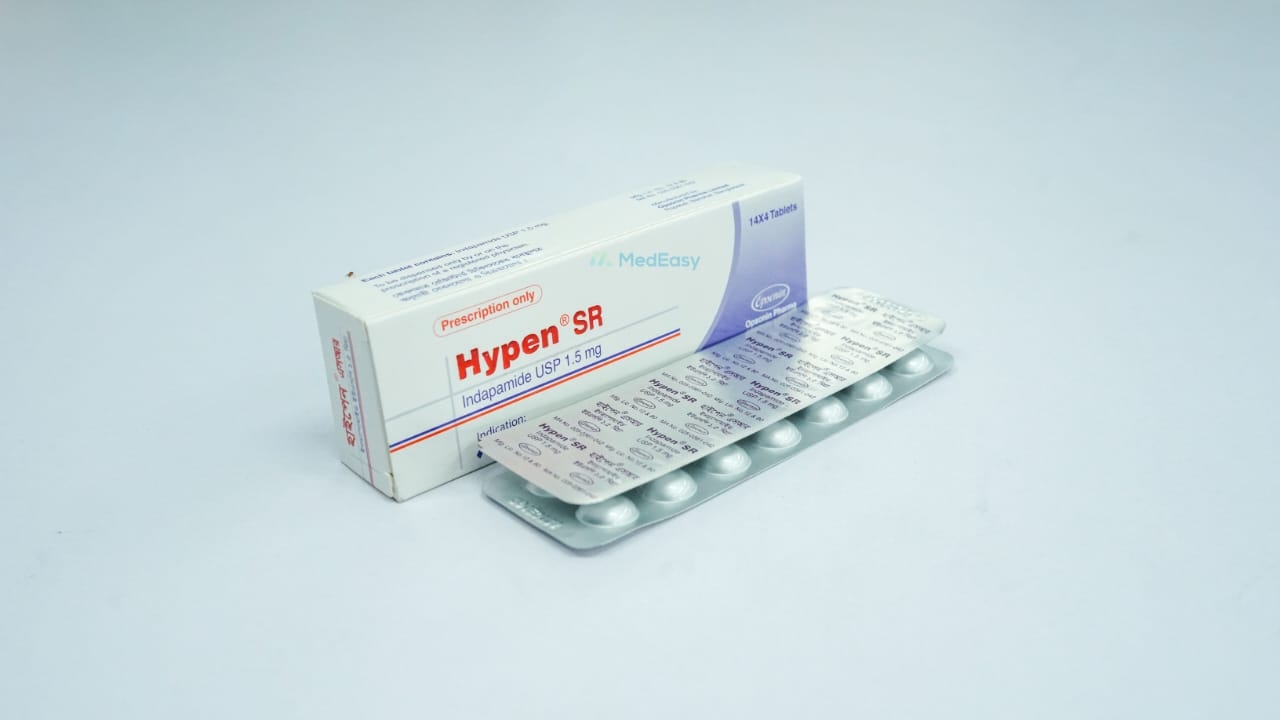
Hypen SR1.5 mg
Opsonin Pharma Ltd.
৳75.60
Add to cart
Indapamide is indicated for the following uses: Established / FDA-approved uses Hypertension: Indapamide is indicated for the management of hypertension and more.
Indapamide is indicated for the following uses:
Indapamide is commonly used as part of a combination antihypertensive regimen when blood pressure is not adequately controlled with a single agent, and it may be combined with other agents such as ACE inhibitors, angiotensin receptor blockers, or calcium channel blockers under medical supervision.
| Step | Dose of Indapamide | Notes |
|---|---|---|
| Initial | 1.25 mg once daily, taken in the morning | Allow at least 4 weeks to assess the response before increasing the dose |
| Second step | 2.5 mg once daily | If blood pressure is not adequately controlled after 4 weeks on the initial dose |
| Third step | 5 mg once daily | Adding a second antihypertensive agent is generally preferred over exceeding 5 mg of Indapamide daily |
The usual starting dose of Indapamide is 2.5 mg once daily. The dose may be increased to 5 mg once daily after about one week if the response is inadequate.
When Indapamide is added to an existing antihypertensive regimen, the dose of the other agent should generally be reduced (often by about half) initially and then re-adjusted according to the blood pressure response, to reduce the risk of additive hypotension.
See Use in Special Populations for renal and hepatic impairment dosing considerations.
Most adverse effects associated with Indapamide are mild and transient. Common effects include headache, dizziness, fatigue or weakness, muscle cramps, nervousness, and nausea.
Indapamide can cause hypokalemia, hyponatremia, and hypomagnesemia, especially at higher doses.
Indapamide can raise uric acid levels (risk of gout) and, less commonly than classic thiazides, can raise blood glucose levels.
Indapamide can cause hypotension and increased sensitivity to sunlight (photosensitivity).
Rarely, Indapamide has been associated with Stevens-Johnson syndrome, acute angle-closure glaucoma, pancreatitis, hepatitis, and blood cell abnormalities. Seek immediate medical attention if any of these occur.
Indapamide should not be used in patients with any of the conditions listed above.
Disclaimer
The information provided is accurate to the best of our knowledge, but it does not replace professional medical advice. We cannot guarantee its completeness or accuracy, and the absence of specific information about a drug should not be taken as an endorsement. We are not responsible for any consequences arising from this information, so please consult a healthcare professional for any concerns or questions.